









70+
Specialties
Expertise
Expertise
 Calculate Your Savings


Our Auto Injury Billing Expertise


We support orthopedic, pain management, rehabilitation, and other practices treating accident injuries. Each claim follows its applicable coverage, documentation requirements, submission method, and deadlines, with unresolved issues tracked across your clinical and administrative teams.
ServicesStatus
Coverage Review
Open Items Tracked
We establish the billing pathway using the accident date, patient involvement, policy details, claim number, and adjuster contact. Our team requests confirmation of PIP or MedPay benefits, deductibles, and available limits. We also check assignment requirements and treatment review procedures where applicable, flagging unresolved coverage questions for follow-up rather than treating an open claim as payment approval.
An accident file checked before bills leave your practice.
Status
Coding Review
Documentation Gaps Flagged
We compare documented injuries and services with ICD-10-CM, CPT, HCPCS, modifiers, and billed units. Injury code review includes anatomical specificity, laterality, and encounter characters based on treatment phase. We query unsupported details instead of inferring them from accident reports. For therapy and procedures, we check whether recorded time, services, and clinical findings support the charges submitted.
Claims should reflect the care documented, including why continued treatment was clinically necessary.
Status
Payment Review
Unexplained Reductions Flagged
We prepare carrier-accepted bills, using electronic submission, portals, or paper workflows as applicable. Submission records retain delivery evidence and document references. When payment arrives, we reconcile each service line against the applicable reimbursement basis, separating fee schedule reductions, deductibles, disputed amounts, and unpaid charges for review.
Know what was submitted, received, paid, reduced, or left unresolved.
Status
Recovery Follow-Up
Unresolved Balances Tracked
Records requests, benefit exhaustion, and medical necessity denials require different responses. We classify the obstacle, retrieve supporting evidence, and track response deadlines. Billing errors return for correction; disputed reductions receive documented follow-up. Matters requiring legal action are organized for your authorized counsel rather than left in routine collection queues without direction.
Every unpaid balance needs a reason and a defined next action.
Bring unpaid bills, carrier responses, and missing information. We’ll identify where claim follow-up should begin.
Discuss Your Unpaid Claims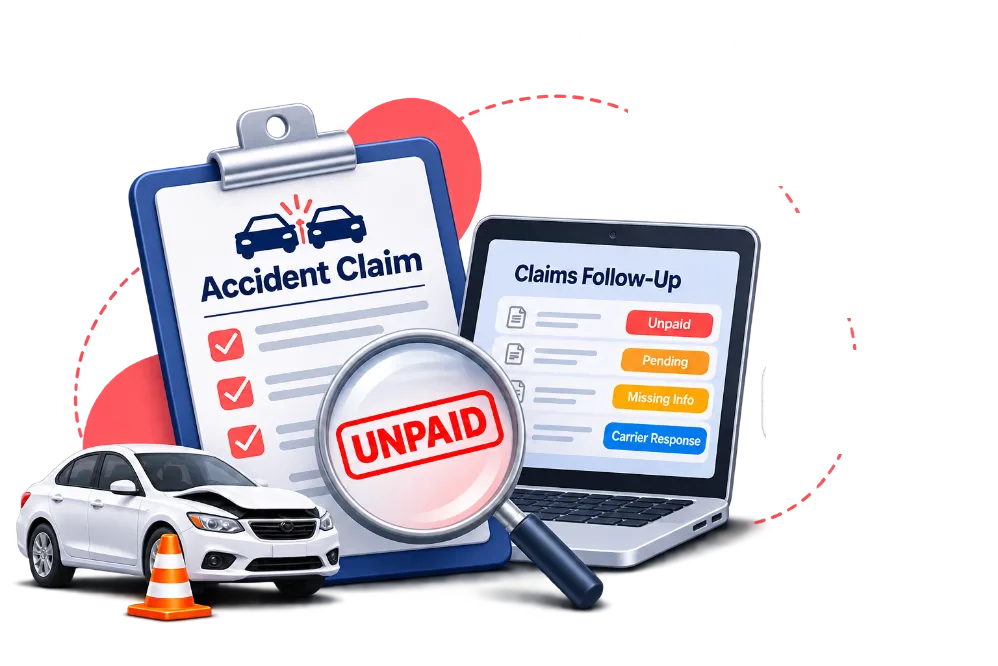


“Pending” tells your practice little. The insurer could be waiting for treatment notes, reviewing causation, applying a fee schedule, or checking remaining benefits. We investigate what the response actually means and identify the records, corrections, or escalation needed to move the account forward.
Our no-fault medical billing services give each account a traceable history: what was billed, which documents accompanied it, when the carrier responded, and what remains outstanding. Our AI-assisted checks also flag inconsistent accident details, missing fields, and approaching deadlines for specialist review. Reports identify unresolved verification requests, disputed reductions, benefit exhaustion, and aging balances, so follow-up decisions reflect each claim’s actual condition.
Two accidents can involve the same patient and insurer. We match dates, claim references, and treatment records to avoid mixing unrelated episodes of care.
An adjuster’s name is a starting point. We request coverage details, record the source and verification date, and keep unanswered questions visible until the carrier supplies clarification.
We track submission, verification response, and appeal requirements separately, retaining delivery records, because one follow-up date cannot protect every deadline.
We compare each payment with the applicable reimbursement basis, separating explained reductions from differences that need further investigation before closing balances.
We track applicable precertification requests, approved services, and outstanding treatment review responses so administrative gaps reach your practice before billing.
Instead of requesting “more notes,” we identify the missing clinical detail, affected service, and payer question so your clinicians can respond with relevant information.
Your A/R report should distinguish unanswered verification, coding corrections, disputed payments, and exhausted benefits. We organize balances by obstacle and next action so the practice can see what requires attention.
When routine follow-up reaches its limit, we assemble bills, records, correspondence, and delivery evidence for authorized escalation, giving your decision-makers a usable account history.
We address difficulties in accident billing: injury documentation, state-specific carrier requirements, and balances that remain unpaid after a documented claim submission.

An injury code’s seventh character describes the treatment phase, not simply whether this is the patient’s first appointment. We review active treatment, routine healing, and sequela documentation before assigning encounter characters, and clarify missing details with the clinician.
Our medical coding services reconcile evaluations, therapeutic procedures, imaging, injections, and supplies with the record. We check laterality, units, modifier support, and diagnosis linkage without assuming that every symptom stems from the collision. With pre-existing conditions or overlapping complaints, the clinician must establish the relationship to the accident. Billing staff identify documentation gaps and request clarification before unsupported details enter claims.
No-fault billing requirements vary by state, so we first identify the rules governing each claim. For example, New York generally requires medical bills within 45 days of service, subject to applicable exceptions, while New Jersey PIP claims involve decision point review and precertification requirements where applicable.
These differences also affect reimbursement. For instance, New York uses parts of its workers’ compensation fee schedules for no-fault payments without adopting every workers’ compensation procedure. We check the relevant state’s filing rules, fee schedules, required forms, and dispute procedures together, so your bills follow the requirements that apply to each claim.


When a carrier reports exhausted benefits, we confirm the exhaustion date and reconcile its payment explanation with the affected services. This helps us establish what remains unpaid and whether another insurer should receive the bill before moving the balance to a different billing route.
If the patient has Medicare, we review the carrier’s response and supporting records against Medicare Secondary Payer rules, including conditional payment requirements where applicable. We then determine whether the account needs a corrected claim, a medical necessity appeal, or referral to counsel, giving each unpaid balance a documented next step.
Connect accident details, records, carrier responses, and follow-up so claims have a clear next step.

Auto Injury Claim Scenarios
Different claim obstacles require different billing responses.

Records Requested
The carrier requests treatment notes after receiving the bill. We identify the specific services under review, collect the relevant records, and retain proof of response. Follow-up then checks whether the documents were received and whether anything remains outstanding. The account stays in a verification queue until the carrier’s next action is established.
Match the records. Confirm receipt. Track the next action.

Payment Reduced
The practice receives payment, but several service lines are reduced. We compare the explanation of benefits with billed codes, units, and the applicable reimbursement basis. Supported differences move into a dispute workflow with the original bill and payment details attached. The remaining balance is investigated before an adjustment or patient statement is considered.
Compare the EOB. Dispute supported differences. Investigate the balance.

Benefits Exhausted
The insurer reports that benefits have been exhausted while visits continue. We request written confirmation, identify affected service dates, and reconcile previous payments. Your team receives the information needed to assess other coverage and future billing. A balance does not move automatically to the patient simply because accident benefits have ended.
Confirm exhaustion. Reconcile payments. Support the next coverage decision.
Build accident files before missing carrier details or unsigned documents interrupt billing workflows.
Match patient, accident date, and claim reference.
Request coverage details and carrier billing instructions.
Collect required signatures, records, and supporting claim documents.
Record pending items before releasing bills for submission.
We connect encounters, charges, submission evidence, and payment responses across compatible systems, managing carrier portals and document-based workflows when standard electronic connections are unavailable.
Auto Injury & No-Fault Billing Management
We retrieve encounter notes, treatment plans, and procedure records for accident billing.




We track electronic submissions, carrier portals, and paper delivery.




We maintain claim references, payments, balances, and follow-up within compatible systems.




50 States
Billing workflows adapted to applicable state requirements
Coverage Review
PIP, MedPay, and liability billing routes assessed
Payment Checks
Fee schedules, EOBs, and unexplained reductions reviewed
A/R Follow-Up
Records requests, disputes, and unpaid balances tracked


“We were sending treatment notes but still getting requests for the same records. MedsIT Nexus helped us track what each carrier requested, what we sent, and whether it was received. Our staff could finally see what was outstanding without searching through emails and fax confirmations.”

“Some accident claims came back with payments we couldn’t explain. Their team compared the EOBs with our billed services and separated the reductions that needed follow-up. Having that detail made it much easier to decide which balances to question and which adjustments were appropriate.”

“We had patients continuing therapy when their accident benefits ran out. MedsIT Nexus helped us organize the exhaustion notices, check the affected visits, and review other coverage. That gave our front desk clearer information when patients asked how their upcoming appointments would be billed.”

“Our older accident claims were all sitting on one follow-up list, even though each needed something different. MedsIT Nexus separated missing records, billing corrections, and payment disputes. We could see who was handling each account and what needed to happen next, without asking for updates every day.”
Real audit findings. Clear corrective action. Better billing control.
Tell us where claims get stuck. We’ll discuss the coverage questions, documentation gaps, and follow-up work affecting your auto injury medical billing.
Every Claim Documented. Next Steps Assigned.
We’ll discuss your claim obstacles and the information needed for assessment.
Understand how accident coverage, documentation, deadlines, and unpaid balances affect your practice before deciding what billing support you need.
Auto injury billing covers medical services related to vehicle accidents. No-fault billing uses applicable accident benefits, often through personal injury protection. Other routes include MedPay and liability coverage. The available policy and governing rules determine how a particular bill should be handled.
No. Attorney involvement does not suspend applicable insurance billing deadlines. We establish the available coverage and filing requirements, then coordinate authorized records requests separately. Settlement-related balances require their own documented follow-up rather than an indefinite billing hold.
Start with patient details, accident date, carrier information, policy and claim numbers, adjuster contact, and treatment records. We also check required assignments, applicable treatment review requirements, prior bills, and carrier responses to identify missing information before submission.
Not automatically. Patient responsibility depends on applicable law, coverage, assignment terms, and the denial reason. In New York, a provider accepting a no-fault assignment cannot pursue the patient for a medical necessity denial. We review the basis before preparing patient statements.
Yes. We first review submission evidence, carrier correspondence, unpaid service lines, coverage status, and applicable deadlines. That establishes whether an account needs records, correction, appeal, secondary billing review, or counsel. Recovery depends on the facts and remaining options for each claim.
More collections. Less stress. That’s the MedsIT Nexus promise.

 Services












 Injury condition matched















 Nationwide Auto Injury Billing Support






































 Payment Reconciliation

 Unpaid Claim Follow-Up
 Billing Coverage