Calculate Your Savings


94010 CPT Code: Pulmonary Function Testing (Spirometry) Explained
Understanding Pulmonary Function Testing: What it is and Why it Matters
Pulmonary function tests (PFTs), which assess lung functionality. These tests will assess various aspects of lung capacity, airflow, and oxygen exchange to help physicians gauge respiratory health and diagnose conditions such as asthma, chronic obstructive pulmonary disease (COPD) or interstitial lung diseases. PFTs can reveal important information about how efficiently your lungs are working, including whether there is an obstruction or restriction that interferes with breathing.
Importance of PFT in Diagnosis and Management of Respiratory Conditions
Pulmonary function tests are essential for the diagnosis of so-called chronic progressive lung diseases. For early disease or worsening lung conditions such as asthma and COPD, PFTs monitor how well a treatment works and if medication needs to be adjusted.
Moreover, these tests are significant in evaluating patients before surgery (to assess how well they will tolerate the procedure) and to monitor the long-term status of patients with chronic lung diseases.
In summary, PFTs are essential to making sound clinical decisions and providing excellent care to patients. Healthcare providers providing these services through Internal Medicine Billing to their patients depend on precise documentation of pulmonary function testing to receive appropriate reimbursement.
94010 CPT Code Meaning, and How It Relates to Spirometry
94010 CPT code description
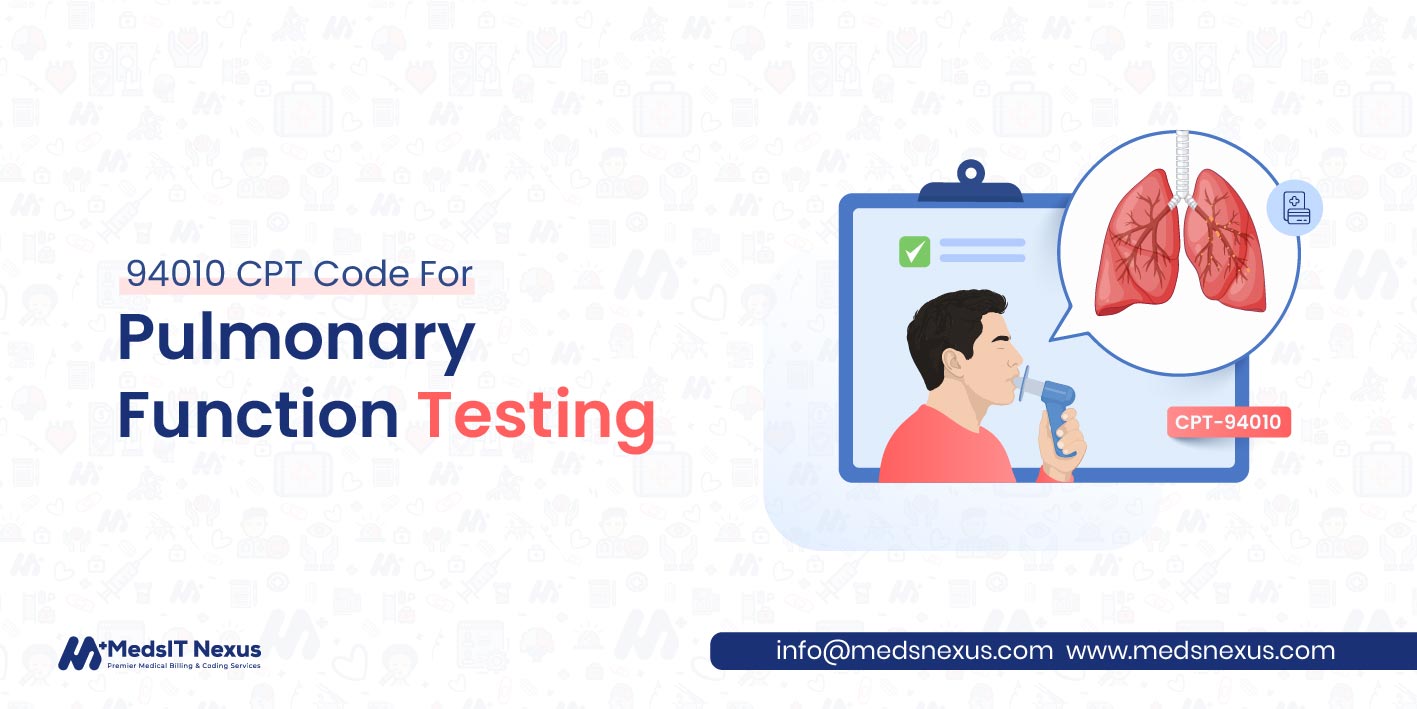
CPT code 94010 is assigned for spirometry without a bronchodilator. When a simple test (spirometry) is done to evaluate lung function, and specifically such parameters as vital capacity (VC) or forced expiratory volume (FEV), this code can be used. The test evaluates how much air someone is able to exhale after they take a deep breath and how quickly they can expel air. It is most often used as an initial diagnostic examination for conditions such as asthma or COPD, and it is used for baseline evaluations, routine tracking, or to test whether treatment approaches are working.
How This Applies to Spirometry Without Bronchodilator
94010 CPT Code is applicable for spirometry that does not receive a bronchodilator. This simple version of spirometry measures a patient’s lung volumes and flow rates, but does not test how responsive the airways are to medications. Unlike bronchodilator challenges that measure reversibility of airway obstruction, this is mainly a lung function test done just one time. It is particularly useful for making preliminary assessments or monitoring lung function in patients not receiving bronchodilator therapy.
Important CPT Codes for Pulmonary Function Testing (PFT)
.jpg)
There are many procedures in pulmonary function testing, all with different CPT codes. Knowledge of such codes is important for proper billing and to ensure the right procedure is documented for compensation purposes. Commonly used CPT codes for PFTs include the following:
|
CPT Code |
Description |
|
94010 |
Basic spirometry without bronchodilator. |
|
94060 |
Spirometry with bronchodilator to assess airway responsiveness. |
|
94726 |
Lung volume measurement using plethysmography. |
|
94729 |
A test that checks how easily oxygen passes from your lungs into your bloodstream. |
|
94617-94621 |
Pulmonary stress testing. |
How Modifiers Are Used in Billing for Pulmonary Function Testing
When it comes to coding pulmonary function tests, modifiers serve as one of the most effective tools needed for medical billing services. They help to clarify the services exhibited and provide assurance for correct 94010 CPT code reimbursement. They aid in clarifying the service provided and the appropriateness of reimbursement. Here is how the most commonly used modifiers apply in PFT billing:
-
Modifier 25: Used when an E/M service is being billed on the same day that a PFT was performed. This modifier denotes that an appropriate, separate E/M service was rendered.
-
Modifier 26: Utilized only when the professional component (the interpretation and the preparation of a report) for the PFT is provided without the technical component (detailed as the time invested in both instruments and technician).
-
Modifier TC: Billed when only the technical component of the PFT is being billed.
Modifiers for Different Situations
Modifiers help determine different parts of a service, such as technical performance, interpretation, or when services are overloaded. For example, if a physician conducts a pulmonary function test and also provides an unrelated E/M service on the same day, Modifier 25 would be appended to the E/M code to indicate the distinct nature of both services.
Uses of Pulmonary Function Testing CPT Code 94010
Commonly used for: Baseline measures; Monitoring COPD; Assessing Asthma.
CPT code 94010 comes up in many common clinical scenarios, including:
-
Baseline Measurements: If the patient is being assessed for evaluation of suspected respiratory abnormalities, then a fundamental spirometry using CPT code 94010 provides them with baseline lung capacity.
-
Evaluating asthma: In evaluating asthma, spirometry is used to assess airflow limitations. Initially, spirometry without a bronchodilator (CPT code 94010) aids in determining the severity of wheezing before a bronchodilator challenge.
Pulmonary Function Testing 94010 CPT Code Uses
Specific use cases: Baseline assessments; COPD monitoring; Asthma evaluations.
There are numerous common clinical scenarios where the CPT code 94010 features, including:
-
Baseline Assessments: If a patient is being evaluated for possible respiratory problems, then a basic spirometry using CPT code 94010 shows their baseline lung function.
-
Evaluating asthma: In evaluating asthma, spirometry is used to assess airflow limitations. Initially, spirometry without a bronchodilator (CPT code 94010) aids in determining the severity of wheezing before a bronchodilator challenge.
When to Use CPT 94010: A Guide
Understanding the context of the test is imperative to know when to use CPT code 94010. This is also an appropriate code if the spirometry is done to evaluate without administering a bronchodilator. However, if a bronchodilator is given, then one must use CPT code 94060 instead.
94060 vs. 94010: Key Differences and When to Use Each
The main differences between CPT codes 94010 and 94060, both of which are used for pulmonary function testing in the context of spirometry procedures, are when a bronchodilator (a text that opens airways) is used. Let’s break down each code:
-
CPT 94010 covers basic spirometry that measures lung volumes and airflow without bronchodilator administration. Takes typically help ensure a standard of baseline assessment, as well as measuring lung function without medication.
-
CPT 94060, The test also includes assessment of lung function before and after the patient inhales a bronchodilator (a medication that opens the airways) to assess how much they respond to the therapy.
Proper Documentation of Pulmonary Function Testing for Accurate Coding
Required Documentation for Proper Coding
Pulmonary function tests code documentation must be accurate and detailed. To bill correctly, the following components must be documented in the medical record:
-
Patient Identification: Provider Name, Date of Service.
-
Clinical Indication: A physician-specific clinical indication or medical necessity for the test should be provided by the physician and is crucial to support the CPT code.
-
Test Details: Record the Graph type of PFT performed (e.g., spirometry, lung volume measurement, diffusion capacity) as well as any medications/interventions (e.g., bronchodilators) used during the test.
-
Results: Document the test results, including relevant measurements (e.g., FEV1, FVC, and FEV1/FVC ratio).
-
Interpretation: The interpretation and written report of a physician are included, confirming the results and their clinical significance.
Avoiding errors in documentation to bill accurately
Some of the common documentation mistakes that result in denials on claims are:
-
Missing or Incorrect Test Results: Ensure that the results include all relevant parameters and are recorded accurately.
-
Missing Physician Interpretation: All test results are interpreted by a physician, and that signed report is part of the patient’s record.
These best practices, when coupled with comprehensive documentation, can help healthcare providers stay clear of common billing mistakes and improve reimbursement accuracy.
CPT Codes for Pulmonary Function Testing with Reimbursement Rates and Guidelines
The notes below cover reimbursement for PFT Services
Here is a breakdown of how PFTs are reimbursed and what can impact the reimbursement:
-
Payer Type: Medicare, Medicaid, private insurance companies, each may or may not reimburse differently for a CPT Code. Correct Billing: Familiarize yourself with the reimbursement rates for each payer.
-
Maintain Inspection of Contracts with Insurance Agencies: Healthcare providers should take a thorough check on contractual obligations with insurance companies that reflect negotiated rates or exclusive reimbursement rules.
-
Location: Reimbursement rates can vary by region or state according to local policies and fee schedules.
Payer, State Policy & Contract Factors That Impact Reimbursement
-
Payer's perspective: There might be payer-specific policies on what constitutes medically necessary for coverage. Accurate health insurance verification before a test ensures that providers can verify coverage and prevent unexpected claim denials.
-
Medical Necessity: Documentation about medical necessity is usually necessary for payers to reimburse. If the clinical indications for the test are poorly documented, payment may be denied.
-
State and Local Policies: State or local policies may dictate a rule governing PFT services in the scope of your practice, so ensuring you stay informed about local coding related to PFT is an essential part of understanding what this article entails.
Avoiding Common Coding Mistakes and Their Prevention
Coding errors can result in denials or reimbursements that are lower than expected. Professional medical coding services are frequently sought after by healthcare providers to ensure that CPT codes are applied correctly and that the documentation meets payer requirements. These include:
-
Wrong CPT Code: If you file a claim using an incorrect CPT code (such as 94010 instead of 94060), then your claims can be rejected. And in all cases, the code should match what was done (or attempted).
-
Insufficient Medical Necessity Documentation: If a payer does not receive enough information to support that the test was necessary, they may deny payment, especially with payers such as Medicare.
-
Modifiers Misuse: Incorrect use of modifiers (e.g., Modifier 25 for separate E/M services) may result in incorrect billing. Always apply the correct modifier so it indicates what was done.
Conclusion
This guide has covered the basics of CPT coding for pulmonary function testing. We also compared and contrasted important CPT codes like 94010 vs. 94060, explaining when each should be used. We also included guidelines for accurate documentation, reimbursement, and how to avoid common coding errors.
Conclusion and Improved Billing & Reimbursement Processes
When considering recommendations to help streamline the process of billing and reimbursement for PFTs, it may be helpful to review these items:
-
Review Payer Guidelines And Updates: Ensure regular review of updates to payer-specific reimbursement policies and guidelines.
-
Modifier Usage: Using the appropriate modifiers will assist in clarifying billing and prevent confusion.
Transparent patient communication related to billing is another top priority, which is why so many practices turn to statement services for patients that offer easy-to-read billing letters and help boost patient payment collections.
FAQs
1. What is the 94010 CPT Code?
The 94010 CPT code, under Pulmonary diagnostic and therapeutic procedures, is used for spirometry testing, which involves performance (patient cooperation required), interpretation, and graphically recording your pulmonary function.
2. What are the documentation requirements for billing 94010?
Patient symptoms, test results, provider interpretation, and a signed report must come with every claim.
3. What are the reasons behind the 94010 Denial?
Common reasons are no interpretation notes, no medical necessity, or an undiagnosed doctor to submit the wrong diagnosis code.
4. When should I use CPT code 94010?
The code 94010 should be used when testing for the presence of conditions such as asthma, COPD, or unexplained respiratory symptoms without bronchodilator administration.
Table of Contents

Services
- Medical Audit Services
- Medical Billing Services
- Medical Credentialing Services
- Medical Coding Services
- Accounts Receivable Management
- Medical Insurance Verification
- Denial Menagement Services
Who we serve
- Private Practices
- Small Practices
- Hospitals & Healthcare
- Physicians
- Medical Equipment
- Outpatient Facilities
Get in Touch
Let's start talking about getting you credentialed
Related Posts
New Patient Visit CPT Codes in Urgent Care Billing