Calculate Your Savings


99199 CPT Code: Complete Billing And Documentation Guide
The 99199 CPT code is used when a specific CPT code does not exist for a medical service or procedure. This code gives medical coders and billers a way to report services that are not otherwise described in the current CPT code set.
It is important to verify with the provider that all necessary and correct documentation is available before billing under an unlisted procedure code. Accurate and sufficient supporting documentation enables justification of the service, decreases the risk of denials, and helps limit payer questions.
In the sections below, we will cover the complete details of CPT code 99199, as well as eligibility requirements, proper use guidelines, documentation rules and regulations, billing considerations, and relevant examples. Let’s get started.
What is the Meaning of the 99199 CPT code?
CPT 99199 is a general reporting code used for services, procedures, or supplies that are not represented by any existing CPT code. Healthcare professionals rely on this code to document unusual, rare, or specialized services that fall outside standard classifications.
This code is frequently assigned to experimental procedures or relatively uncommon services or conditions that do not have a CPT code available.
Utilization of CPT 99199 ensures correct reporting and reimbursement for these uncommon services. Including a detailed service report and an explanation of the procedure on the claim to avoid denials and compliance problems.
While referencing CPT 99199, this code serves the critical purpose of bridging a gap for providers who can logically tie their service to be reported within a delivered encounter, but it’s either not specific enough or left out of the CPT frame.
Eligibility Criteria
The 99199 CPT code reporting eligibility depends on the specific medical service performed. Your provider must determine that the service is medically necessary and cannot be accurately reported using any established or valid CPT code.
The practitioner should also contact the payer to ensure that the patient’s insurance policy covers reimbursement for the procedure or treatments prior to submitting claims.
For clarity, eligibility scenarios may be classified into different categories as follows:
|
Unusual or Experimental Services |
99199 CPT code reserved for rare and unique or experimental procedures with no assigned CPT code. |
|
Emergency Situations |
In situations where there is no time to determine a specific CPT code for a particular procedure, 99199 may be reported. |
|
Investigative or Specialized Services |
These procedures would be investigational or specialized, requiring billing but not having a specific CPT code assigned to them. |
|
Absence of an HCPCS Code |
When there is no applicable HCPCS code for a given service, CMS may permit reporting under CPT 99199. |
|
Proper Use of 99199 CPT Code |
CPT 99199 should only be reported when a physician performs a service or procedure that is not represented by any current CPT code. |
It is important not to choose a code that merely approximates the service provided. According to CPT guidelines, if no specific procedure code exists, the appropriate unlisted procedure code must be used instead. Before billing, ensure that complete and accurate documentation supports the service performed.
Documentation Requirements
If submission of CPT 99199 does occur, it must be coupled with correct documentation. A cover letter explaining why a defined and active CPT code was used to accompany the claim.
It is helpful to include one or more comparable CPTs, with a comparison of the complexity of resources and the time used at your institution relative to others, in the justification for the billed amount.
Use secure messaging to attach operative reports, clinical notes, and other relevant documentation to help ensure the validity of the claim and reduce the risk of denial.
For this reason, each payer looks at unlisted procedure claims on a case-by-case basis and decides whether to reimburse based on submitted documentation.
Billing Guidelines
Remember these key points when billing for CPT 99199:
-
Do not choose a code that is close to the service provided.
-
When no specific CPT code exists, use the appropriate unlisted procedure code.
-
Do not report an unlisted code if a Category III CPT code is available.
-
Add a cover letter that addresses why the unlisted code was needed.
-
Provide a similar CPT to substantiate the charge and consideration of the service.
Similar Codes to CPT 99199
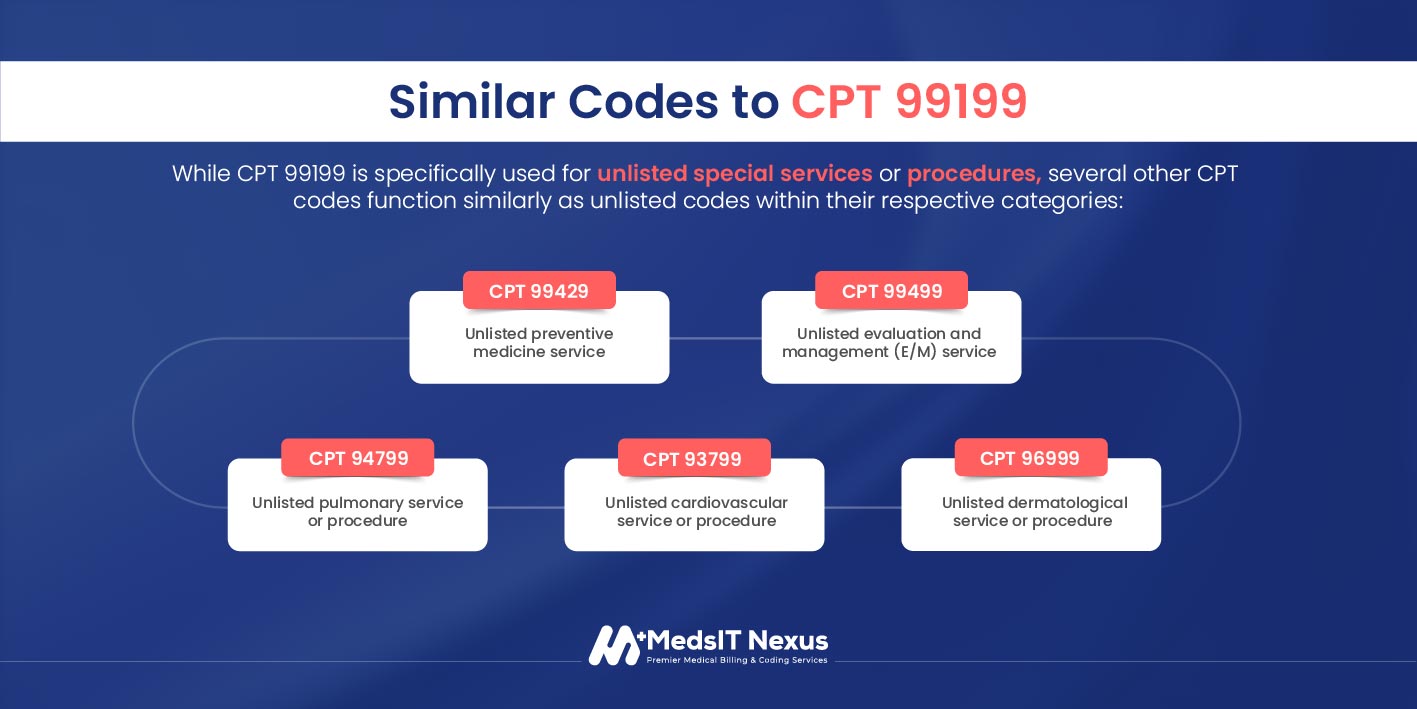
While CPT 99199 is specifically used for unlisted special services or procedures, several other CPT codes function similarly as unlisted codes within their respective categories:
-
CPT 99429 – Unlisted preventive medicine service
-
CPT 99499 – Unlisted evaluation and management (E/M) service
-
CPT 96999 – Unlisted dermatological service or procedure
-
CPT 93799 – Unlisted cardiovascular service or procedure
-
CPT 94799 – Unlisted pulmonary service or procedure
These codes are used when a performed service does not have a specific, assigned CPT code within its category.
Examples of CPT 99199 Usage
The following are ten examples of circumstances in which CPT 99199 may be reported:
-
One example is a clinician performing an advanced diagnostic test for a rare condition that does not yet have its own unique CPT code.
-
A doctor provides an experimental therapy for a chronic condition not yet listed in the CPT.
-
A specialist clears a foreign body from a patient’s airway with an innovative technique not captured by current codes.
-
A single advanced CPT code cannot truly reflect a complex, multiple-technique wound care procedure.
-
A doctor administers a specialized treatment for a neurological disorder that does not have an exact billing code.
-
A cardiology specialist performs an atypical diagnostic evaluation, not present in standard cardiovascular CPT codes.
-
A clinician conducts sophisticated genetic testing for a rare inherited disease, but no CPT code is available.
-
Treat congenital abnormality (the physician does not currently have CPT coding guidelines to adhere to for this method)
-
A healthcare provider administers a novel therapy for a rare immune disorder awaiting classification by the American Medical Association's current procedural terminology (CPT) codes.
-
A clinician performs a typical procedure for pain management that does not have a corresponding CPT code.
Conclusion
CPT 99199 serves a critical purpose for reporting extraordinary and or unique medical services that do not have an established standard of CPT nomenclature. It is widely used for experimental therapies, rare procedures, novel diagnostic techniques, and nonclassified services.
However, this code is used only in cases when there is no other more specific CPT code to describe the service provided. Thus, having proper documentation, a complete explanatory process, and valid medical necessity will defend for any denials or audits and minimize the chances of compliance violations.
FAQs
1. What is CPT 99199 used for?
CPT 99199 is used to report special, unusual, or unlisted medical services and procedures that do not have a specific CPT code assigned.
2. When should CPT 99199 be reported?
It should only be used when no existing CPT or Category III code accurately describes the service performed.
3. What documentation is required for CPT 99199?
Claims must include detailed clinical documentation, a cover letter explaining the service, and often a comparable CPT code to justify the charge.
4. Can CPT 99199 be used if a similar CPT code exists?
No, providers should not use CPT 99199 if a specific or Category III CPT code appropriately describes the service.
5. Does CPT 99199 guarantee reimbursement?
No, reimbursement is determined by the payer on a case-by-case basis and depends heavily on medical necessity and supporting documentation.
Table of Contents

Services
- Medical Audit Services
- Medical Billing Services
- Medical Credentialing Services
- Medical Coding Services
- Accounts Receivable Management
- Medical Insurance Verification
- Denial Menagement Services
Who we serve
- Private Practices
- Small Practices
- Hospitals & Healthcare
- Physicians
- Medical Equipment
- Outpatient Facilities
Get in Touch
Let's start talking about getting you credentialed
Related Posts
New Patient Visit CPT Codes in Urgent Care Billing