Calculate Your Savings


Anxiety ICD 10: Updated Coding List for Accurate Billing
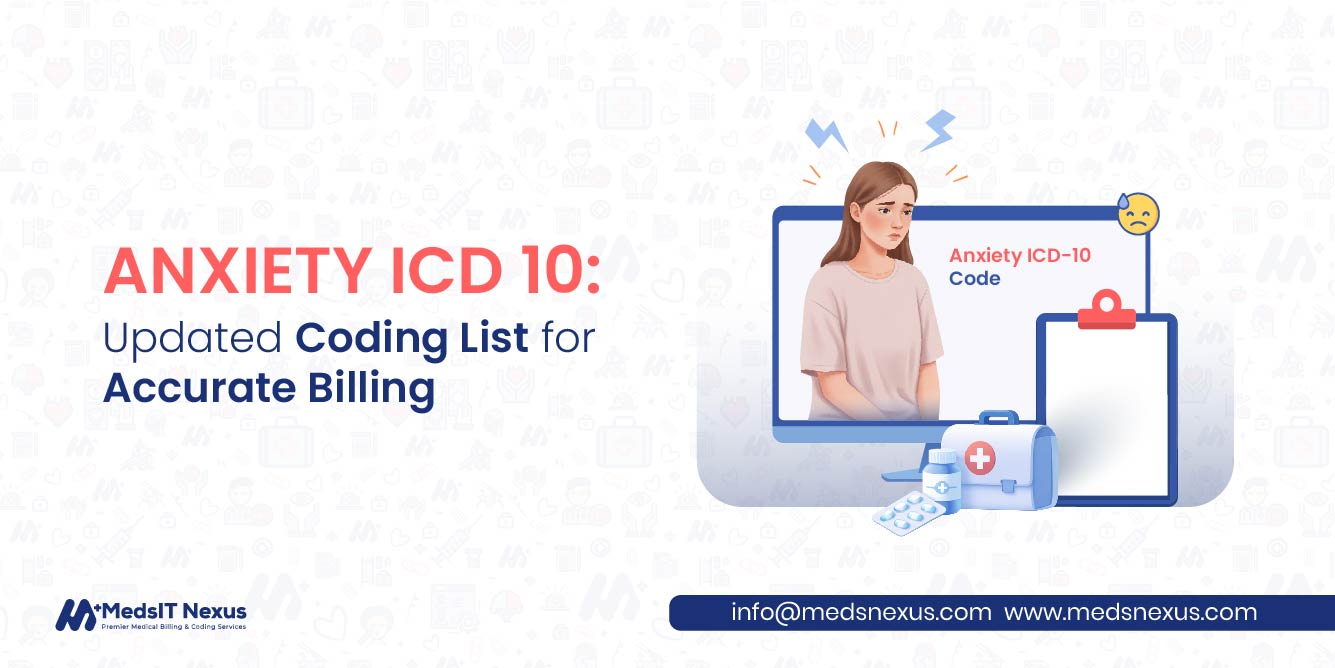
F41: Common icd 10 anxiety and depression codes. This blog will cover. 1 (Generalized Anxiety Disorder), in addition to codes for panic disorder, social phobias, and some specific phobias. Knowing the diagnostic criteria for all anxiety disorders is beneficial both for proper documentation, insurance billing, and reporting purposes.
The generalized anxiety disorder icd 10 code is F41.1. This includes icd 10 generalized anxiety disorder, and generalised anxiety disorder icd 10 code. For general conditions such as icd 10 anxiety and icd 10 code for anxiety disorder, a specific F41 subcategory must be selected. If documentation is unclear, anxiety unspecified icd 10 and icd 10 code for anxiety unspecified refer to F41.9.
For combined conditions like anxiety and depression, icd 10, icd 10 anxiety and depression and icd 10 code for depression with anxiety, coding may fall under mixed anxiety and depressive disorder icd 10.
When symptoms are stress-related, use adjustment disorder with anxiety icd 10 or adjustment disorder with mixed anxiety and depressed mood, icd 10. For phobic cases, use social anxiety disorder icd 10.
Furthermore, each code has its own diagnostic criteria that practitioners must meet in order to appropriately treat the patient and guarantee reimbursement by insurance. An insurance billing course for therapists can help build on this information.
Generalized Anxiety Disorder (F41. 1)
F41. 1 is often a “catch-all” code; it does require specific symptoms lasting at least six months. Appropriate use of ICD-10 codes not only ensures appropriate clinical care but also helps you stay within the bounds of insurance compliance both for yourselves and your patients.
Social Phobia (F40. 1) and Specific Phobias (F40. 2)
Social phobia and specific phobias are only diagnosable when symptoms seriously interfere with ordinary functioning or result in extreme avoidance behavior. This distinction helps differentiate clinical phobias from everyday fears or general discomfort.
Summary
The most frequently used code icd 10 for anxiety:
-
F41.1 – Generalized Anxiety Disorder ICD 10 (GAD)
-
F41.0 – Panic Disorder
-
F40.1 – Social Phobia (Social Anxiety Disorder ICD 10)
-
F40.2 – Specific Phobias
In addition, improve your billing performance with our specialized insurance coding services. To ensure that we maximize the revenue cycle of your practice, we give attention to precision, compliance, and efficient processing of claims.
ICD-10 List of Codes
The anxiety disorders are classified under the primary ICD-10 group F41, which includes other anxiety disorders. This code is in itself non-reimbursable and further subdivided into five particular sub-categories with the aim of making it possible to report and remunerate.
The major icd 10 code anxiety disorder is F41, which comprises other anxiety disorders. This code is not billable in itself, but is further divided into five other specific subcategories that need to be reported, and reimbursements made accordingly.
Anxiety disorders are mental health disorders that are marked by excessive anxiety, fear, or panic that may have devastating effects on one's life. The ICD-10 code also differentiates the various anxiety-related disorders, including Generalized Anxiety Disorder, Panic disorder, and mixed anxiety and depressive disorders, assigning each disorder a unique code.
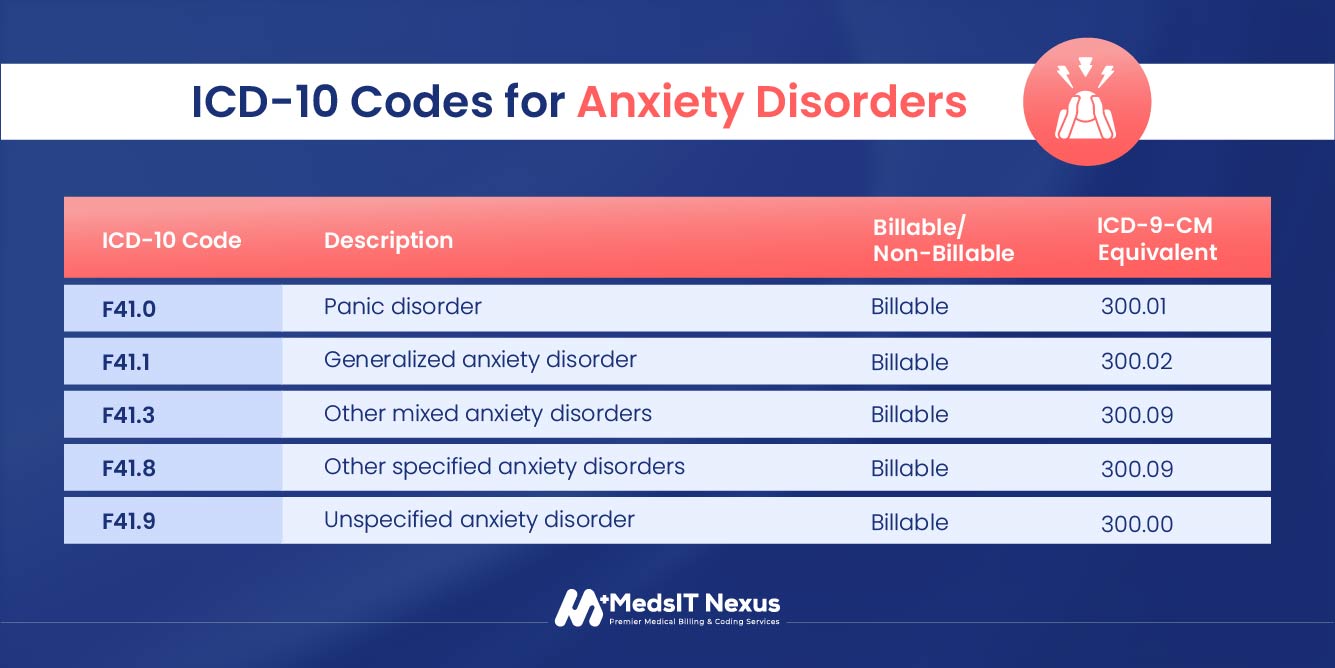
The following table will provide you with detailed information regarding icd 10 code for anxiety, their billable status, and their ICD-9-CM value.
ICD-10 Codes for Anxiety Disorders
|
ICD-10 Code |
Description |
Billable/Non-Billable |
ICD-9-CM Equivalent |
|
F41.0 |
Panic disorder |
Billable |
300.01 |
|
F41.1 |
Generalized anxiety disorder |
Billable |
300.02 |
|
F41.3 |
Other mixed anxiety disorders |
Billable |
300.09 |
|
F41.8 |
Other specified anxiety disorders |
Billable |
300.09 |
|
F41.9 |
Unspecified anxiety disorder |
Billable |
300.00 |
Proper coding ensures precise documentation and enhances the efficiency of medical billing and claims processing for mental health services.
Problems Regarding Depression with Anxiety icd 10
It can be tricky to assign the right ICD-10 codes for anxiety disorders. There are many barriers providers encounter during the coding process, especially when symptoms overlap among numerous diagnoses. Here’s a look at one of the more frequent problems:
Overlapping Symptoms
Many anxiety disorders are characterized by similar psychological and physical symptoms, including worry that doesn’t go away, restlessness, sweating, and palpitations. Such traits are common in conditions like generalized anxiety disorder (GAD), panic disorder, and specific phobias.
The overlap of symptoms makes it challenging to differentiate between one anxiety disorder and another. So, you might have recurrent panic attacks in e.g. panic disorder and GAD, but it looks very different:
In Panic disorder patients often fear (panic) attacks after an initial panic attack (and thus minimise their chances of visiting a situation that makes them vulnerable to a panic attack, whereas someone with GAD may have one or two each month that they do not particularly want to avoid in the future. Recognizing these nuances is essential for choosing the proper ICD-10 code.
Coding wrong diseases may have potentially disturbing downstream consequences, which can affect treatment choices, reimbursement, and the long-term prognosis of the disease, when the symptoms may be mischaracterized or the conditions may be confused.
Comorbidity
Other mental health disorders that are often accompanied by anxiety include depression, post-traumatic stress disorder (PTSD), and substance use disorders. This presence may complicate the diagnosis and coding process, as symptoms may overlap or complement each other.
To illustrate, a person with anxiety and depression icd 10 can have a mixture of symptoms that cannot be fully credited to one or the other disorder. When there is a combination of disorders, it may be difficult at times to determine the diagnosis.
The actual practice should be captured in the ICD-10 coding by documenting and reporting all the conditions that require care. The correct combination of codes is determined by a clear understanding of the relationship between these disorders. Failure to properly identify and record this comorbidity will complicate their cases unnecessarily and expose them to coding errors.
Acute and Chronic Anxiety Coding
Depending on whether the anxiety being coded is acute (short-term) or chronic (long-term), specific ICD-10 codes may change. The length and pattern of symptoms can be hard to capture. For example, generalized anxiety disorder (GAD) is usually characterized by a long-standing pattern of excessive worry, whereas panic disorder may be marked by sudden, acute bouts of severe fear.
Properly classifying within these timeframes is critical for accurate coding. Providers must choose codes that capture how long the disorder lasted and its clinical course. Symptoms may vary over this course, or the timeline is not always clearly defined in some categories, making selection of the code more difficult; for example, this can impact treatment strategies and reimbursement decisions.
Coding for Anxiety-Related Physical Symptoms
Anxiety Disorders commonly manifest with physical (somatic) complaints like palpitations, dizziness, GIT disturbances, and headache. In many cases, these physical complaints may be the patient’s main reason for care-seeking even when psychological symptoms are less obvious.
It can be challenging to decide if you code the anxiety disorder itself or the physical symptoms. Sometimes, the somatic symptoms are recorded as being secondary to the anxiety diagnosis. In others, they may require separate or primary coding, depending on the clinical focus and documentation. Errors in this decision-making process can result in incomplete or inaccurate medical records.
Coding for Anxiety Disorders in Children and Adolescents
Anxiety disorders may manifest differently in children and adolescents than in adults. “Young patients may not say they are anxious, but may seem irritable and want to avoid school or complain of physical ailments. These differences in development necessitate an appropriate clinical examination and coding knowledge.
Assessment for anxiety in pediatric populations can be more challenging as anxiety symptoms are variable and age-dependent. It may be difficult to choose the right anxiety ICD 10 code because there are so many subcategories of anxiety disorders in young patients included in the classification system.
Moreover, prior authorization requirements for anxiety-related treatments can serve as administrative barriers. Learn more about common challenges of prior authorization and how health care providers can navigate approval processes to help ensure timely access to necessary care.
5 Prior Authorization Challenges You Need to Know
Prior authorization requirements can contribute to treatment delays, add administrative burden, and delay reimbursement. Among the typical difficulties are missing documentation, wrong coding of diagnosis, lack of information on medical necessity, past period limit payer responses, and frequent policy changes. The ability to understand these red flags is one of the most crucial factors that will guarantee continuous claims processing and patient care.
Finding a Solution to Anxiety Coding Problems with Health Quest Billing
We ensure that your practice is paid on time with minimal mistakes and rejection of payment. The following are typical anxiety coding situations that we deal with:
Addressing Overlapping Symptoms
Overlapping clinical features are common with anxiety disorders and may make the process of differentiating them a challenging issue. To distinguish between closely similar conditions, our clinical coding staff, including highly experienced senior coders, applies standardized diagnostic criteria and clinical decision-support tools to the best of their abilities. This helps in the accurate assignment of ICD-10 codes and improved documentation.
Managing Comorbidity
Anxiety usually goes hand in hand with such disorders as depression and PTSD. In order to cope with this complexity, specific coding rules are observed that help to report the primary diagnosis and any other diagnosis properly. Our coders and our providers work together and make sure that all the correct conditions have been coded
Coding Acute vs. Chronic Anxiety
Accurate coding for anxiety is dependent on the correct identification of the type of anxiety: acute vs. chronic. We leverage sophisticated EHR prompts to prompt providers with clear symptom duration documentation. Internal coding standards and regular audits within our system also assist in preventing miscategorization and enhancing overall accuracy.
Coding Anxiety-Related Physical Symptoms
A careful code selection is necessary when anxiety presents with physical symptoms that overlap, such as palpitations or dizziness. As our coding approach is very structured, it helps to indicate if the symptoms should be coded separately or as secondary to the anxiety disorder. These decision-support tools and internal review processes encourage consistent and accurate documentation.
Coding for Induced Anxiety
In situations where anxiety is secondary to a medical condition or substance use, proper sequencing is critical.” First, we are coding for the underlying cause, and second, when appropriate, for the anxiety diagnosis. Frequent compliance audits assure adherence to ICD-10 standards.
Anxiety in Children and Adolescents
The presentation of anxiety disorders in pediatric patients may differ. Our team understands developmental differences and uses specific coding guidelines established by pediatricians. Pediatric providers’ collaboration ensures the appropriate code selection and documentation for younger patients.
FAQs
1. What is the ICD-10 code for Generalized Anxiety Disorder (GAD)?
The ICD-10 code for Generalized Anxiety Disorder is F41.1, used when excessive anxiety and worry persist for at least six months.
2. What is the difference between F41.0 and F41.1?
F41.0 is used for Panic Disorder (recurrent unexpected panic attacks), while F41.1 applies to Generalized Anxiety Disorder, characterized by chronic, excessive worry.
3. Is F41 a billable ICD-10 code?
No, F41 (Other anxiety disorders) is a non-billable category code. Providers must select a more specific subcategory, such as F41.0, F41.1, or F41.9, for reimbursement.
4. How should anxiety with physical symptoms be coded?
If physical symptoms like palpitations or dizziness are directly linked to anxiety, they are typically coded as secondary to the anxiety disorder unless documentation supports separate reporting.
5. Why is accurate ICD-10 coding important for anxiety disorders?
Accurate coding ensures proper documentation, supports medical necessity, reduces claim denials, and improves reimbursement outcomes.
Table of Contents
Services
- Medical Audit Services
- Medical Billing Services
- Medical Credentialing Services
- Medical Coding Services
- Accounts Receivable Management
- Medical Insurance Verification
- Denial Menagement Services
Who we serve
- Private Practices
- Small Practices
- Hospitals & Healthcare
- Physicians
- Medical Equipment
- Outpatient Facilities
Get in Touch
Let's start talking about getting you credentialed