Calculate Your Savings


Chronic Constipation ICD-10 Code K59.04: Billing Guide 2026
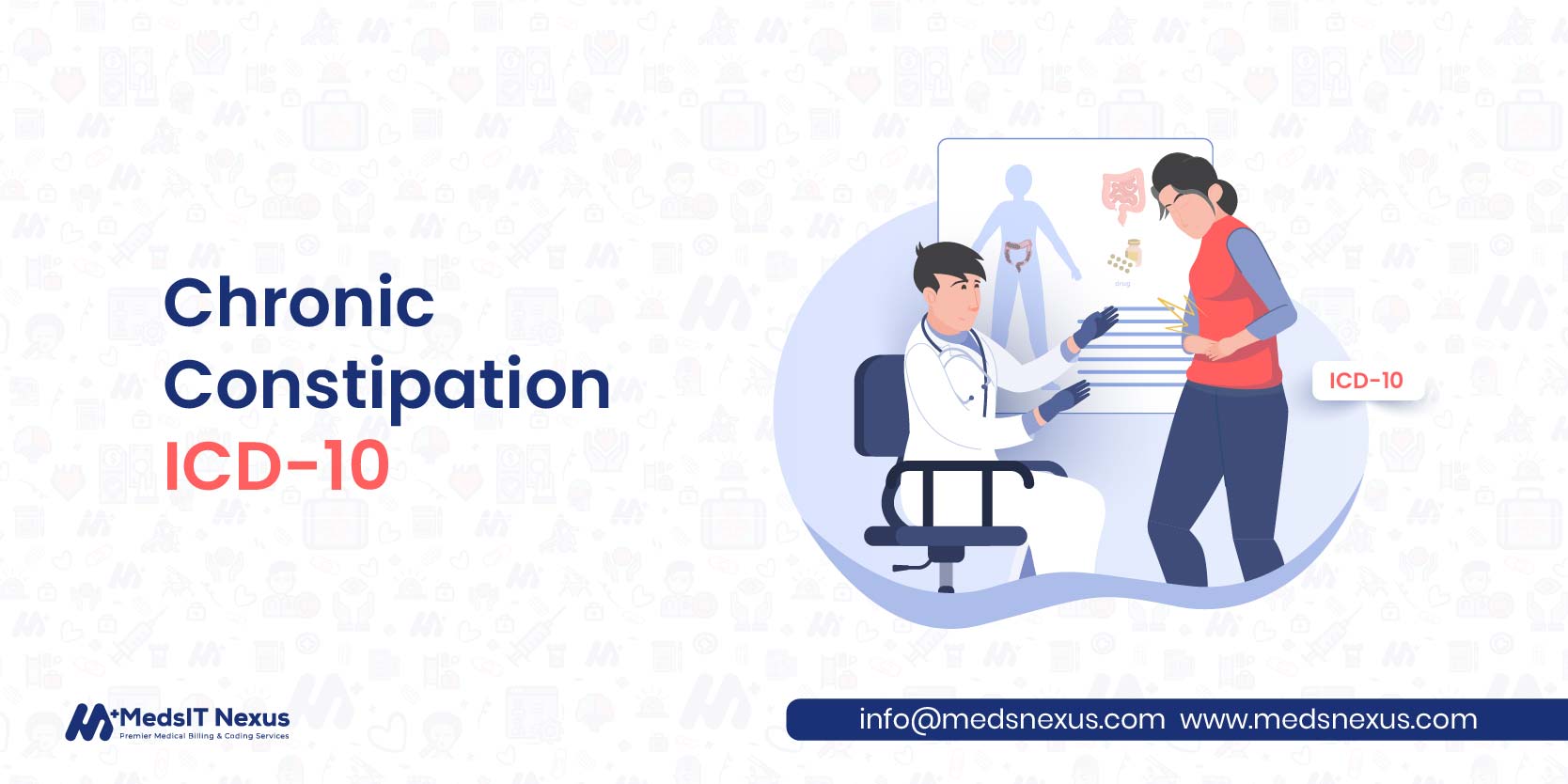
Accurate Chronic Constipation icd 10 coding is key to making clean claims, avoiding audits, and ensuring correct reimbursement. In the United States, diagnosis-related documentation errors have accounted for about 15-20% of the claim denials in the healthcare industry.
Even a common GIT complication, such as constipation, can cause a denial if the paperwork can explicitly indicate chronicity or underlying cause. In this regard, the selection of a suitable ICD-10 code related to constipation would require thorough clinical support and the provider's record.
This guide comprehensively describes the process of choosing the most accurate constipation ICD-10 code to support meaningful reporting and reimbursement.
Constipation Diagnosis Code Meaning?
Chronic constipation is a situation that occurs when the bowels are infrequently passed, difficulty in passing tool and these conditions continue beyond three months. For ICD-10-CM reporting, a patient should also have documentation of chronicity indicating the presence of the symptoms for at least 90 days.
It is commonly identified by:
-
Hard or dry stools
-
Straining or a sense of unsatisfactory evacuation
-
Less than three bowel evacuations weekly
-
Lasting symptoms over three months.
Medical coding chronic constipation could be either functional (idiopathic) or secondary to medication-related, metabolic problems, neurologic, or structural.
As per the above description, different types act differently in terms of the ICD-10, wherein the type of the problem, duration, and reason must be clearly noted by the provider.
Similarly, in the absence of such detail, unspecified codes can be assigned, and thus, more denial can occur, and reduce reimbursement accuracy.
How to Determine the Appropriate ICD 10 Code for Chronic Constipation?
Correct, ICD-10-CM constipation codes are determined simply by providers' documentation, including the type and underlying cause. Report when chronic functional constipation ICD-10 is clearly diagnosed, and the secondary condition is unknown:
-
K59.04 – Coding Chronic Idiopathic Constipation
-
K59.03 – Drug-induced constipation
-
K59.00 – Constipation, unspecified
Coding should always reflect the highest level of accuracy in documentation, as the use of general codes may increase denial rates and damage the precision of reimbursement.
Understanding the ICD 10 for Chronic Idiopathic Constipation
The code for chronic idiopathic constipation icd 10 is K59.04. This code is appropriate only when documentation confirms:
-
The condition is not caused by drugs.
-
The symptoms continue for three months or more.
-
A functional (idiopathic) cause is mentioned.
-
There is no secondary cause, structural or metabolic, or identifiable.
K59.04 should not be reported in case something is wrong. Rather, attach the code that is representative of the etiology recorded. The exploitation of this code can increase the risk of audit and create potential compliance concerns.
Common Constipation Codes
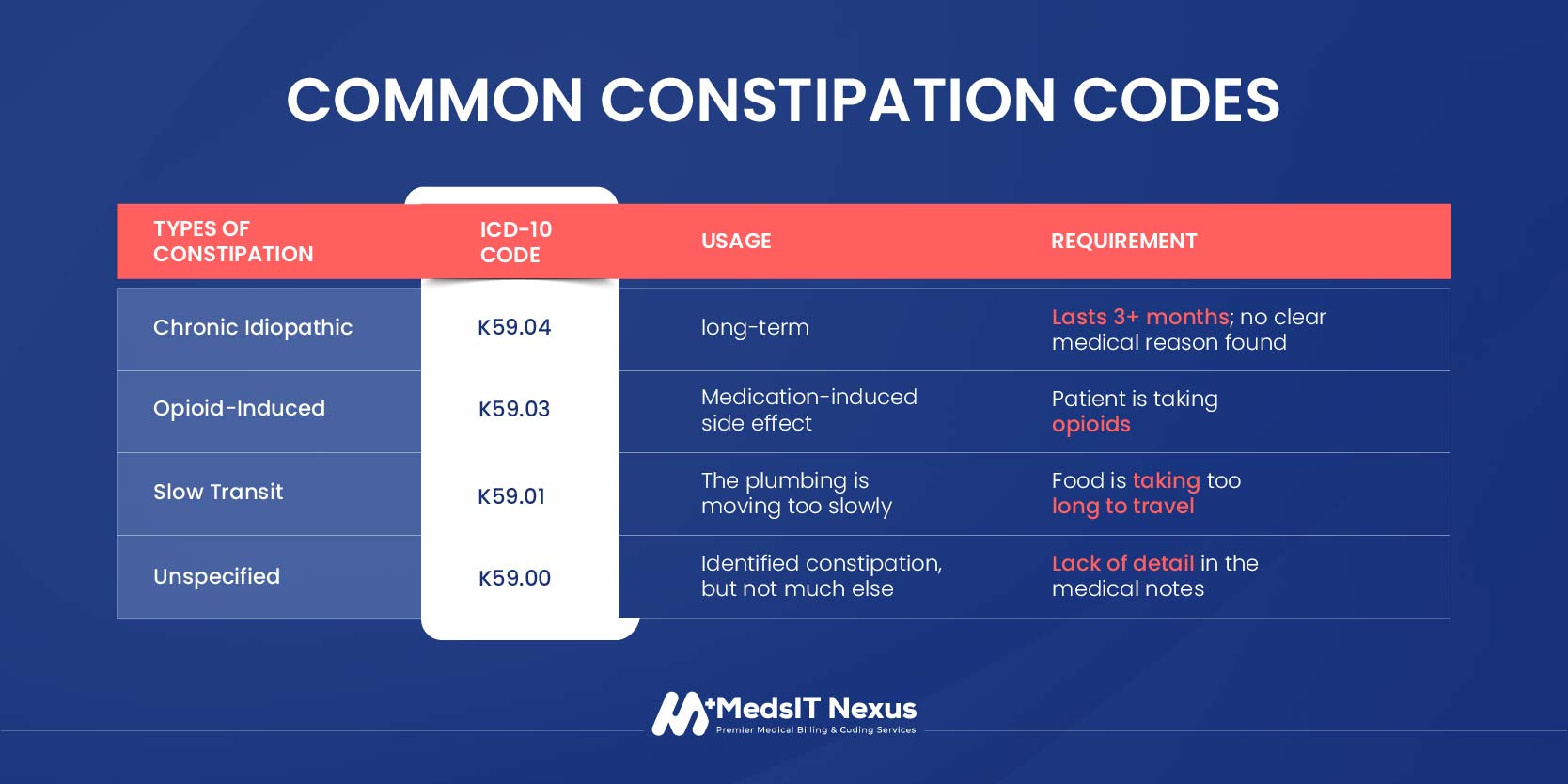
|
Type of Constipation |
ICD-10 Code |
Usage |
Requirement |
|
Chronic Idiopathic |
K59.04 |
long-term |
Lasts 3+ months; no clear medical reason found |
|
Opioid-Induced |
K59.03 |
Medication-induced side effect |
Patient is taking opioids |
|
Slow Transit |
K59.01 |
The plumbing is moving too slowly |
Food is taking too long to travel |
|
Unspecified |
K59.00 |
Identified constipation, but not much else |
Lack of detail in the medical notes |
Guidelines for Reporting K59.04 Correctly
When is it Appropriate to Report K59.04?
-
The extensive assessment proves the absence of any other cause.
-
Initial symptoms have persisted for at least three months and fit the definition of chronic.
-
Clinical notes support a primary functional origin rather than a temporary or situational issue.
When Should K59.04 Not Be Reported?
-
The disorder is acute or temporary (see K59.00 or other possible acute codes).
-
Constipation follows a known pathology, such as using drugs, blockage of the outlets, or stagnant movement.
-
The code should be a more definitive underlying diagnosis (e.g., fecal impaction or bowel obstruction).
-
Documents are vague and only mention constipation without elaborating on the type and duration.
Appropriate Coding Order for Secondary Constipation
When the constipation is a secondary diagnosis to another known diagnosis, e.g., hypothyroidism, Parkinson's disease, or another opioid therapy, report the underlying diagnosis first.
An appropriate code of constipation (e.g., K59.03, drug-induced constipation) must be included afterward. This sequence is in line with those recommended by ICD-10-CM, and it ensures that the major condition for which the patient was treated is well represented in the claim.
Required Documentation for Payers
The appropriate Chronic Constipation icd 10 coding solely depends on provider documentation. In the medical record, the information needed for chronic constipation billing code includes:
-
Type of constipation: clearly indicate whether the case is idiopathic, slow transit, outlet dysfunction, drug-induced, or unspecified.
-
Chronicity: Record the time of symptoms and ensure that it corresponds to the clinical definition of the diagnosis code for chronic constipation.
-
Diagnostic evidence: Provide evidence of relevant tests, such as colon transit studies, anorectal manometry, or Sitzmarker testing, that were done or not.
-
Root causes: With the drug-induced constipation, link the diagnosis with the list of medications a patient takes to prove the causality.
-
Severity and impact: Outline the severity of the symptoms and impact on everyday life to prove the necessity of medical treatment or procedures.
Clinical Validation Reminder
Always make sure that documentation of constipation aligns with the clinical presentation of the patient and objective findings, which support the documentation of constipation in terms of type, chronicity, and cause.
This may include findings of physical examination, the results of diagnostic tests, and the duration of registered symptoms. Coded without adequate clinical correlation might lead to audit problems, failures to receive claims, and compliance risk.
Gastroenterology ICD-10 Coding Tips
1. Promote Documentation Precision
Ask the physician to adopt the application of accurate terminologies in their documentation, like chronic idiopathic constipation, rather than simply constipation.
2. Verify Missing Info
In case the nature or persistence of the constipation is uncertain, then insert a coding query and revert to unspecified codes.
3. Identify Related Issues
Give separate codes when recording the complications, such as fecal impaction or incomplete evacuation.
4. Track Overused Codes
Regularly review constipation coding to identify and correct the overuse of unspecified codes.
Why Constipation Claims Are Denied?
Practically, the refusals to grant a constipation claim can hardly be attributed to the choice of the incorrect ICD-10 code. The denials are generally due to a lack of clear documentation in terms of supporting chronicity and underlying cause.
Based on audits of thousands of GI claims, common documentation issues include:
-
Provider notes do not elaborate on constipation.
-
The duration of the symptoms is not recorded.
-
The constipation imposed by drugs is not related to the medicine affecting the patient.
-
Chronicity is assumed but not explicitly documented.
-
Diagnostic tests that are of high cost are being done without a recorded medical necessity.
Constipation itself is a low-acuity symptom; typically, payers will not believe that constipation is a result of functional disorder or chronic disease unless it is clearly visible in the record. Claims can be undercoded or rejected without specific documentation. Proper coding begins with patient-specific provider documentation.
Need to Improve Chronic Constipation icd 10 Coding Outcomes?
Coding gastrointestinal conditions, such as chronic constipation, cannot be approved by simply involving the use of the ICD-10-CM codes.
Hence, a certain combination of professional coding skills and Clinical Documentation Improvement (CDI) strategies would make sure that claims are finished, accurate, and justifiable in case of audit.
This skill set includes specialized provider education about recording constipation type, duration, and underlying cause, and extensive pre-submission audits to detect coding mistakes and misplaced coding variations before submission.
Key Takeaways
By considering all the above guidelines, it forms a real-time cooperation between the coders and the providers; therefore, the form of denial-preventive workflow of the complex GI diagnoses contributes to ensuring the adequate assigning of the codes in accordance with the payer standards and industry guidelines.
By performing such practices, not only secure reimbursement, but also support compliance, decrease refusal of claims, and help healthcare organizations maintain a healthy financial status in the long-term perspective.
Optimize Chronic Constipation Coding with MedsIT Nexus
At MedsIT Nexus, we help healthcare organizations master accurate ICD-10 coding for chronic constipation and other GI conditions. We provide:
-
Pre-submission audits
-
Structured workflows
Reference
All recommendations follow the ICD-10-CM guidelines 2026, CMS documentation rules, and proven best practices used by certified medical coders to keep coding accurate, compliant, and efficient.
FAQs
Q. What are icd 10 codes for chronic constipation?
Chronic idiopathic constipation is coded K59.04, where it is functional and over a duration of three months.
Q. What are common constipation symptoms?
Common symptoms of constipation include infrequent bowel movements, hard or dry stools, straining during elimination, a sense of incomplete evacuation, abdominal bloating or discomfort, and reduced urge to defecate.
Q. What code is used for the ICD-10 opioid induced constipation?
Tab K59.03 opioid-induced constipation, also ensure that you place the code first of the adverse effect of the medication being used in the claim.
Q. How do payers justify chronic constipation?
The payers generally examine the recorded length of symptoms, ineffective previous treatment, and the effect of the condition on the usual activities of the patient.
Q. What are other names for chronic constipation?
Chronic constipation is also referred to as chronic idiopathic constipation, functional constipation, or long-term constipation. In some cases, it may be described based on its cause, such as opioid-induced constipation or slow-transit constipation.
Table of Contents

Services
- Medical Audit Services
- Medical Billing Services
- Medical Credentialing Services
- Medical Coding Services
- Accounts Receivable Management
- Medical Insurance Verification
- Denial Menagement Services
Who we serve
- Private Practices
- Small Practices
- Hospitals & Healthcare
- Physicians
- Medical Equipment
- Outpatient Facilities
Get in Touch
Let's start talking about getting you credentialed