Chronic Hypoxic Respiratory Failure ICD-10 (J96.11) Complete Guide

Did you know that improper coding of chronic hypoxic respiratory failure icd 10 can result in a high rate of claim denials, with average denial rates across healthcare claims reaching about 10–15% due to coding and documentation errors?
Furthermore, healthcare organizations are experiencing rising financial and compliance burdens. Therefore, the high-risk category is chronic respiratory failure, which is frequently questioned by the payers because of its effect on the risk adjustment and reimbursement.
This complete guide provides a roadmap to assist you in coding chronic hypoxic respiratory failure in an accurate and confident manner.
-
The primary measure that is needed in icd 10 code for acute on chronic hypoxic respiratory failure is the clear documentation of the chronicity and hypoxia, with evidence of the clinical results.
-
In addition, keeping a documentation checklist is necessary as it reduces the risk of denials and errors.
-
Similarly, regular internal audits and automated-coding checks are mandatory, consistent with the 2026 CMS standards.
How to Code Chronic Hypoxic Respiratory Failure ICD-10?
The right ICD-10-CM code for acute on chronic hypoxic respiratory failure icd 10 is J96.11.
-
J96 is respiratory failure
-
The 1 represents chronic respiratory failure icd-10
-
The last character 1 identifies hypoxia
This code assures that the respiratory failure in the patient is chronic and low in oxygen and not acute and temporary.
-
J96.11 is a reference to long-lasting respiratory failure and hypoxia
-
Chronic status should be well recorded (e.g., long-term oxygen therapy)
-
The diagnosis should mention clinical findings
ICD-10 J96.11 Coding Guidelines
-
An appropriate example of J96.11 would be a patient who has Ventilatory support with hypoxia.
-
Oxygen saturation has been kept stable with treatment, and no acute distress was reported at the time of encounter.
-
J96.11 should not be assigned to cases where the medical record is one of acute respiratory failure, acute exacerbation, or hypercapnia.
-
J96.11 occurs mostly in adults since respiratory failure in elderly patients is most likely to occur as an extension of preexisting pulmonary or cardiac illness.
How to Document Chronic Respiratory Failure for Billing?
Use J96.11, whereby the patient is recording Hypoxia-related respiratory disorders. This is typically associated with Long-term oxygen therapy patients who have underlying diseases like Geriatric pulmonary failure or severe asthma, which need long-term oxygen treatment.
For example, use J96.11 when a patient:
-
Wears home oxygen (24/7)
-
Recorded with low levels of PaO 2
-
Chronic lung disease has been diagnosed over a long period of time
-
Geriatric pulmonary failure is observed in the case of regular follow-up care
Additionally, if there is a reflection of Long-term respiratory insufficiency, then it is necessary to use another ICD-10 code. When there is an acute and chronic element, then the combined code should be used rather than using J96.11 only.
Overall, proper charting of severity, oxygen saturation level, and underlying cause of the disease enhances reimbursement and medical necessity, especially in risk-adjusted payments.
Clinical Criteria
Applicable Code: J96.11
The following is a formatted clinical measure that is more specific to chronic hypoxic respiratory failure icd-10 reporting and billing:
-
Age Group: Mainly Adult chronic respiratory failure
-
Chronic pulmonary insufficiency in adults
-
Persistent hypoxia condition
-
Long-standing respiratory disease documentation over 3 or more months
-
Long-term oxygen therapy is often connected with it
-
None has acute respiratory distress or ventilator reliance
-
In the case of acute-on-chronic, one will have to assign a different ICD-10 code
ICD-10 Respiratory Failure Coding in Medical Billing
J96.11 is not only a billing code, but it is also an expression of the medical necessity of Long-term oxygen deficiency, pulmonary monitoring, lab testing (ABGs), medication management, and assessment and management (E/M) services.
Payers must have a direct record stating that the condition is:
-
Chronic
-
Hypoxia is clinically supported.
-
Actively managed
As a justification for the code, the documentation must incorporate:
-
Ongoing oxygen therapy
-
SpO 2 or ABG results monitoring
-
Measuring respiratory symptoms
-
Review of medication
-
Modifying treatment where necessary
It is not enough to list chronic respiratory failure without providing the traces of monitoring and treatment. Documentation: MEAT principles should be followed:
-
Monitoring oxygen levels
-
Assessment of respiratory status
-
Evaluating stability or evolution
-
Oxygen or medication modification treatment
EMR Documentation For Pulmonary Diagnosis
The use of standard documentation involves detailed and specific charting. The area of assessment must be able to state:
-
Hypoxia and chronic respiratory failure
-
The diagnosis should be based on clinical findings
-
Recent oxygen saturation, or ABG
-
Existing respiratory drugs
-
Follow-up and management plan
-
Compliance with hypoxemia documentation standards
Step-by-Step Guide to Chronic Respiratory Failure Coding
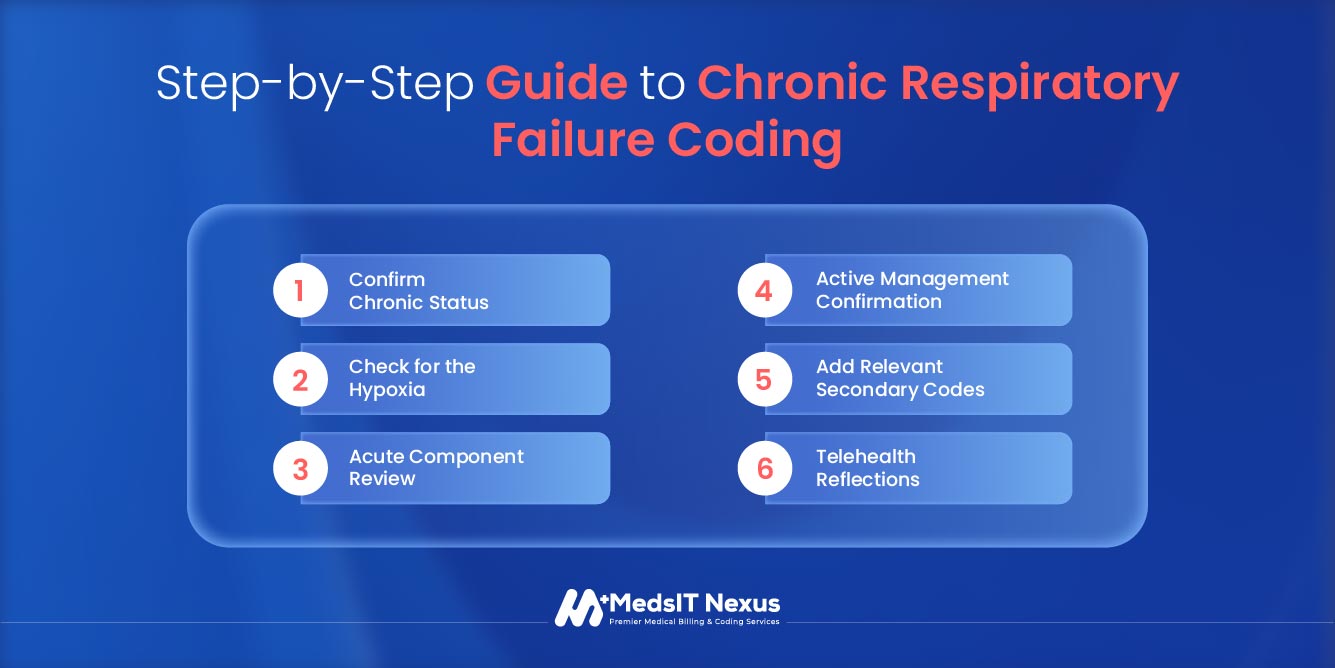
Step 1: Confirm Chronic Status
Make sure it is not acute respiratory failure, but chronic. The long-term oxygen dependence or duration should be observed.
Step 2: Check for the Hypoxia
Confirm pathophysiologic evidence of low oxygen levels (ABGs, SpO 2 measurements, or recorded oxygen dependence).
Step 3: Acute Component Review
In case of acute respiratory failure or acute-on-chronic respiratory failure, do not code J96.11 alone; choose the right combination or acute one.
Step 4: Active Management Confirmation
The record should indicate continuous observation, oxygen treatment, or medication treatment to substantiate medical necessity.
Step 5: Add Relevant Secondary Codes
Include underlying conditions codes (e.g., COPD, interstitial lung disease) where recorded because they aid in adjusting the severity and risk.
Step 6: Telehealth Reflections
Provided that chronic respiratory failure is treated through telehealth, the records should indicate oxygen surveillance, symptom assessment, and treatment supervision according to payer requirements.
Errors in Diagnosis Code J96.11
|
Common Coding Issue |
Why It’s a Problem |
Correct Approach |
|
Lack of clarity in chronic categorization |
Respiratory failure alone does not confirm chronic status |
Clearly document chronic respiratory failure with hypoxia before assigning J96.11 |
|
Using J96.11 when hypercapnia is documented |
Hypercapnia requires a different ICD-10 code |
Assign the appropriate chronic respiratory failure with hypercapnia code |
|
Missing supporting clinical evidence |
Diagnosis may be denied without proof of hypoxia |
Support with ABGs, pulse oximetry, or documented oxygen therapy |
RCM for Respiratory Disease Management
The appropriate application of J96.11 in the revenue cycle management reduces the risk of denials and enhances the accuracy of reimbursement.
Chronic respiratory failure is a high-impact chronic condition that is used in value-based care and risk-adjustment models. Accurate coding supports:
-
Risk-adjustment score (HCC impact where necessary)
-
Chronic breathing disorders classification
-
Reporting on population health
-
Pulmonary management services justification
Healthcare coding and billing are supposed to demonstrate the actual clinical severity of the respiratory status of the patient. Under-documentation can cause lost revenue and under-severe reporting.
|
Factor |
Risk Level |
Expected Outcome |
|
Excessive Coding |
High |
Audits, Denials, and Disputes |
|
Chronic Claims (No Updates) |
High |
Intensive Payer Scrutiny |
|
2026 ICD-10-CM Alignment |
Low |
Smooth Claim Flow & Compliance |
Key Takeaways
-
J96.11 is used properly to minimize revenue cycle management denials
-
The coding should reflect the actual chronic conditions of hypoxia in the patient
-
Claims of chronic conditions are often audited
-
Good internal audit practices enhance compliance and reimbursement.
The MedsIT Nexus Workflow
MedsIT Nexus billing service doesn't just assign a code; we verify the clinical integrity of the claim to ensure it stands up to payer scrutiny. The following components make us unique from other billing companies.
-
Clinical Verification
-
Chronicity Confirmation
-
MEAT Implementation
-
Final Scrubbing
|
Feature |
Standard Coding |
Medsit Nexus |
|
ICD-10-CM Prep |
Basic 2025/2026 Updates |
Advanced 2026 CMS Compliance |
|
Chronic Failure (J96.11) |
Often coded without active proof |
Mandatory Active Management Validation |
|
Audit Defense |
Reactive (after denial) |
Proactive (Internal Automated Checks) |
|
Revenue Cycle |
High risk of payment disputes |
Optimized for Smooth Claim Flow |
Conclusion
J96.11 is an apparent diagnosis code that should be properly documented and followed to the letter of the ICD-10 instructions. This code may only be utilized in case:
-
There is a well-documented chronicity
-
There is hypoxia, which is clinically supported
-
Active management is exhibited
Additionally, J96.11, properly recorded and used, will be a great benefit to the revenue cycle- improving compliance, maximizing reimbursement, and true clinical severity. Conclusively, proper coding is not just a billing role, but rather a question of clinical integrity, regulatory conformance, and better patient outcomes.
FAQs
Q1. What is the diagnosis code of J96.11?
J96.11 is an ICD-10-CM code that indicates chronic respiratory failure, including hypoxia.
Q2. J96.11 applicable to acute or chronic cases?
J96.11 applies to patients who have recorded chronic respiratory failure with hypoxia. It is not applicable in acute respiratory failure, which needs a separate ICD-10 code.
Q3. Is telehealth usable at J96.11?
Yes. J96.11 is accurate to the patient's diagnosis, not to the environment where care is provided. The code can be suitable in case a provider makes a telehealth visit to examine oxygen saturation logs, assess such symptoms as shortness of breath or fatigue, change oxygen therapy, or evaluate pulmonary medications.
Q4. What differences does J96.11 have with other codes of respiratory failure?
The J96.11 specifically is chronic respiratory failure with hypoxia. Hypercapnia chronic respiratory failure is cited under another ICD-10 code. Acute respiratory failure is classified under a different coding code, whereas acute-on-chronic respiratory failure has its specific coding code.
Table of Contents

Services
- Medical Audit Services
- Medical Billing Services
- Medical Credentialing Services
- Medical Coding Services
- Accounts Receivable Management
- Medical Insurance Verification
- Denial Menagement Services
Who we serve
- Private Practices
- Small Practices
- Hospitals & Healthcare
- Physicians
- Medical Equipment
- Outpatient Facilities
Get in Touch
Let's start talking about getting you credentialed