CO-16 Denial Code: Causes, Fixes & Prevention in Medical Billing
CO-16 Denial Code Description
A CO-16 denial is used in medical billing where a payer denies a claim based on a lack of information, incorrect information or incomplete information. It is among the most frequently reimbursed reasons and is normally caused by small mistakes in data entry or documentation that slow down processing.
CO-16 is considered a Contractual Obligation (CO); a provider may not charge the patient the amount that has been denied. CMS and the majority of payers state that code 16 indicates that the claim lacks information or contains errors in submission or billing.
The denials in CO-16 frequently arise when important details of claims, like patient details, CPT or ICD-10 codes, provider NPIs, or insurance information, are absent or incorrect.
The codes of remark on the Explanation of Benefits (EOB) include M51 (incorrect procedure), N290 (invalid provider ID), or MA63 (missing date of birth), which allows the billing teams to identify the problems, correct them, and resubmit claims.
This blog discusses typical reasons to deny CO-16, how to resolve them, and best practices to prevent them, contributing to safeguarding your revenue cycle.
Typical Denial of CO-16
The CO-16 denial code usually results from preventable errors in data accuracy or claim submission. Even minor mistakes in patient or insurance information can lead to delayed or denied reimbursements. Understanding these common causes helps billing staff identify the source of the problem and take quick corrective action.
Outdated Insurance Information
One of the most prevalent causes of CO-16 denials is the use of outdated insurance information. Patients tend to switch jobs or insurance companies, yet their records in the EHR or billing system are not always updated. Additional claims that have been filed with expired coverage or where the plan information is outdated or with an inactive policy number are automatically denied.
Incorrect Insurance Details
Even with active coverage, a claim may be incomplete or invalid due to inaccurate payer information, such as an incorrect member ID, plan code or payer address. These mistakes are likely to occur when entering data manually or registering patients. This underscores the importance of pre-submission verification in order to provide proper billing.
Insurance Policy Changes
Unexpected changes in payer policy instructions or plan designs may influence the way claims have to be filed. When the billing system is not in synchronisation with the current demands of the payer, the changes to the mandatory fields, coding regulations or claim structure could result in denials. Keeping abreast with such changes would involve regular dialogue with payers.
Lack of Communication
Lack of information on claims may also be due to a lack of effective communication between clinical, billing and front desk teams. As an example, the payers might raise red flags when clinical documentation does not correspond to billing records. These errors are prevented with clear workflows and regular internal audits.
Inaccurate Patient Information
Mismatches in claims are mostly a result of false or missing patient data, which could be spelling of names, date of birth, sex or address. These small mistakes usually lead to CO-16 rejections, but they are easily avoided by frequent data checks.
System or Data Entry Errors
Duplicate claims, incorrect codes, or missing fields can occur as a result of technical glitches or human errors. To avoid most of these mistakes, use accurate systems, educate employees on how to enter claims and run automated checks before submitting claims.
Effects of CO 16 Denial Code on Revenue Cycle
The CO-16 denial code can have a considerable effect on the revenue cycle, even though it might appear that it is just a data error. Every denial interferes with cash flow to sustain operations and patient care, slows down payment, and adds administrative burden. Repeated refusals lead to a backlog, which slows down the performance of the entire claims process and decreases the efficiency of collection.
The effect of CO-16 on Claim Turnaround
One CO-16 denial has the potential of adding days or even weeks to claim turnaround. The billers should find out any information that is missing and update it while they wait until the payer reprocesses a claim. Delay of payment will result in more time for the correction of errors and will disrupt the cash flow of the provider.
Examples of Delays or Payment Losses Due to CO-16
The absence of a birthdate or incorrect provider NPI might appear to be a small matter, yet the claim cannot be made until these concerns are addressed. Even the few CO-16 denials would help postpone thousands of dollars worth of payment to large practices or hospitals. Such delays increase administrative expenses as well, since employees waste time rectifying errors that they could have avoided.
The reason why Co-16 is prevalent in multi-payer billing settings.
In multi-payer billing, payers have their own rules to use in submitting claims. What is accepted by one payer may be rejected by another. Such variations lead to errors, and comprehensive pre-submission checks are important. Failure to comply with payer regulations can easily lead to the denial of CO-16, which may affect revenue and workflow.
How to Fix a CO-16 Denial
An easy, step-by-step method allows finding mistakes and correcting them and approving claims to overcome CO-16 denials. Dealing with denials effectively will not only accelerate the reimbursement timeline but also minimise the chances of making the same mistake and increase the quantity of administrative tasks.
Reviewing the Explanation of Benefits (EOB)
The initial one is to look through the EOB or ERA. The specific remark codes and denial code causes, like M51 (invalid procedure) or N290 (incorrect provider ID), are shown on these documents and identify the problem. A detailed review enables billers to concentrate on the right fix and not speculate.
Identifying the Correct Payer
There is always the possibility of a CO-16 denial due to the claim being presented to an old plan or the wrong payer. Confirm the payer information to make sure the correct payer is being provided with the claim. It is possible to prevent rejection due to the resubmission of eligibility and coverage details by re-checking them.
Proper Billing and Patient Data
Next, fill in the claim with the correct patient and billing facts. CPT/ICD-10 codes, patient demographics, NPI numbers, insurance policy details, and others might need updating. This risk of re-rejection of CO-16 can be mitigated by having automated claim scrubbers or pre-submission verification applications that detect and rectify such errors and resubmit the request.
Resubmitting the Claim
Re-file the claim when the required changes have been made. To ensure that there is no delay, submit any supporting paperwork that is requested by the payer. Monitor the resubmission to be sure the claim is addressed immediately, and payment is not delayed any longer.
Appealing a CO-16 Denial
There are instances where the payer can decline the claim despite the right information due to a misinterpretation or failure of a system. Think of appealing in case of denial, even after corrections. Be very well documented, give brief explanations of the nature of the changes that were carried out and any EOB references to support your case. An appeal that was already rejected, the CO-16 claim could be paid successfully with a well-structured appeal.
Strategies to Prevent CO-16 Denials
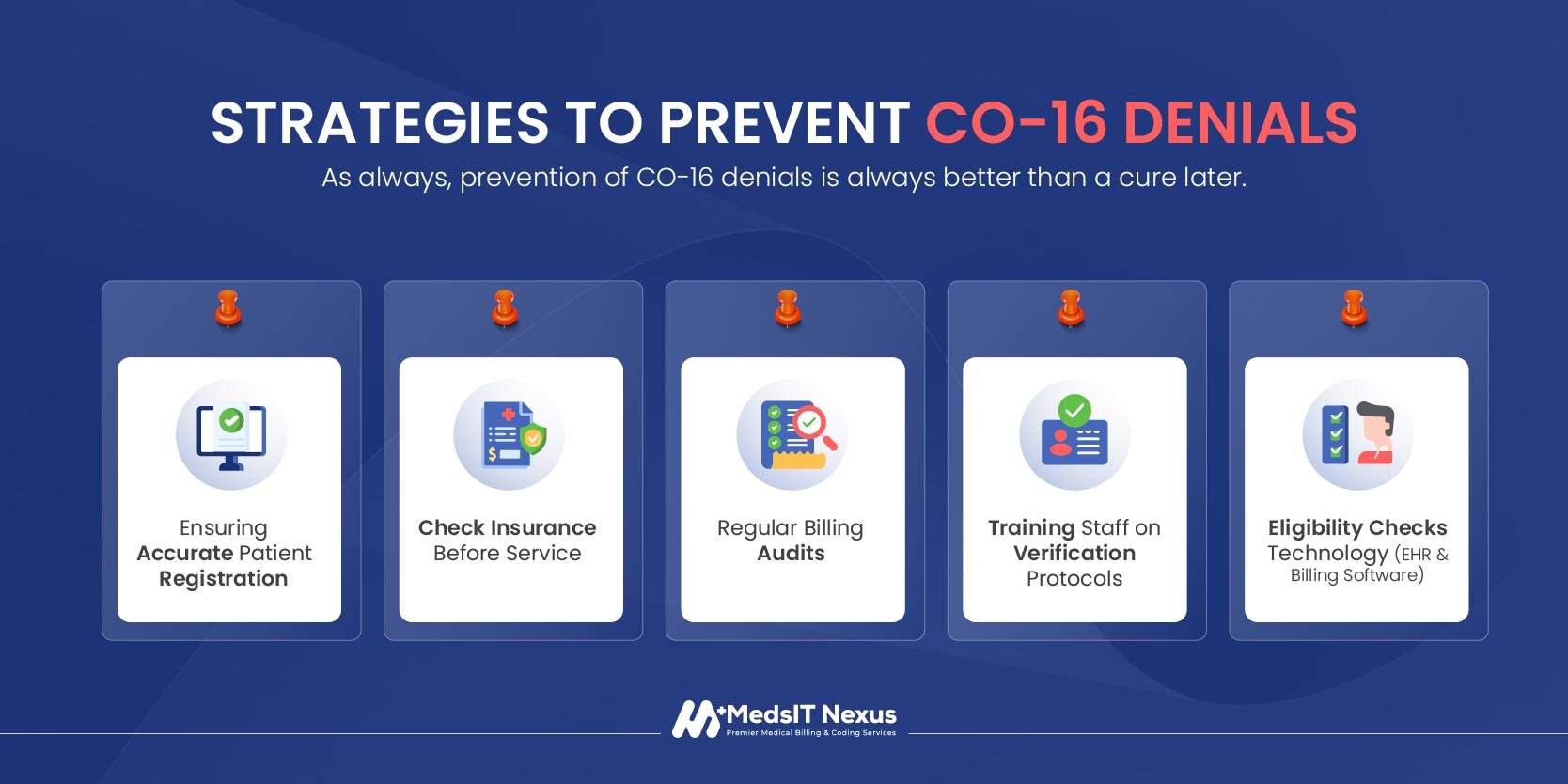
As always, prevention of CO-16 denials is always better than a cure later. Through proactive initiatives, the healthcare providers will be in a position to have a healthier revenue cycle, less administrative workload, and better claim accuracy.
Ensuring Accurate Patient Registration
To avoid CO-16 denials, it is important to have an accurate patient registration. Register all patient data, such as name, date of birth, contact details, and insurance numbers. Checking this information twice will reduce the chances of rejection of claims because of errors or incomplete information.
Check Insurance Before Service
Patient coverage and benefits should always be verified before delivering services. Eligibility, plan status, and payer requirements are verified pre-submission to ensure cleaner and more accurate claims and minimise first-pass denials. This lessens CO-16 refusals due to wrong or obsolete insurance data.
Regular Billing Audits
Common claim errors can be detected when regular billing audits are conducted, and they may include wrong provider details and wrong CPT/ICD codes. These errors are best identified and corrected early in the process, which will assist the staff in bettering the quality of claims and minimise chances of recurring denials.
Training Staff on Verification Protocols
Training of the staff is necessary to make sure that all the staff understand the verification procedures, documentation requirements and claim submission requirements. Professionally trained personnel will be less prone to data errors and will be able to identify problems prior to submitting claims to the payer.
Eligibility Checks Technology (EHR & Billing Software)
EHR and billing software can be used to automate many verification tasks. These tools are used to automatically check eligibility and scrub claims. Automation minimises the errors of man. It also assists in claims acceptance the first time by locating missing data, verifying payer regulations, and patient information.
With such strategies, providers are able to minimise CO-16 denials, speed up the processing of claims, and protect their revenues.
CO-16 vs. Similar Denial Codes
CO-16 is different from other denial codes. Knowing this helps billing teams identify the problem quickly and resolve it. CO-16 typically occurs when claim data is missing or incorrect. Other codes occur for reasons such as incorrect provider information or payer mismatches.
|
Denial Code |
Description |
Key Difference |
|
CO-16 |
Claim/service lacks necessary information |
Denial occurs due to missing or incorrect claim data |
|
CO-109 |
Sent to the wrong payer |
Denial relates to payer mismatch, not missing data |
|
CO-197 |
Provider not credentialed |
Denial occurs due to a provider's eligibility issue |
By comparing these codes, providers can avoid unnecessary resubmissions and follow the right fix. CO-16 means correcting claim data, CO-109 may require sending the claim to the correct payer, and CO-197 involves checking provider credentials before submission.
Scenario of a CO-16 Denial
To have a better insight into a CO-16 denial, consider the following real-life scenario in a typical outpatient clinic.
Real-World Case Example
A patient had a routine diagnostic test in a clinic which had filed a claim. On the EOB, the claim was initially denied using a CO-16 denial code. The EOB revealed that the date of birth of the patient was not included in the submission of the claim.
What Went Wrong
The front desk workers accidentally left the date of birth field blank when registering the patient. The claim was incomplete even though the information about the insurance and the procedure codes was correct. This demonstrates that the rejection of a CO-16 claim may occur as a result of a small error.
How it was Resolved
The billing team added to the system the information that was missing after reading the EOB and realising that the information was missing. Following corrections, they re-filed the claim with the payer. The claim was satisfactorily addressed, after which the clinic was promptly reimbursed. This case highlights the value of the correct patient data, proper pre-submission verification, and the timely resolution of the CO-16 denials.
Best Practices for Denial Prevention
All this requires technology, process improvements and employee cooperation to stop CO-16 denials and other common claim rejections. Best practices are used to protect your revenue cycle and ensure claims are accurate.
Integrating Claim Scrubbing Software
Claim-scrubbing tools can automatically identify missing or inaccurate data before submission. These systems reduce the risk of CO-16 and other medical billing denial codes by checking insurance details, procedure codes and patient demographics.
Automating Eligibility Verification
This is done by automating the eligibility checks to make sure that patient coverage and benefits are checked before service. This proactive measure helps eliminate mistakes in out-of-date or wrong insurance and enhances the first-pass claim rate.
Improving Communication Between Front Desk and Billing Teams
There should be clear communication between clinical, billing and registration teams. Reporting of updated patient and insurance information in a short time avoids disparities in claims. Frequent meetings and established procedures develop accountability and minimise CO-16 denials.
Regular implementation of these practices assists providers in minimising typical denials, simplifying revenue cycle operations and improving financial outcomes.
Final Recommendations
Check claims using automated methods before submission. Claim scrubbers will help ensure that all claims meet the payer requirements the first time by quickly pointing out missing data, faulty codes, or formatting issues.
Automate Claim Validation
Make sure that your plan details and payer database are current. The records that are out of date can lead to unnecessary CO-16 denials due to the constantly evolving payer regulations, policies, and electronic submission forms. Ensure compliance by regularly reviewing payer correspondence.
Maintain Updated Payer Records
Ensure your plan details and payer database are up to date. Outdated records may result in needless CO-16 denials because payer regulations, policies, and electronic submission formats are constantly changing. Maintain compliance by routinely reviewing payer correspondence.
Review Denial Trends Regularly
Track and assess the denial patterns within your billing system to identify areas to improve. Following the denials of CO-16 and other similar ones assists in exposing the underlying causes, which may be system malfunctions, omissions in the documentation, or registration errors.
Educate Billing Staff
Continued training of staff is necessary. Educate the coding, billing, and front-desk staff on the payers' regulations, appropriate verification, and the best practices to enter claims correctly. Denials are best countered by a well-educated staff.
These measures assist medical institutions in having cleaner claims, faster reimbursements, and a more efficient revenue cycle.
Conclusion
CO-16 denials can be avoided in medical billing. By ensuring that they verify information beforehand, use the appropriate technology, and train their staff regularly, providers can minimise denials, and enhance claim success. Eligibility checks, keeping patient and payer records up-to-date, and encouraging effective communication between teams can aid in ensuring cleaner claims and faster reimbursements.
MedsIT Nexus medical billing services can assist health facilities in avoiding CO-16 and similar avoidable denials. We use a combination of state-of-the-art verification mechanisms and trained claim processes to ensure that all claims are paid to satisfaction the first time. Collaborate with MedsIT Nexus to automate your revenue cycle, become compliant, and speed up the process of billing.
FAQs
Q: What is co 16 denial code mean in medical billing?
CO-16 is a denial code indicating that a claim was rejected due to missing, incorrect, or incomplete information. It often results from small data entry or documentation errors.
Q: What are co 16 denial code solution?
To fix a CO-16 denial, review the Explanation of Benefits (EOB) for the specific error, correct the inaccurate or missing information (like patient details, CPT/ICD codes, or provider NPI), and resubmit the claim.
Q: What are common causes of CO-16?
CO-16 denials commonly occur due to incorrect patient demographics, incorrect CPT or ICD-10 codes, invalid provider information, missing insurance data, or discrepancies between clinical and billing records.
Q: Is CO-16 the same as CO-109?
No. CO-16 refers to claims with missing or incorrect information, while CO-109 generally involves redirecting the claim to the correct payer. Each code requires a different approach to resolution.
Q: How can billing software prevent CO-16 errors?
Billing software can prevent CO-16 denials by automating eligibility checks, validating patient and payer information, flagging missing or incorrect data, and guiding staff with built-in claim-scrubbing tools.
Table of Contents

Services
- Medical Audit Services
- Medical Billing Services
- Medical Credentialing Services
- Medical Coding Services
- Accounts Receivable Management
- Medical Insurance Verification
- Denial Menagement Services
Who we serve
- Private Practices
- Small Practices
- Hospitals & Healthcare
- Physicians
- Medical Equipment
- Outpatient Facilities
Get in Touch
Let's start talking about getting you credentialed