CPT Code 97110 Explained | Therapeutic Exercise Billing Guide
97110 CPT Code Description
97110 CPT code is an exercise procedure to develop strength, endurance, range of movement, and flexibility. As one of the most frequently billed physical therapy codes, it's also one of the most scrutinized by payers and auditors.
This is a complete guide that reveals all you need to know about the requirements of the 97110 CPT code, documentation standards, and best practices in compliance in order to avoid denials and audits in your practice.
What is CPT code 97110?
CPT code 97110 is a physical therapy code that is applied in the case of therapeutic exercises.
It includes activities that will enhance strength, flexibility, balance, and range of motion.
The training should be supervised and led by a trained medical practitioner. It is charged at 15 minutes, depending on the duration spent with the patient.CPT 97110 Meaning and Critical Elements.
Key Elements of 97110:
-
Time-based code: Billed by the 15-minute increments.
-
Patient contact is necessary: One-on-one contact with the patient.
-
Active participation: The patient will have to actively do exercises.
-
Competent service: Needs clinical judgment and competence.
When to Use 97110 CPT Code
97110 can be used in the following applications:
-
Strength-building exercises (progressive resistance)
-
Active range of motion exercises
-
Bending and stretching programs
-
Endurance training activities
-
Postural exercises
-
Balance activities (when strength/coordination)
Do NOT use 97110 for:
-
Passive range of motion (use 97140 in place of this)
-
Gait training (use 97116)
-
Neuromuscular re-education (use 97112)
-
Group therapy (use 97150)
-
Documentation Requirements for CPT 97110
Your records must demonstrate:
1. Medical Necessity
-
Evident functional impairments in strength, ROM, or endurance.
-
The effect of these deficits on day-to-day activities.
-
The need to use skilled therapy vs. a home exercise program.
2. Specific Exercise Details
-
Exercise type: Be specific (e.g., not leg exercises, but seated knee extensions).
-
Parameters: Sets, repetitions, resistance level, and hold times.
-
Progression: The change in exercise as per patient response.
-
Patient performance: Compensations, quality of movement observed.
3. Time Documentation
-
Total time spent on 97110 activities.
-
Start times and stop times when two or more codes are billed.
-
The deliberate separation of CPT codes of various types has been completed.
4. Clinical Decision-Making
-
Why were particular exercises selected.
-
Alterations were made in treatment.
-
Patient education provided.
-
Evaluation of patient response.
Top 97110 Billing Mistakes to Avoid
1. Insufficient Documentation
-
Issue: Generics such as therapeutic exercises performed x 30 minutes.
-
Solution: Document specific exercises, parameters, and patient response.
2. Billing for Non-Skilled Services
-
Issue: Billing 97110 for exercises that the patient can perform independently.
-
Solution: Explain why a skillful intervention is required to ensure safety, efficiency, or development.
3. Incorrect Time Calculations
-
Issue: Rounding up of units or setup/rest time.
-
Solution: Follow the 8-minute rule precisely and document actual treatment time.
4. Mixing Codes Inappropriately
-
Issue: 97110 to charge activities that should be coded differently.
-
Solution: Learn to distinguish between therapeutic codes and charge the most suitable code.
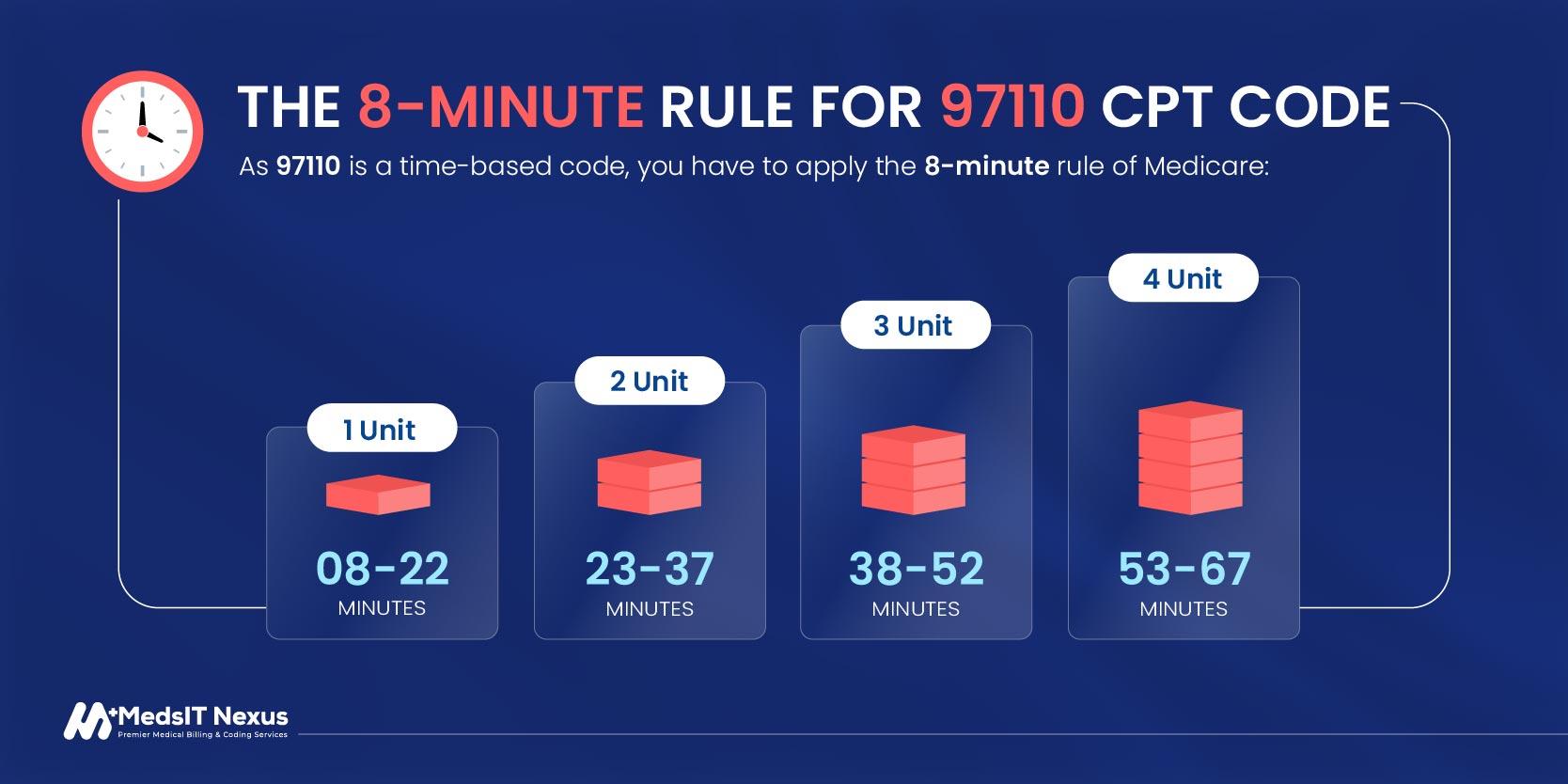
As 97110 is a time-based code, you have to apply the 8-minute rule of Medicare:
-
8–22 minutes = 1 unit
-
23–37 minutes = 2 units
-
38–52 minutes = 3 units
-
53–67 minutes = 4 units
Notable: Sometimes, when you are billing several time-based codes, add up all the timed minutes, then decide the total units, and then allocate them to each particular code.
Payer-Specific Requirements for CPT Codes 97110
Medicare
-
Needs to be shown to have improved in functionality.
-
Anticipates competent documentation of interventions.
-
May limit units based on diagnosis.
Commercial Payers
-
Frequently do have visit or unit restrictions.
-
May require pre-authorization after a certain number of visits.
-
Some need particular outcome measures.
Workers Compensation
-
Usually needs job-related instrumental objectives.
-
May have state-specific documentation requirements.
-
Frequently, questions the length of care.
Best Practices for 97110 CPT Compliance
1. Create Exercise Templates
Create templates of common diagnoses that involve:
-
Evidence-based exercise progressions
-
Clear documentation prompts
-
Outcome measure tracking
2. Regular Documentation Audits
Review charts monthly to ensure:
-
Exercise specificity meets standards.
-
Documentation of time is correct.
-
The issue of medical necessity is established.
3. Staff Training
Provide ongoing education on:
-
Proper exercise documentation
-
Time tracking requirements
-
Payer-specific guidelines
4. Technology Solutions
Consider implementing compliance software that can:
-
Flag incomplete documentation
-
Verify time calculations
-
Meet medical necessity requirements
How MedsIT Nexus Helps with 97110 Compliance
MedsIT Nexus helps healthcare professionals ensure complete compliance with the billing 97110 CPT code physical therapy. Our staff takes care that all services are well documented with clear medical necessity, time tracking, and proper procedure description as mandated by the payer requirements.
We critically examine clinical notes to ensure that exercises carried out are well-connected to the treatment plan of the patient. This assists in the prevention of coding errors, and claims are in compliance with insurance requirements. Our billing people also ensure that the 15-minute time limit on CPT 97110 is appropriately implemented to avoid cases of underbilling and overbilling.
Besides this, we enhance the accuracy of claims and speed of reimbursement by deploying sophisticated billing systems and having highly skilled coding professionals. We aim to make sure that the providers are paid on time and remain well within the insurance and regulatory requirements.
Conclusion
The correct coding and billing of CPT code 97110 is highly crucial both in compliance and financial sustainability of a therapy practice. The therapeutic exercise CPT code 97110 is applicable in exercises that enhance strength, flexibility, balance, and range of movement. In order to charge it appropriately, it is necessary to present all the details of the service in writing by the healthcare providers.
Learning what payers need and how to prevent the most typical billing errors can greatly decrease both claim rejection and audit risk. A lot of problems arise when there is no complete documentation, or the documentation lacks time details, or the medical necessity is not clearly supported. Through effective and well-maintained documentation, providers will have a chance to verify that no claims are incorrect and lack support.
Proper time-based billing rules should also be adhered to, and every 15 minutes of CPT 97110 should be properly documented. This assists in keeping up transparency and enhances the accuracy of reimbursement.
To conclude, clarity, accuracy, and consistency are key to CPT 97110 success. Recording each session is a safeguard that helps providers avoid compliance challenges and enhance financial results. Specificity is your greatest weapon, you see, you must always chronicle what was done, why done, and what the patient did about it, every time.
FAQs
Q1. Can 97110 be billed with other therapy codes?
Yes, 97110 can be billed with other CPT codes during the same session. However, you must clearly document the time spent on each distinct service and ensure activities don't overlap.
Q2. What's the difference between 97110 and 97530?
97110 focuses on exercises for strength, ROM, and flexibility. 97530 (therapeutic activities) involves functional tasks that incorporate multiple parameters simultaneously, like lifting, carrying, or reaching activities.
Q3. How many units of 97110 can I bill per session?
There's no absolute limit, but payers expect reasonable amounts based on patient tolerance and medical necessity. Most sessions include 2–4 units of 97110, often combined with other interventions.
Q4. Do I need to document each repetition?
While you don't need to count every rep, you should document exercise parameters (sets, reps, resistance) and any modifications made during treatment.
Q5. What is the most important thing to remember when documenting CPT 97110?
The most important thing is to be specific and detailed. You should clearly document the exact exercises performed, the medical reason for doing them, the time spent, and how the patient responded. This helps ensure compliance, reduces claim denials, and protects against audit risks.
Q6. Why is CPT 97110 documentation important?
It ensures proper billing, compliance, and reduces claim denials.
Table of Contents

Services
- Medical Audit Services
- Medical Billing Services
- Medical Credentialing Services
- Medical Coding Services
- Accounts Receivable Management
- Medical Insurance Verification
- Denial Menagement Services
Who we serve
- Private Practices
- Small Practices
- Hospitals & Healthcare
- Physicians
- Medical Equipment
- Outpatient Facilities
Get in Touch
Let's start talking about getting you credentialed
Related Posts
New Patient Visit CPT Codes in Urgent Care Billing