Calculate Your Savings


CPT Code 99396: Complete Guide to Preventive Visit Billing
CPT Code 99396 – The Complete Guide to Preventive Visit Billing
Accurate billing for preventive medicine service visits is critical to maintaining steady revenue and minimizing claim rework. CPT Code 99396 is one of the most commonly used preventive medicine codes for established adult patients, yet it remains a frequent source of denials and confusion.
Understanding how CPT Code 99396 works can significantly reduce denials and improve the overall efficiency. This guide simplifies the rules, clarifies common problem areas, and provides practical strategies to help your team bill preventive visits accurately and confidently.
Key Takeaways:
-
CPT Code 99396 is strictly for established patients aged 40–64, and using it outside this range will result in automatic claim denial.
-
When a preventive visit includes a separate, medically necessary problem-oriented service, append Modifier 25 to the E/M code to ensure proper reimbursement.
-
Accurate, comprehensive documentation, including preventive-focused history, exam, counseling, and correct ICD-10 Z-codesis critical to support medical necessity.
-
Reduce denials by verifying insurance benefits, checking annual frequency limits, and scrubbing claims before submission to ensure CPT Code 99396 is billed correctly.
What is CPT Code 99396, and Who Does it Cover?
CPT Code 99396 is a specific code used for a “periodic comprehensive preventive medicine reevaluation and management of an individual.” In simple terms, this code represents a wellness visit for an established patient. An established patient is someone who has received professional services from the physician or another physician of the same specialty in the same group within the past three years.
The most critical factor for using CPT Code 99396 is the patient's age. The CPT 99396 age limit is strictly defined for patients between 40 and 64 years old. Using this code for a patient outside this age bracket will result in an automatic denial.
Understanding the CPT 99396 Age Guidelines
The age rules for preventive visits are precise. Billing with the correct age-based CPT code is non-negotiable for payment. The CPT manual divides established patient preventive visits into specific age groups to ensure the services rendered are appropriate for the patient’s stage of life.
Here is a simple breakdown of the preventive visit CPT codes by age for established adult patients:
-
CPT 99395: Patients aged 18-39 years
-
CPT Code 99396: Patients aged 40-64 years
-
CPT 99397: Patients aged 65 years and over
What Services Are Included in CPT Code 99396?
When billing CPT Code 99396, the visit must reflect a comprehensive preventive evaluation for established patients aged 40–64. This service is designed to focus on overall health maintenance, early detection, and risk reduction, not the management of new or existing medical problems.
To support proper reimbursement, documentation should clearly show that the visit included the core preventive components outlined below.
Services Covered Under CPT Code 99396
|
Service Type |
Description |
|
Comprehensive Physical Exam |
Complete age-appropriate examination, including vital signs and system review |
|
Medical History Update |
Review of personal, family, and social history, including chronic condition updates |
|
Risk Factor Assessment |
Evaluation of cardiovascular, metabolic, and lifestyle-related risk factors |
|
Preventive Counseling |
Guidance on diet, exercise, tobacco cessation, alcohol use, and behavior modification |
|
Age-Appropriate Screenings |
Orders or referrals for screenings such as colorectal cancer, breast cancer, lipid panels, or diabetes testing |
Clear, preventive-focused documentation of these elements is critical to justify medical necessity and reduce denials. Properly distinguishing preventive services from problem-oriented care ensures CPT Code 99396 is billed accurately and reimbursed without delay.
How to Bill CPT 99396 Correctly
Billing for CPT Code 99396 requires careful attention to detail, especially when other services are provided on the same day. One of the most common sources of error is the incorrect use of modifiers.
The most frequently used modifier with CPT 99396 is Modifier 25.
Modifier 25 is defined as a "Significant, Separately Identifiable Evaluation and Management (E/M) Service by the Same Physician on the Same Day of the Procedure or Other Service." Here is how it works:
-
A patient comes in for their scheduled annual wellness visit (a preventive service).
-
During the visit, the patient also complained of a new, separate problem, such as sinus pain or a sprained ankle.
-
The provider performs the full preventive exam (CPT 99396) AND addresses the new problem, which requires its own evaluation and management.
Bill both services: use the problem-visit code (like 99213) with Modifier 25, and bill 99396 separately to show they were two different services done at the same visit.
Essential Documentation for CPT 99396
Clean claims start with strong documentation. For a preventive visit billed with CPT Code 99396, the medical record must clearly support the service. Payers need to see that a comprehensive, age-appropriate preventive evaluation occurred.
Your documentation should include:
-
A comprehensive patient history update.
-
A complete physical examination.
-
Counseling on risk factor reduction and behavior change.
-
Orders for immunizations and lab tests appropriate for a patient aged 40-64.
The primary diagnosis for a preventive visit is usually a Z-code from the ICD-10-CM manual, such as Z00.00 (Encounter for general adult medical examination without abnormal findings) or Z00.01 (with abnormal findings), to establish medical necessity. Using a problem-oriented diagnosis as the primary reason can trigger a denial.
Common Reasons for CPT 99396 Denials
Claim denials for CPT Code 99396 often stem from a few common mistakes. Understanding these pitfalls is the first step toward avoiding them and improving your revenue cycle.
-
Age Mismatch: The most frequent reason for denial is billing CPT Code 99396 for a patient who is younger than 40 or older than 64. Always verify the patient's age before submitting the claim.
-
Incorrect Modifier Usage: Failing to use Modifier 25 when a separate E/M service is provided on the same day will cause the payer to bundle the services and pay for only one.
-
Insufficient Documentation: If the medical record does not reflect a comprehensive preventive evaluation, a payer may deny the claim upon review. The documentation must stand on its own as proof of service.
-
Frequency Limits: Most insurance plans cover one preventive visit per year. Billing CPT Code 99396 more than once within 12 months for the same patient will likely lead to a denial.
CPT 99396 vs. Other Preventive Codes
While CPT Code 99396 covers a large portion of the adult population, it is important to see it as part of a larger family of preventive CPT codes. As mentioned, CPT 99395 is for younger adults (18-39) and CPT 99397 is for older adults (65+).
The key difference between these codes is the age-specific guidance from bodies like the U.S. Preventive Services Task Force (USPSTF).
-
CPT 99395 (18-39 years): Focuses on lifestyle counseling, screenings for cervical cancer, and STI prevention.
-
CPT 99396 (40-64 years): Adds screenings for breast cancer, colorectal cancer, and cardiovascular risk factors.
-
CPT 99397 (65+ years): Includes screenings for osteoporosis, fall risk assessment, and cognitive function.
Each code reflects a different set of clinical priorities. Using the correct code ensures that the billed service aligns with established preventive health standards for that age group.
Revenue Cycle Management Tips for CPT 99396
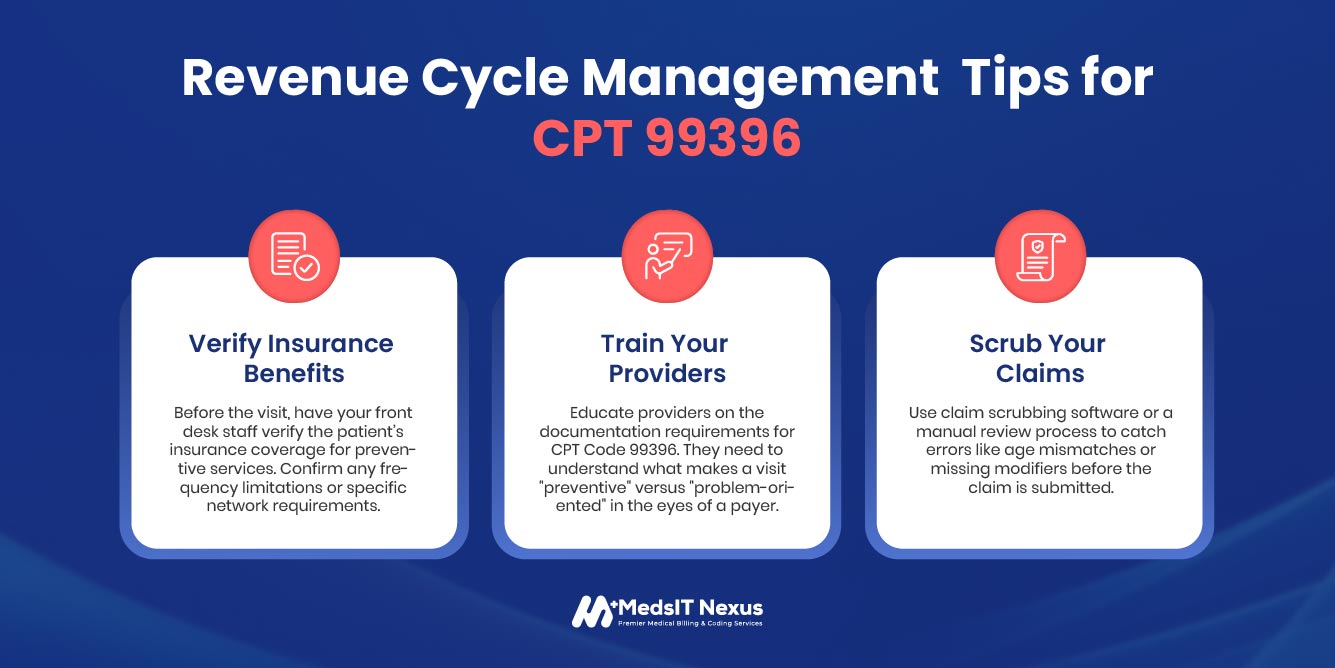
Optimizing your revenue cycle for preventive visits involves more than just correct coding. It requires a coordinated effort from the front desk to the billing office.
Here are a few practical tips:
-
Verify Insurance Benefits: Before the visit, have your front desk staff verify the patient’s insurance coverage for preventive services. Confirm any frequency limitations or specific network requirements.
-
Train Your Providers: Educate providers on the documentation requirements for CPT Code 99396. They need to understand what makes a visit "preventive" versus "problem-oriented" in the eyes of a payer.
-
Scrub Your Claims: Use claim scrubbing software or a manual review process to catch errors like age mismatches or missing modifiers before the claim is submitted.
For practices struggling with denials and administrative burden, adopting end-to-end RCM solutions can provide the expertise and technology needed to optimize billing for preventive codes and maximize reimbursement.
Conclusion
Successfully billing CPT Code 99396 comes down to precision. By adhering to the strict age guidelines, using modifiers correctly, and maintaining thorough documentation, your practice can significantly reduce claim denials. Mastering these preventive visit CPT codes is crucial for protecting revenue and streamlining your billing operations. A proactive approach to billing compliance not only ensures faster reimbursement but also supports the delivery of valuable preventive care to your patients.
Frequently Asked Questions (FAQs)
1. What is CPT Code 99396 used for?
CPT Code 99396 is used to report a comprehensive preventive medicine evaluation and management (E/M) visit for an established patient aged 40–64 years. It covers an age-appropriate history, physical examination, risk assessment, and preventive counseling.
2. Does CPT Code 99396 include an annual physical?
Yes. CPT Code 99396 is the correct code for billing an annual physical or preventive wellness visit for established patients between 40 and 64 years old.
3. What is the age requirement for CPT Code 99396?
CPT Code 99396 applies only to established patients aged 40 through 64. Patients aged 18–39 should be billed with CPT 99395, and patients 65 and older should be billed with CPT 99397.
4. When should Modifier 25 be used with CPT Code 99396?
Modifier 25 should be appended to a separate problem-oriented E/M code when a significant, distinct medical issue is evaluated during the same visit as the preventive service billed under CPT Code 99396.
5. Why do claims for CPT Code 99396 get denied?
Claims for CPT Code 99396 are commonly denied due to age mismatches, incorrect modifier usage, insufficient documentation, improper diagnosis coding, or exceeding annual frequency limits.
Table of Contents

Services
- Medical Audit Services
- Medical Billing Services
- Medical Credentialing Services
- Medical Coding Services
- Accounts Receivable Management
- Medical Insurance Verification
- Denial Menagement Services
Who we serve
- Private Practices
- Small Practices
- Hospitals & Healthcare
- Physicians
- Medical Equipment
- Outpatient Facilities
Get in Touch
Let's start talking about getting you credentialed
Related Posts
New Patient Visit CPT Codes in Urgent Care Billing