Calculate Your Savings


G0463 CPT Code Hospital Outpatient Billing Guide
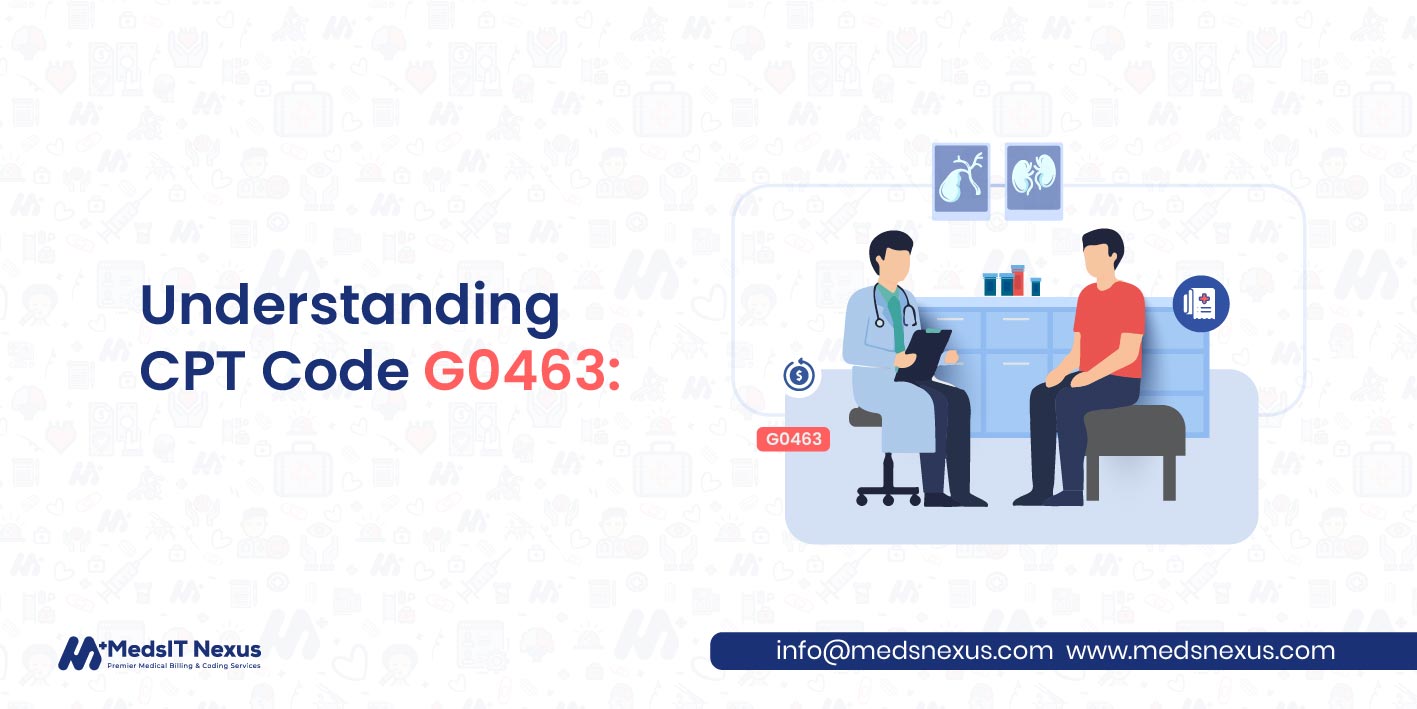
The G0463 CPT code is used by hospitals to bill for outpatient clinic visits. In simple terms, it enables hospitals to earn money by assessing and treating patients who walk in the hospital seeking care but are not hospitalized within a particular night.
The significance of this code is that it has a direct influence on the extent to which a hospital is reimbursed. In order to utilize it properly, the providers should follow Medicare regulations and present clear and detailed records. Even minor errors may lead to the delay of payments or rejection of claims.
Hospitals can enhance their billing procedures, prevent compliance problems, and stabilize revenues when they learn how G0463 functions. Effortless billing translates to less financial pain and more attention to patients.
Understanding CPT Code G0463
There are multiple complex medical billing codes, and CPT Code G0463 is one of them. It is applied whenever a patient goes to an outpatient clinic in a hospital to seek assessment and management services.
With more patients receiving care in outpatient settings, using this code correctly has become increasingly important. Thus, to avoid denials, hospitals have to pay close attention to the Medicare guidelines and document the offered services properly.
Understanding how and when to use G0463, healthcare providers will be able to minimize the number of errors, enhance cash flow, and maintain their operations at a high level of efficiency, yet they still will be able to provide quality care to their patients.
Significance
G0463 CPT code is paid to hospital outpatient clinic visits in cases where a patient is assessed and treated by medical specialists. Simply put, it enables hospitals to provide care in an outpatient facility, i.e., the patient is given treatment without being admitted to an overnight facility.
The significance of this code is that it distinctly differentiates between outpatient clinic visits and other kinds of services. This is the difference that assists Medicare in making payments and ensures that hospitals are paid properly. As a provider, one of the most important aspects of medical billing and remaining within the framework of Medicare regulations is to comprehend the use of G0463.
It’s also important to understand how G0463 works alongside other coding systems, such as ICD diagnosis codes and HCPCS procedure codes. These systems collaborate to describe the reasons why the patient was visited and what was done to him.
In particular cases, additional codes may be used within certain facilities, such as critical access hospitals, thereby impacting payment calculation. Being aware of these details will assist providers in avoiding billing errors and enhancing revenue cycle performance.
Concisely, understanding how to implement the G0463 code assists in compliance, enhances billing correctness, and helps hospitals to sustain the financial capability to offer quality outpatient services.
How G0463 Is Used in Real Clinical Practice
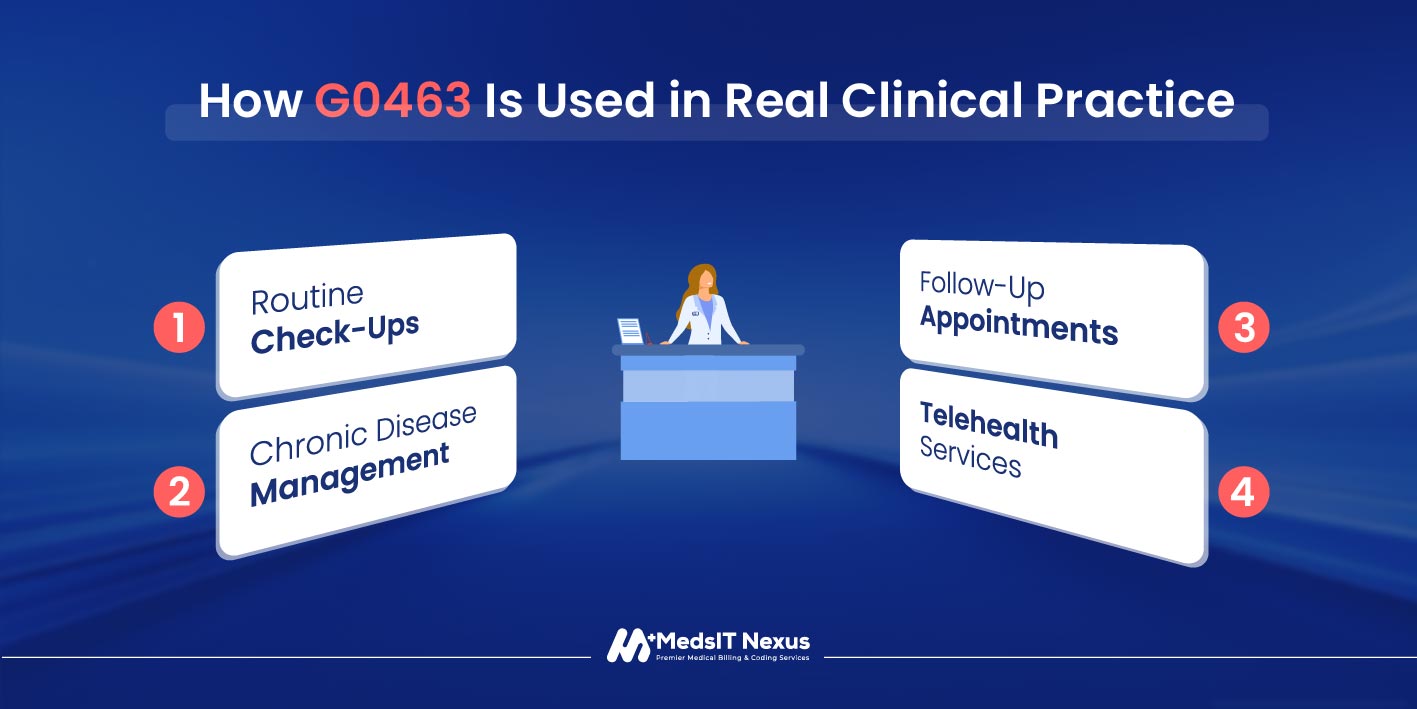
The G0463 code is highly utilized in hospital outpatient clinics and is a significant factor in patient care and Medicare billing. It helps in reimbursing appropriately and enables providers to give consistent and quality services. The primary ways it can be utilized in clinical practice are as follows:
Routine Check-Ups
Hospitals are coding G0463 to charge regular outpatient visits when patients visit the hospital to have regular checkups. These regular check-ups are crucial in tracking health, and the code provides the facility with the right remuneration for the service.
Chronic Disease Management
Long-term patients like diabetics, high blood pressure, or heart patients usually need 24/7 monitoring. There is an opportunity to bill follow-up visits to manage these chronic illnesses under G0463. This assists in continuity of care as well as aiding in appropriate reimbursement.
Follow-Up Appointments
Patients might require further visits to assess progress, following an initial evaluation or treatment. These follow-ups can be conducted with G0463, which will make sure the providers are paid to continue providing care that would lead to an improved health outcome.
Telehealth Services
As telemedicine expands, outpatient visits may at times be carried out via video and other communication technology. G0463 can be charged in most instances on these remote visits, as long as Medicare requirements are fulfilled. New CMS guidance throughout the COVID-19 Public Health Emergency and after clarified the way that hospitals are to report and bill these services. Telehealth requires accurate coding, particularly to prevent claims being denied.
Hence, knowledge of these applications can assist healthcare providers in billing properly and minimize delays in reimbursement. G0463 is paid according to the Relative Value Units (RVUs) of the Physician Fee Schedule, which has a direct financial effect on its usage.
In brief, G0463 is not only a billing code, but it belongs to the Evaluation and Management (E/M) category and is indicative of the way contemporary outpatient care is provided. By being aware of how and when to use it, providers can effectively proceed with billing without interfering with good care.
G0463 Billing Rules and Payments
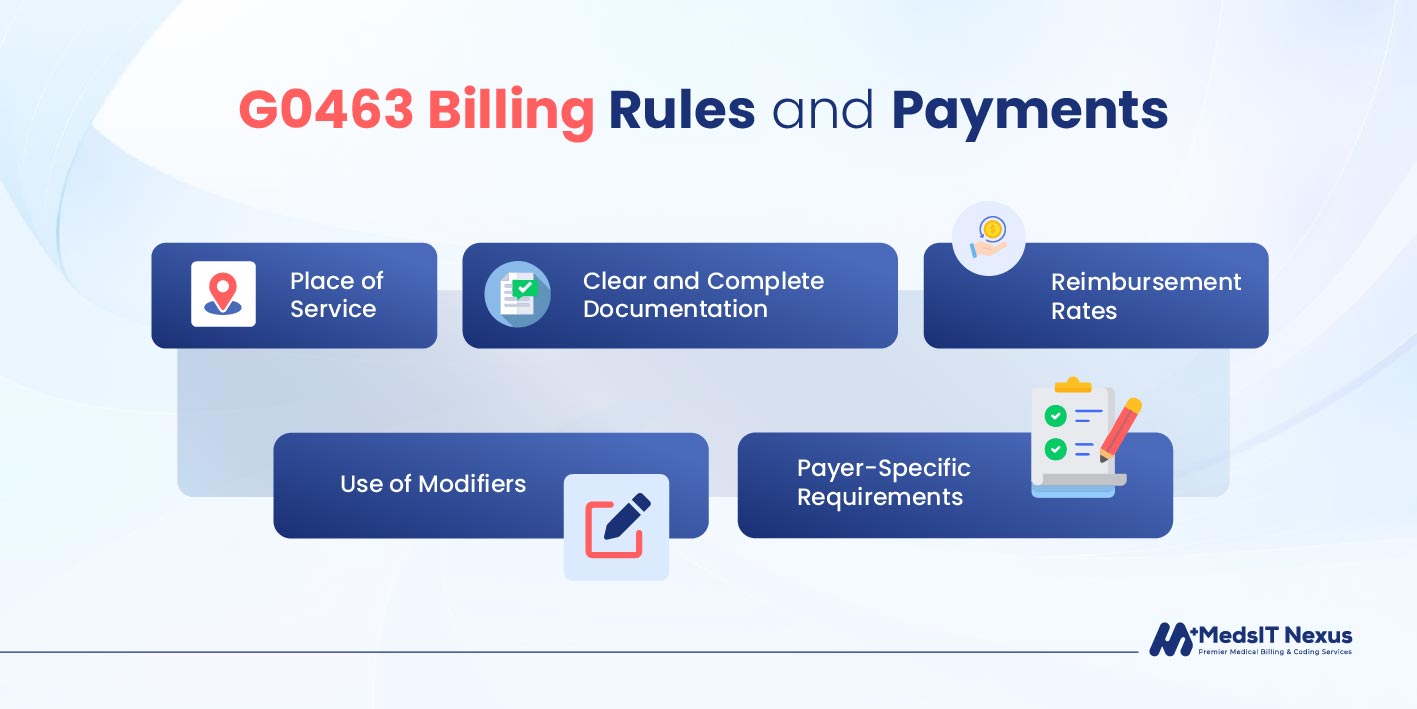
It is important to adhere to the rules of Medicare and insurance billing in order to use the G0463 code appropriately. Since this code has a direct impact on reimbursement, even minor errors may result in claims reimbursement or delay of payment. The following are the most significant billing rules that providers need to be familiar with:
Place of Service
G0463 is applicable to services that are given in a hospital outpatient environment only. It is not billable in an inpatient hospital setting or regular physician office visits. Application in an inappropriate environment may lead to claims being rejected.
Clear and Complete Documentation
Well-documented records are mandatory. The medical record should be clear on the reason why the visit was medically necessary, the condition of the patient, and the services supplied. In the absence of detailed notes, the payers might doubt the claim and refuse to pay.
Reimbursement Rates
The average cost of a G0463 payment is normally more than an average office visit since the cost of operation in the hospital outpatient facilities is more expensive. Reimbursement amounts are based on Medicare’s payment structure and may change over time, so providers must stay updated on current rates and policy adjustments.
Use of Modifiers
In some contexts, like telehealth visits, particular modifiers could be necessary to indicate the nature of the service provided. Using the right modifier will help to describe the claim as the duly given care and avoid problems in its processing.
Payer-Specific Requirements
Although Medicare imposes general rules, other insurance firms might include more rules. Avoid unnecessary losses caused by unforeseen denials or lessened payments by providers. Payers have policies that are specific to the provider. This must be checked always.
Following these billing guidelines helps healthcare organizations remain compliant, minimize errors, and strengthen their revenue cycle. Medical billing is also one of the facilities that are being outsourced to professionals. Through outsourcing, the administrative workload can be decreased, the accuracy of claims can be enhanced, and reimbursement can be quickened so that the providers are able to concentrate more on patient treatment and less on the intricate billing practices.
Common Challenges and Smart Solutions for G0463 Billing
It may be difficult to bill the G0463 code when providers do not pay attention to documentation and coding regulations. One of the biggest reasons for claim denials is incomplete or unclear medical records. Unless the visit is well captured, such as the status of the patient and services given, the insurers might not pay. To avoid this, the healthcare facilities are advised to keep proper records and conduct internal audits regularly to identify mistakes in the early stages.
The other problem is applying the code in an inappropriate context. Because G0463 is used only in outpatient visits in hospitals, its misuse can result in denied claims or slow payments. Staff training about appropriate coding practices can mitigate such errors.
Changes in Medicare and insurance reimbursement policies may be confusing, too, as they are often altered. Providers need to keep up with the changes in policies to make sure that claims are filed in the right way. Telehealth services have also created an additional complexity issue, as certain rules and modifiers can be in effect. Moreover, billing issues are frequent causes of problems in cases of improper bundling or submission of non-covered services.
To overcome these challenges, healthcare organizations should adopt practical best practices:
-
Offer training on coding and billing to staff
-
Remain informed on Payers and Medicare
-
Reliable coding and billing software (coding) will help minimize mistakes
-
Carry out regular claim review and compliance audit
These measures enhance not only the accuracy of bills but also patient trust. Research indicates that a significant number of patients are not certain that their health care bills are accurate, and billing mistakes are a major cause of insurance claims. Providers will be able to decrease denials and enhance patient confidence by enhancing transparency and accuracy.
Conclusion
G0463 CPT code is an important aspect of hospital outpatient billing. It is relevant in that healthcare providers are reimbursed appropriately in terms of evaluation and management services offered in outpatient care. Knowing how and when to utilize it, such as regular visits, the management of chronic conditions, follow-ups, and telehealth, enables the facilities to enhance compliance and financial performance.
Adherence to billing best practices, ensuring well-documented records, and remaining mindful of rules unique to payers are all important measures in minimizing denials and enhancing revenue cycle efficiency. Meanwhile, errors in coding could be significantly reduced by investing in personnel education and new billing tools.
Ultimately, the art of mastering G0463 is not simply a matter of being paid right. It facilitates easier operations and enables healthcare providers to concentrate on the most important aspect, which is to provide high-quality care to their patients. By focusing on accuracy, transparency, and continuous learning, healthcare organizations can establish stronger financial standing and sustainability.
FAQs
1. What is CPT Code G0463 used for?
G0463 is used to bill hospital outpatient clinic visits for evaluation and management services.
2. Who can bill CPT code G0463?
CPT code G0463 can be billed only by hospital outpatient departments, including critical access hospitals, for qualifying outpatient clinic visits.
3. Does G0463 cover telehealth visits?
Yes, it can be used for eligible telehealth services if Medicare guidelines are met.
4. Why do claims for G0463 get denied?
Most denials happen due to poor documentation, incorrect place of service, or missing modifiers.
5. Is G0463 CPT code reimbursement higher than a regular office visit?
Yes, it is generally higher because hospital outpatient facilities have greater operational costs.
Table of Contents

Services
- Medical Audit Services
- Medical Billing Services
- Medical Credentialing Services
- Medical Coding Services
- Accounts Receivable Management
- Medical Insurance Verification
- Denial Menagement Services
Who we serve
- Private Practices
- Small Practices
- Hospitals & Healthcare
- Physicians
- Medical Equipment
- Outpatient Facilities
Get in Touch
Let's start talking about getting you credentialed
Related Posts
New Patient Visit CPT Codes in Urgent Care Billing