Calculate Your Savings


ICD-10-CM Code for Leukocytosis - D72.829 Code Guide
ICD-10 Code for Leukocytosis: A Comprehensive Guide
Medical coding needs precision. Administrative difficulties, delayed payments, and claim denials can result from a single missing code. Documenting a high white blood cell count, or leukocytosis, is a typical source of confusion. A practice's revenue cycle may be disrupted if this finding is reported incorrectly.
This tutorial provides a clear and easy explanation of the ICD 10 code for leukocytosis. Based on clinical data, we will explain leukocytosis, which codes to use, and how to apply them appropriately. Medical billers and coders can use this information to increase accuracy, lower claim rejection rates, and guarantee appropriate compensation.
Key Takeaways:
-
D72.829 is the primary ICD-10 code for leukocytosis and should be used only when a high white blood cell count is clinically significant, but the cause or specific cell type is not yet identified.
-
Always code the underlying condition first (such as infection, inflammation, or malignancy) when leukocytosis is reactive or secondary; leukocytosis should only be added if it affects patient management.
-
Use the most specific ICD-10 code available when documentation identifies a subtype (e.g., neutrophilic, chronic, or reactive leukocytosis) to reduce claim denials and improve reimbursement accuracy.
Why is leukocytosis important, and what is it?
In simple terms, leukocytosis is the medical name for a high white blood cell (WBC) count. The body uses white blood cells to combat infections. Sudden Increases in their quantity indicate that the body is reacting to an injury, inflammation, or infection.
While leukocytosis itself is a lab-based finding and not an illness, it is a critical signal. A clinician studies this discovery to determine the underlying cause, which could be anything from a minor infection to a more serious illness like leukemia. Medical coders must comprehend this background. Choosing a code that appropriately represents the provider's diagnostic procedure is the aim.
The Primary Code for Unspecified Leukocytosis: D72.829
D72.829 is used as the most common ICD 10 code for leukocytosis. It means "Elevated white blood cell count, unspecified."
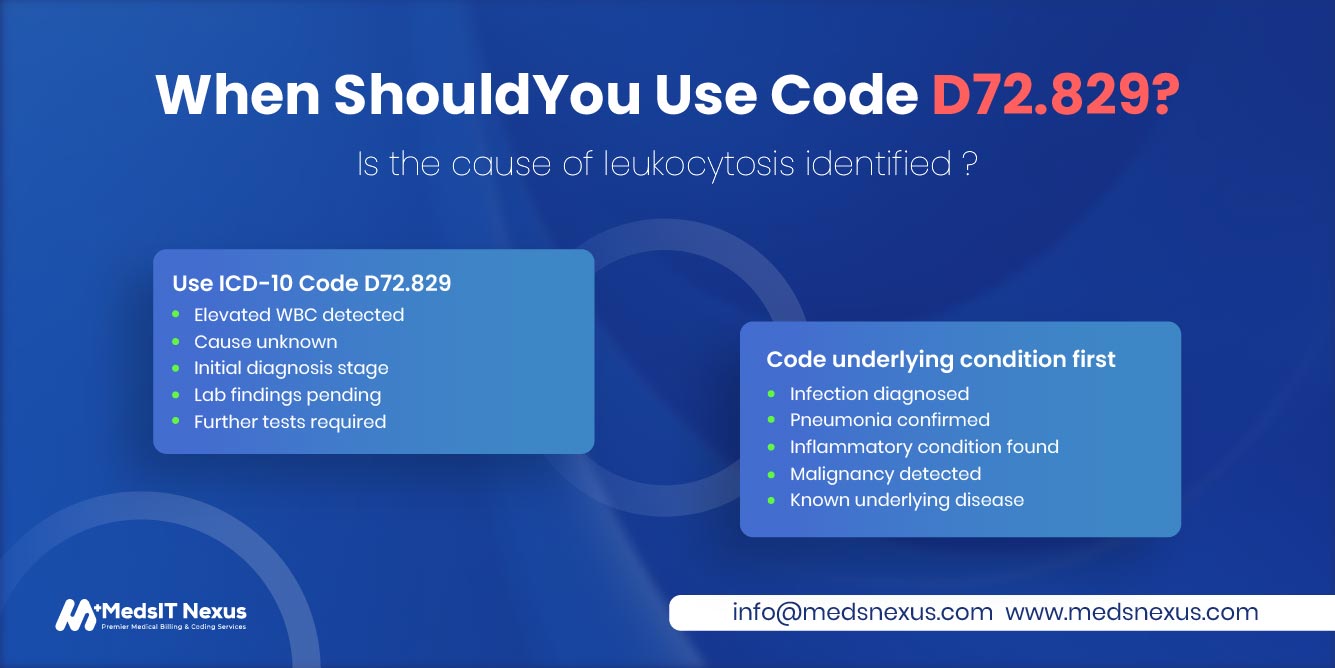
This code is used when:
-
A lab test shows that the number of white blood cells is high.
-
The doctor wrote down that the result was clinically significant.
-
The exact type of white blood cell that is causing the rise has not been found or recorded.
-
The main reason for the high white blood cell count has not been found yet.
Think of D72.829 leukocytosis as a starting point. It is appropriate for initial encounters where the patient presents with an elevated WBC count, and further investigation is needed.
When Not to Use D72.829
Using D72.829 incorrectly is a frequent cause of claim denials. This code should not be used if the leukocytosis is linked to a definitive diagnosis.
For example, if a patient is diagnosed with pneumonia and also has a high WBC count, the pneumonia is the primary diagnosis. The leukocytosis is a symptom or clinical sign of pneumonia. In this case, you would code for pneumonia first. The leukocytosis ICD 10 code would be secondary, if it is coded at all, as it is considered integral to the primary diagnosis.
Always code the underlying condition first if it has been identified. This provides a more complete and accurate picture of the patient's health status.
Related ICD-10 Codes for Leukocytosis
When the specific type of white blood cell increase is identified, it’s important to use the most accurate ICD-10 code. The table below outlines related codes that may be used instead of D72.829 when more detail is available from clinical documentation.
|
ICD-10 Code |
Description |
Use Case |
|
D72.820 |
Lymphocytosis (symptomatic) |
Used when elevated lymphocytes are the main abnormal finding |
|
D72.821 |
Monocytosis (symptomatic) |
Applies when monocytes are elevated beyond the normal range |
|
D72.822 |
Plasmacytosis |
Used for an abnormal increase in plasma cells |
|
D72.823 |
Leukemoid reaction |
Indicates a marked increase in white cells, often mimicking leukemia |
|
D72.824 |
Basophilia |
Used when basophil counts are abnormally high |
|
D72.825 |
Bandemia |
Applicable when there is an increase in band neutrophils |
|
D72.828 |
Other elevated white blood cell count |
Used when the elevation is known but doesn’t fall into a listed subtype |
|
D72.82 |
Elevated white blood cell count |
Parent category for all specific leukocytosis codes |
Understanding Reactive and Chronic Leukocytosis Coding
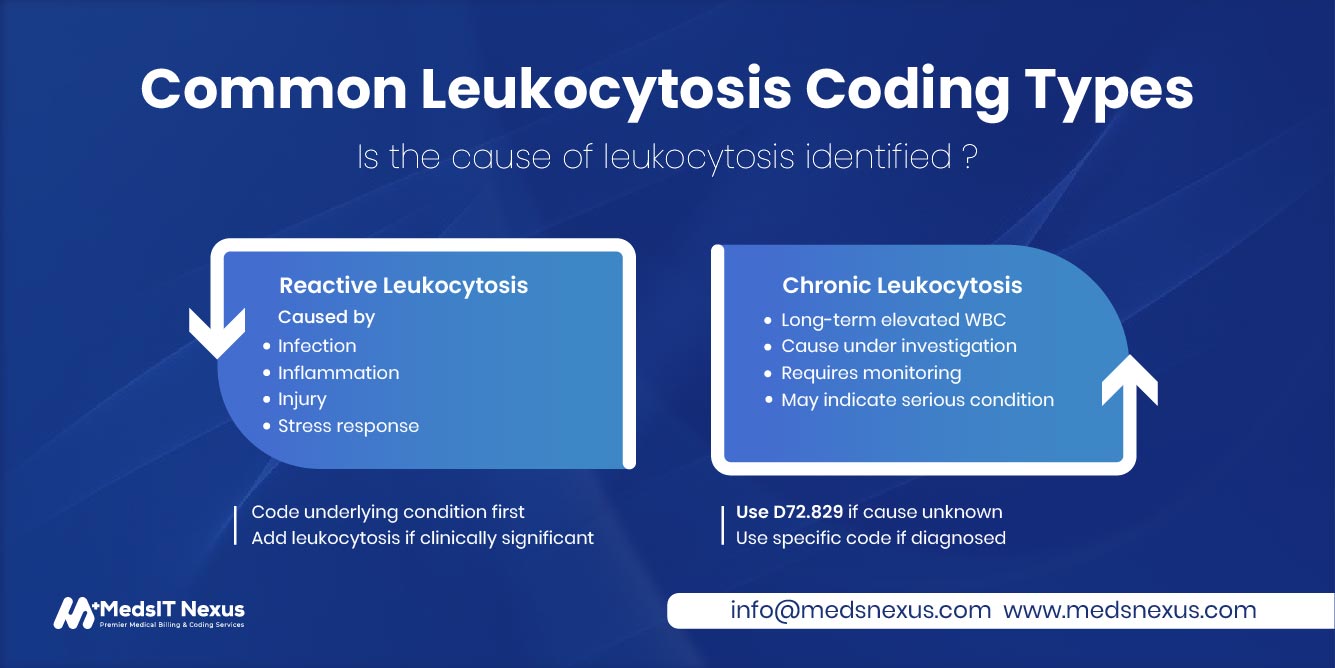
Clinical documentation may also describe the nature of the leukocytosis, which can impact coding.
Reactive Leukocytosis ICD 10
Reactive leukocytosis means the high WBC count is a reaction to another condition, such as an infection, inflammation, or even stress.
It is the body's normal response. When coding for reactive leukocytosis icd 10, the primary diagnosis should be the condition causing the reaction. For instance, if a patient had an abscess and reactive leukocytosis, you would code the abscess first.
Chronic Leukocytosis ICD 10
Chronic leukocytosis means having a high white blood cell count for a long time. This frequently means that more tests need to be done to rule out serious underlying illnesses, such as bone marrow abnormalities.
If the reason for chronic leukocytosis icd 10 is still uncertain after the first evaluation, D72.829 can be utilized. If a cause is found, like chronic myelogenous leukemia, that exact diagnosis code must be utilized.
Correct coding is not only about having claims paid; it's also about telling the patient's narrative correctly. If you want to improve your billing procedures, working with professionals in Comprehensive Revenue Cycle Management Services will make sure that every claim is clean and follows the rules.
The basis of correct code is proper documentation. The provider's notes must make it clear why the high WBC count is important for the patient's health. Without this, the payer might turn down the claim since it wasn't medically necessary. One of the best things about using simplified medical billing solutions is that they make this workflow better.
Helpful Tips for Using Leukocytosis Codes in Medical Billing
Using leukocytosis codes appropriately can help claims go through more quickly and cut down on denials. Here are some useful tips for billing:
-
Always begin with accurate documentation:
Check that the provider has supplied clinical facts before using any code linked to leukocytosis. This should cover lab results (high WBC count), the patient's symptoms, and notes on whether the elevated count is linked to a specific diagnosis.
-
Use the most specific code available:
If the chart notes show what kind of white blood cell is high (such as neutrophils or lymphocytes), use the ICD-10 code that matches it instead of D72.829.
-
Sequence codes properly:
If leukocytosis is secondary to another condition (such as an infection or malignancy), list the primary diagnosis first, then add the leukocytosis code if it adds value to the claim.
-
Watch for medical necessity:
Include leukocytosis as a billable diagnosis only if it is being actively addressed or impacts management. For example, if follow-up tests or treatments are added because of it.
-
Avoid coding errors and common pitfalls:
-
Do not use D72.829 if the elevated count can be explained by another, already coded diagnosis.
-
Do not automatically code every high WBC result; only code when it is clinically significant per the provider's notes.
-
Double-check for missing lab references; claims often get denied if the coding is not backed by lab data.
Example:
A patient comes in with a fever and a high WBC count. The doctor diagnoses pneumonia. Correct billing would list pneumonia as the primary code. Only use the ICD 10 code for leukocytosis if the elevated count leads to additional management steps.
By following these steps, medical billers and coders can make sure leukocytosis codes are applied where appropriate, claims are supported by strong documentation, and avoid unnecessary payment delays.
Final thoughts
The clinical record is the only thing that can tell you what the right icd 10 leukocytosis code is.
That said, Leukocytosis D72 829 is the code to use when there isn't a clear cause, but it's important to utilize more specific codes when they are available. Always make sure to code the proven underlying disease first.
Only use the leukocytosis code when it is a clinically important finding with no known cause. Medical coders can avoid denials, make sure their bills are accurate, and help their practice's finances by following these rules.
Frequently Asked Questions (FAQs)
Q1. What is the primary ICD 10 code for leukocytosis?
Ans. The primary code for an unspecified high white blood cell count is D72.829. This code should be used when the cause of the leukocytosis icd 10 is not yet determined but is clinically significant.
Q2. How do I code for neutrophilic leukocytosis icd 10?
Ans. For neutrophilia, or neutrophilic leukocytosis, the appropriate code is often D72.828, which stands for "Other elevated white blood cell count." This code specifies that a particular type of WBC is elevated, making it more precise than the unspecified D72.829.
Q3. What does D72.829 leukocytosis mean in medical billing?
Ans. In medical billing, d72.829 leukocytosis indicates that the patient has a high white blood cell count of unknown origin. This code is billable and can be used as a primary diagnosis if it is the main reason for the patient encounter and requires further investigation.
Q4. When should I use the code for reactive leukocytosis icd 10?
Ans. When your white blood cell count is elevated because of another condition, it's called "reactive leukocytosis." You should use the underlying ailment (such as an illness or trauma) as the main diagnosis. The leukocytosis is a related finding, not the main concern.
Q5. Can I use a code for chronic leukocytosis icd 10?
Ans. Yes. If a patient has a long-term elevated WBC count and the cause is still unknown, you may use D72.829. However, if a chronic condition like a myeloproliferative neoplasm is diagnosed as the cause, you must use the specific code for that disorder.
Table of Contents

Services
- Medical Audit Services
- Medical Billing Services
- Medical Credentialing Services
- Medical Coding Services
- Accounts Receivable Management
- Medical Insurance Verification
- Denial Menagement Services
Who we serve
- Private Practices
- Small Practices
- Hospitals & Healthcare
- Physicians
- Medical Equipment
- Outpatient Facilities
Get in Touch
Let's start talking about getting you credentialed