Calculate Your Savings


Right Hand Pain ICD-10 Code M79.641 Guide & Billing Tips
Right-hand pain is one of the most common symptoms documented in modern-day medical practices. Due to this, accurately coding the medical procedure is absolutely critical for a clean claim and payment reimbursement.
To reflect this crucial standard of accuracy in claims, most practices approach this by relying on the right hand pain ICD 10 code.
While the code itself seems simple, not using it the right way can cause some difficult hurdles in the way of clean reimbursement. Many practices face denials or delayed payments because the code was applied at the wrong time or without proper documentation. This mainly happens when teams are unsure of how symptom-based coding works.
This guide has all the information you’ll need for approaching this scenario the right way and understanding what you should and shouldn’t do. We explain what the right hand pain ICD 10 code means, when to use M79.641, when not to use it, and how to support it with the right documentation so claims move forward without any issues coming your way.
Key-Takeaways
-
M79.641 is a symptom-based ICD-10 code used only when right hand pain is present without a confirmed diagnosis.
-
The code is most appropriate during initial visits, while testing, imaging, or evaluations are still in progress.
-
Once a specific condition is diagnosed, M79.641 must be replaced with the diagnosis-specific ICD-10 code to avoid denials.
-
Laterality matters; right, left, and unspecified hand pain each requires different codes, and documentation must match the claim.
-
Clear, detailed provider documentation is essential to support medical necessity and justify symptom-based coding.
-
Common errors like reusing M79.641 after diagnosis or missing laterality frequently lead to delayed or denied payments.
-
Accurate, timely code updates improve claim acceptance, reduce audit risk, and keep the revenue cycle moving smoothly.
What the Right Hand Pain ICD 10 Code Represents
The right hand pain ICD 10 code is basically a symptom code. This means that it is used when a patient reports pain, but the provider has not yet confirmed a specific diagnosis. In ICD-10-CM, symptoms are coded when they are the main reason for the visit.
Laterality is a key part of ICD-10. That is why right-hand pain, left-hand pain, and unspecified hand pain each have different codes. Payers expect this level of detail because it helps them understand the patient’s condition with clarity and ease.
We see this code used most often during initial visits. At this stage, the provider may still be evaluating the cause of the pain. Using the correct symptom code allows care to begin without delaying your billing.
Understanding ICD-10 Code M79.641 for Right Hand Pain
M79.641 falls under the ICD-10 category for other soft tissue disorders. In simple terms, it represents pain in the right hand when no specific reason has been identified yet.
The code icd m79 641 is widely accepted by payers when used correctly. It signals that the provider is aware of the symptom and is actively evaluating it. This is especially common when imaging, lab work, or specialist referrals are still pending.
The m79 641 diagnosis code should only be used when pain is the primary finding. Once a confirmed condition is identified, the symptom code should be replaced with a diagnosis-specific code.
When to Use ICD-10 Code for Right Hand Pain (M79.641)
Appropriate Clinical Scenarios
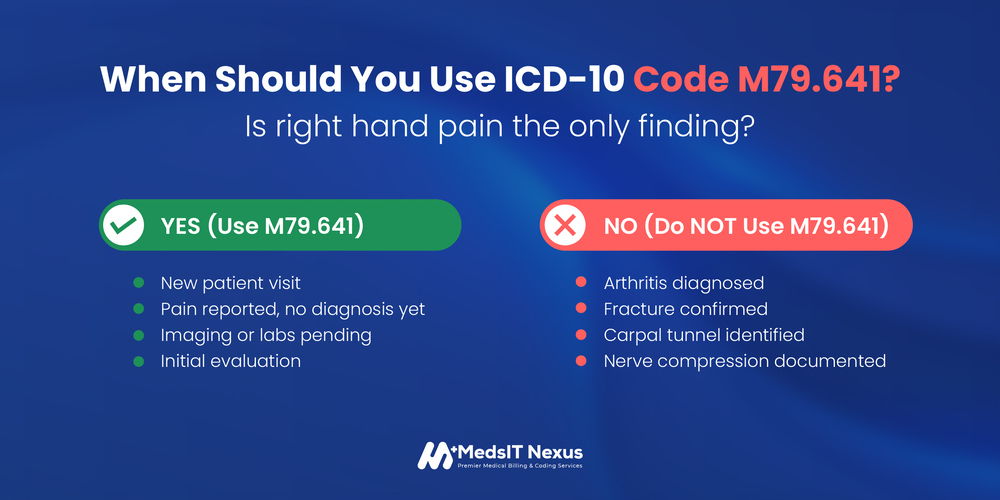
The right hand pain ICD 10 code is deemed accurate to be used in several common circumstances. These include new patient visits for hand pain, injuries, or mild inflammation in which imaging results are not yet available.
Providers often use M79.641 during the early stages of care. For example, a patient may arrive with soreness after repetitive work-related activities. At this point, the provider may document pain but not yet confirm tendonitis or arthritis, as it could be any of the two.
Why M79.641 Is Often Used Early in Care
Using the m79 641 diagnosis code early allows providers to treat the patient while continuing the diagnostic process. It also supports medical necessity, showing that care was required based on reported symptoms.
From a billing perspective, this prevents delays. Claims can be submitted without waiting for a final diagnosis, as long as the documentation supports the symptom.
When Not to Use M79.641
Confirmed Conditions That Require a Different Code
Once a diagnosis is completed, M79.641 should no longer be relied upon under any given circumstance. This is because illnesses or conditions like arthritis, fractures, nerve compression, or carpal tunnel syndrome all have their own ICD-10 codes that are used if any of these are diagnosed by the practitioner.
Continuing to use the right hand pain ICD 10 code after a diagnosis is completed is a common error made by many practitioners. Payers expect coding to evolve as clinical information becomes clearer and moves closer to the root of the problem.
Why Using M79.641 After Diagnosis Causes Denials
When documentation shows a confirmed condition, but the claim still uses icd m79 641, payers may deny the claim. This is because symptom codes are considered incomplete once a diagnosis exists.
We often get to see denials that are tied directly to this mismatch between documentation and coding. Hence, updating the code at the right time is critical for clean and accurate claims.
Quick Reference Table: ICD-10 Codes for Hand and Finger Pain
Choosing the correct code depends on location and specificity. The table below helps clarify when M79.641 is appropriate and when another code may be a better fit.
|
ICD-10 Code |
Description |
When to Use |
|
M79.641 |
Pain in the right hand |
General or soft-tissue pain in the right hand, no confirmed cause |
|
M79.642 |
Pain in the left hand |
General or soft-tissue pain in the left hand |
|
M79.643 |
Pain in the unspecified hand |
When laterality is not documented |
|
M79.644 |
Pain in the right finger(s) |
Pain is limited to one or more right fingers |
|
M79.645 |
Pain in the left finger(s) |
Pain is limited to one or more left fingers |
|
M79.646 |
Pain in unspecified finger(s) |
Finger pain with missing laterality |
|
M25.541 |
Pain in the joints of the right hand |
Pain localised to the right-hand joint |
|
M25.542 |
Pain in the joints of the left hand |
Pain localised to a left-hand joint |
|
M25.549 |
Pain in the joints of the unspecified hand |
Joint pain without laterality |
Using the closest code instead of the most accurate one increases audit risk. Clear documentation helps avoid this.
Documentation Requirements to Support M79.641
Strong documentation is essential when using the right hand pain ICD 10 code. Provider notes should clearly state that the pain is located in the right hand. The duration, severity, and impact on daily activities should also be included.
Documentation should also indicate that no confirmed diagnosis has been made yet. This supports the use of M79.641 as a symptom-based code.
When documentation is complete, payers are far less likely to question the claim. Clear notes protect both reimbursement and compliance.
Common Coding Mistakes With the M79 641 Diagnosis Code
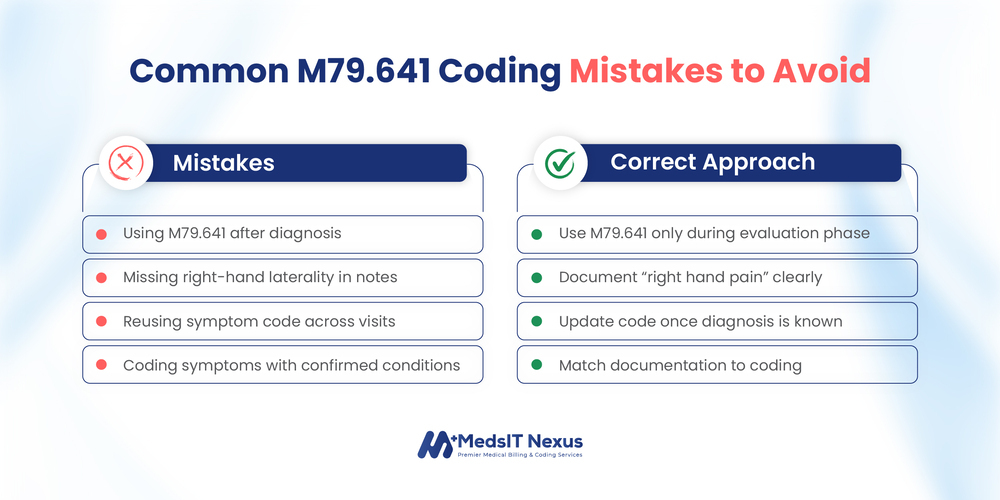
One mistake made frequently is reusing M79.641 across multiple visits without reviewing updated clinical records.
Another is missing laterality in the provider note while still billing the right-sided code.
Some claims also fail because symptom codes are used alongside confirmed diagnoses. These errors may seem small, but they often lead to denials or payment delays.
Regularly analysing coding reviews and partnering with professional medical coding services helps catch these issues early on.
Checklist: How MedsIT Nexus Helps Ensure Accurate Coding for Right Hand Pain
- Reviews claims for the correct use of the right hand pain ICD 10 code.
- Confirms documentation supports M79.641.
- Identifies when diagnosis codes should replace symptom codes.
- Prevents denials caused by laterality errors.
- Maintains consistency across clinical and billing records.
Conclusion
The right hand pain ICD 10 code plays a crucial role in both early patient care and billing.
When used correctly, M79.641 enables providers to treat their patients without delay while also maintaining clean claims and prompt reimbursements.
The key here is going for timing, accuracy, and documentation. Use the code when pain is the only finding of the diagnosis process, and the diagnosis hasn’t been completed yet. Make sure you update it afterwards, that is, once a diagnosis has been confirmed.
With the correct approach to this scenario, practices can not only reduce their chances of denials but also speed up their payments in their payment cycle and maintain their revenue cycle management smoothly and reliably.
Frequently Asked Questions
Q. Can I bill M79.641 if the patient already has diagnosed arthritis in their right hand?
A. No. Once arthritis is confirmed, you must use the specific arthritis code instead of M79.641. Using the symptom code after diagnosis will likely result in claim denials since payers expect coding to reflect the confirmed condition.
Q. What happens if my provider note says "hand pain" without specifying right or left?
A. You should use M79.643 (pain in unspecified hand) instead of M79.641. Billing the right-sided code without documented laterality creates a mismatch between your claim and clinical notes, which increases audit risk and potential denials.
Q. How many follow-up visits can I use M79.641 before it becomes a problem?
A. There's no fixed limit, but you should update the code as soon as diagnostic testing reveals a specific condition. If you're still using M79.641 after multiple visits with completed imaging or lab work showing a diagnosis, payers will likely deny those claims as improperly coded.
Q. Can I use M79.641 and a joint pain code like M25.541 on the same claim?
A. Not for the same hand. If the pain is clearly joint-related, use M25.541 (pain in joints of the right hand) instead. Using both codes suggests uncertainty in documentation and may trigger payer scrutiny or denials.
Q. Does M79.641 cover finger pain or just the hand itself?
A. M79.641 is specifically for hand pain. If the pain is isolated to fingers, use M79.644 (pain in right finger[s]) instead. Using the wrong anatomical code, even on the same side, can result in claim rejections.
Table of Contents

Services
- Medical Audit Services
- Medical Billing Services
- Medical Credentialing Services
- Medical Coding Services
- Accounts Receivable Management
- Medical Insurance Verification
- Denial Menagement Services
Who we serve
- Private Practices
- Small Practices
- Hospitals & Healthcare
- Physicians
- Medical Equipment
- Outpatient Facilities
Get in Touch
Let's start talking about getting you credentialed