Calculate Your Savings


Understanding the m54.50 Diagnosis Code: A Complete Guide
Understanding the m54.50 Diagnosis Code: A Simple Guide for Patients
Ever seen a medical bill or doctor’s note and felt as though you were looking at something written in a foreign language? You may see a bunch of letters and numbers, such as “M54.50," and you wonder just how it relates to your health and your wallet.
It’s a common frustration. You’re already struggling with back pain, and now you have to figure out a complicated billing system so that you can understand your own medical records.
Our goal is to clear up any confusion through this complete guide that covers the m54.50 code description, the reasoning of your doctor, and all the information that this code carries to your coverage.
Key Takeaways:
-
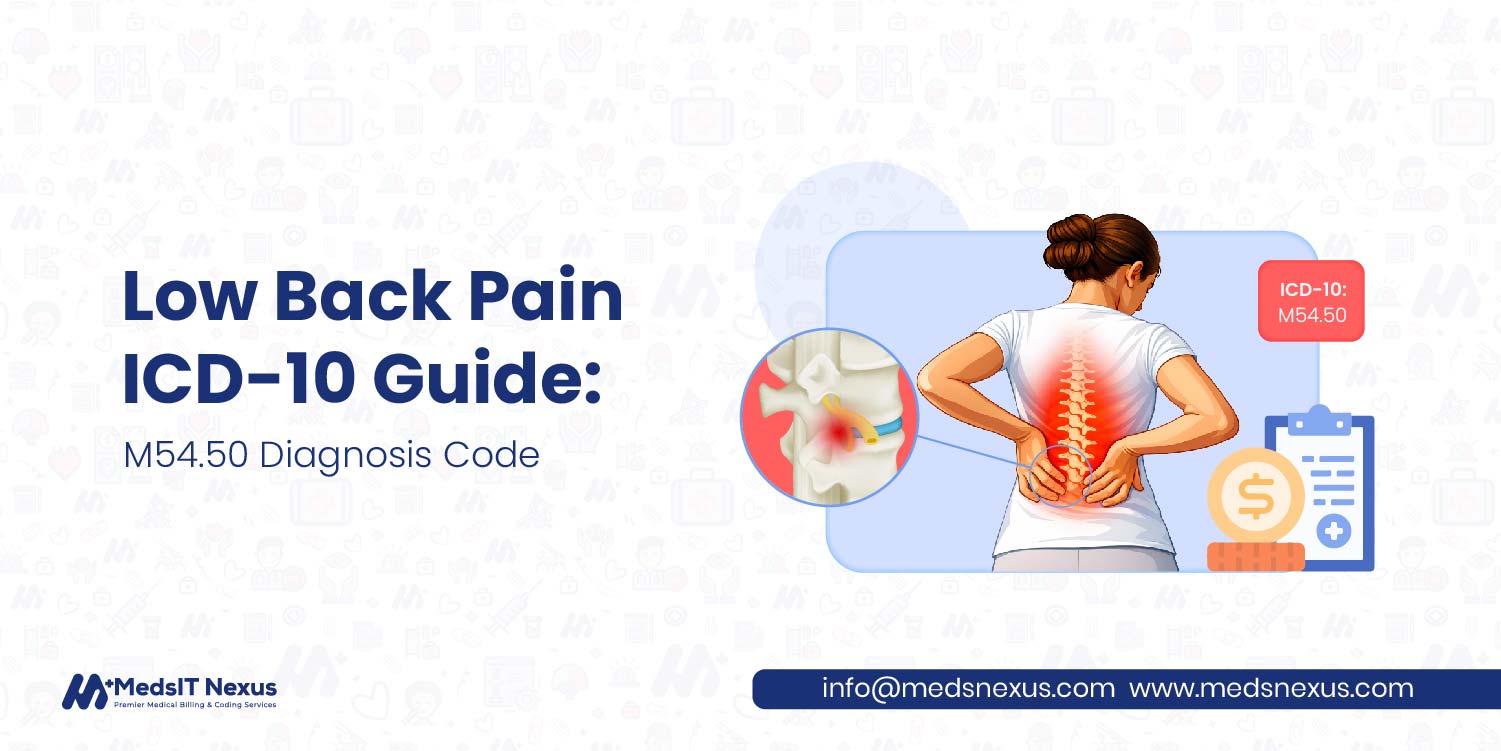
M54.50 Code Explained: The M54.50 diagnosis code refers to "Low back pain, unspecified," meaning the pain is in the lumbar (lower back) region, but the exact cause is not yet determined.
-
Common Use in Healthcare: M54.50 is a frequently used code for low back pain, commonly appearing in medical records and insurance claims for patients with undiagnosed lower back pain.
-
Role in Insurance and Billing: This code helps insurance companies determine coverage for treatments like physical therapy and X-rays, as it's used to justify medical procedures for low back pain.
-
Unspecified Doesn't Mean Unknown: The term "unspecified" in the m54.50 code simply means the exact cause of pain hasn't been identified yet, not that the issue is unknown or untreatable.
-
Primary or Secondary Diagnosis: The m54.50 code can be used as either a primary or secondary diagnosis, depending on the reason for the doctor's visit (e.g., an injury or general back pain).
-
Not for All Types of Back Pain: This code isn't used for all types of back pain. Specific conditions like sciatica or herniated discs require different codes for accurate diagnosis and treatment.
-
Impact on Insurance Coverage: While m54.50 is generally accepted for initial visits and basic treatments, insurance companies may limit long-term coverage until a more specific diagnosis code is provided.
What’s the m54.50 Diagnosis Code Description?
Let's begin with the fundamentals. In the medical field, hospitals and physicians use an established method to monitor illnesses and medical conditions. ICD-10 is the name of this system. Each illness, injury, or symptom has a unique code.
The m54.50 diagnosis code description specifically refers to "Low back pain, unspecified."
When you read this code, it really just means pain in the lower back, where we haven’t quite figured out the cause yet OR doesn't fit into a more particular category.
That’s the clinical way of saying, we’ve documented that you are in pain in one corner of your lower back, without saying it is a fracture, a slipped disc, or an exact type of nerve problem at this early stage.
This code is incredibly common. Because back pain is one of the leading reasons people visit the doctor, M54.50 appears on thousands of medical claims every single day. It serves as a universal label that tells insurance providers, "This patient has pain in the lumbar region."
Why Do Doctors Use Codes Like m54.50?
You may be thinking, “Why can’t my doctor just say ‘back pain’ on my chart? It all just comes down to organization and billing.
Healthcare is a multi-million-dollar claims industry. To manage this volume, they need a lingua franca. The diagnosis code m54.50 is something that both computers and clinicians can understand.
-
Billing and Insurance: Insurance companies that offer both billing and insurance use codes to determine if they will pay for your visit. If a physician prescribes an X-ray for your back, they have to justify it with a code like m54.50. If they chose a code for a headache, the insurance company would probably refuse to pay for the back X-ray.
-
Tracking Health Trends: These codes help researchers understand how common certain conditions are. By tracking how often the m54.50 diagnosis code is used, public health officials can see that low back pain is a major health issue affecting the population.
-
Medical Records: Change doctors and new doctor can look at your codes, instantly know your medical history without having to read pages of handwritten notes.
What is Diagnosis Code m54.50?
You can break the code down and make sense of what the diagnosis code m54.50 means.
-
M: This letter designates the section in the disease classification system. M: musculoskeletal and connective tissue diseases. This means it’s the result of muscles, bones, or joints.
-
54: This is the condition number. In this instance, ‘54’ stands for Dorsalgia, fancy medical jargon for back pain.
-
5: This number narrows the site. The "5" here points to the lower back region.
-
0: This final digit indicates "unspecified." This means the exact spot in the lower back isn't defined in the code.
|
Code Part |
What It Stands For |
What It Means for You |
|
M |
Musculoskeletal system |
This letter designates the section in the disease classification system. M = Musculoskeletal and connective tissue diseases. This means it’s the result of muscles, bones, or joints. |
|
54 |
Dorsalgia (back pain) |
This is the condition number. In this instance, ‘54’ stands for Dorsalgia, fancy medical jargon for back pain. |
|
5 |
Low back (lumbar region) |
This number narrows the site. The "5" here points to the lower back region. |
|
0 |
Unspecified |
This final digit indicates "unspecified." This means the exact spot in the lower back isn't defined in the code. |
So, when you put it all together, the M54.50 diagnosis code tells the story of a musculoskeletal issue located in the lower back, defined generally as pain.
Can m54.50 be a Primary Diagnosis Code?
A common question patients ask is: Can m54.50 be a primary diagnosis code? The short answer is yes.
A "primary diagnosis" is the main reason you sought medical attention during that specific visit. If you woke up with a stiff, aching back and went to urgent care, your primary reason for being there is the pain itself. In this scenario, the doctor would list M54.50 as the primary code.
However, sometimes it is a secondary code. For example, if you were in a car accident and suffered a fracture, the fracture would be the primary code. The low back pain might be listed secondarily to describe your symptoms. But for many general visits to a chiropractor or family doctor, the M54.50 diagnosis code is perfectly acceptable as the main reason for the appointment.
When Is This Code NOT Used?
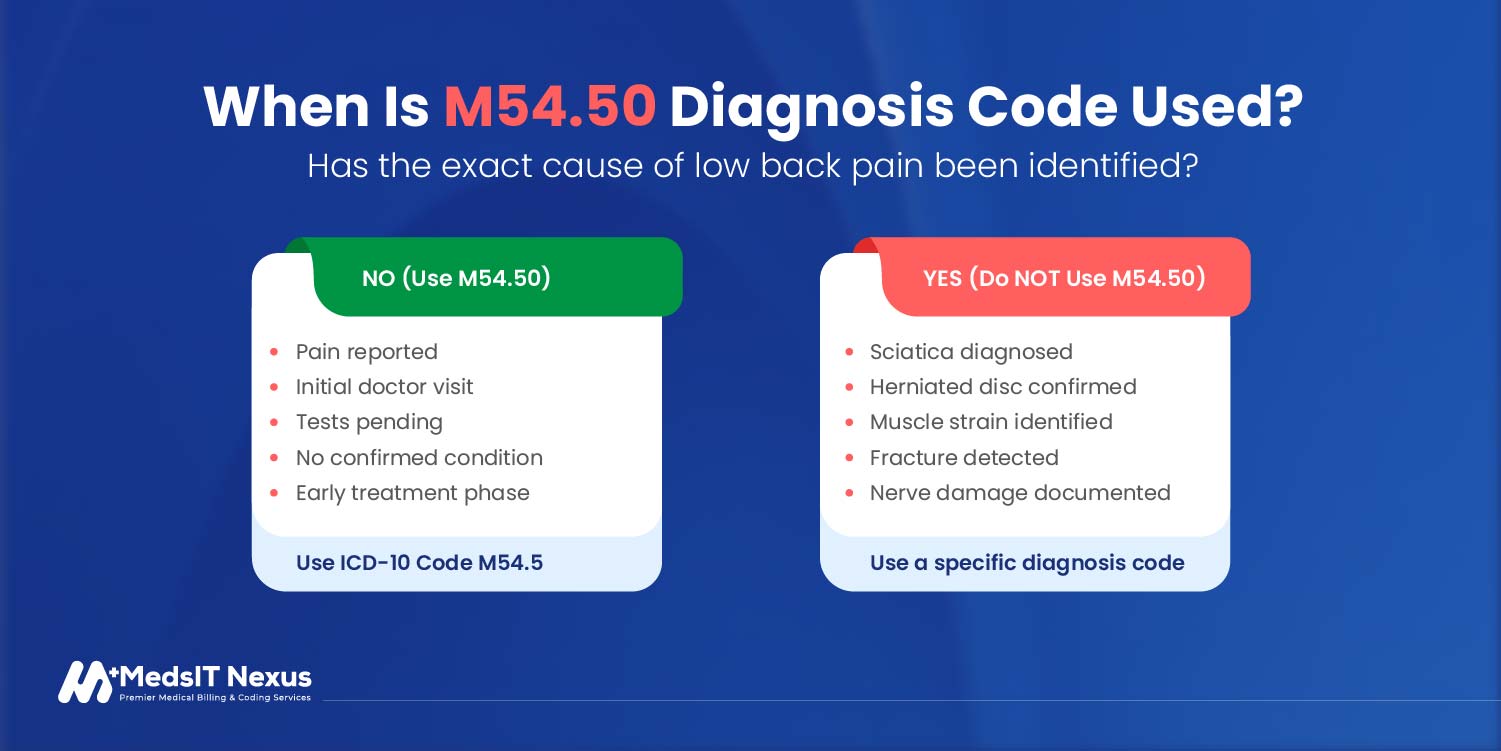
It is important to know that the diagnosis code M54.50 isn't used for every type of back pain. Medical coding is very specific.
If your doctor knows exactly what is causing the pain, they should use a more specific code. For instance:
-
Sciatica: If your pain shoots down your leg due to a pinched nerve, there is a different code for that (usually starting with M54.3 or M54.4).
-
Disc Issues: If an MRI confirms a herniated disc, the doctor will use a code that describes disc displacement.
-
Strains: If you lifted a heavy box and pulled a muscle, the doctor might use a code for a muscle strain (starting with S39).
The m54.50 diagnosis code description implies that the pain is the condition itself, rather than a symptom of a known injury like a fracture. It is often used in the early stages of diagnosis before advanced testing like MRIs or CT scans is done.
Understanding "Unspecified" Low Back Pain
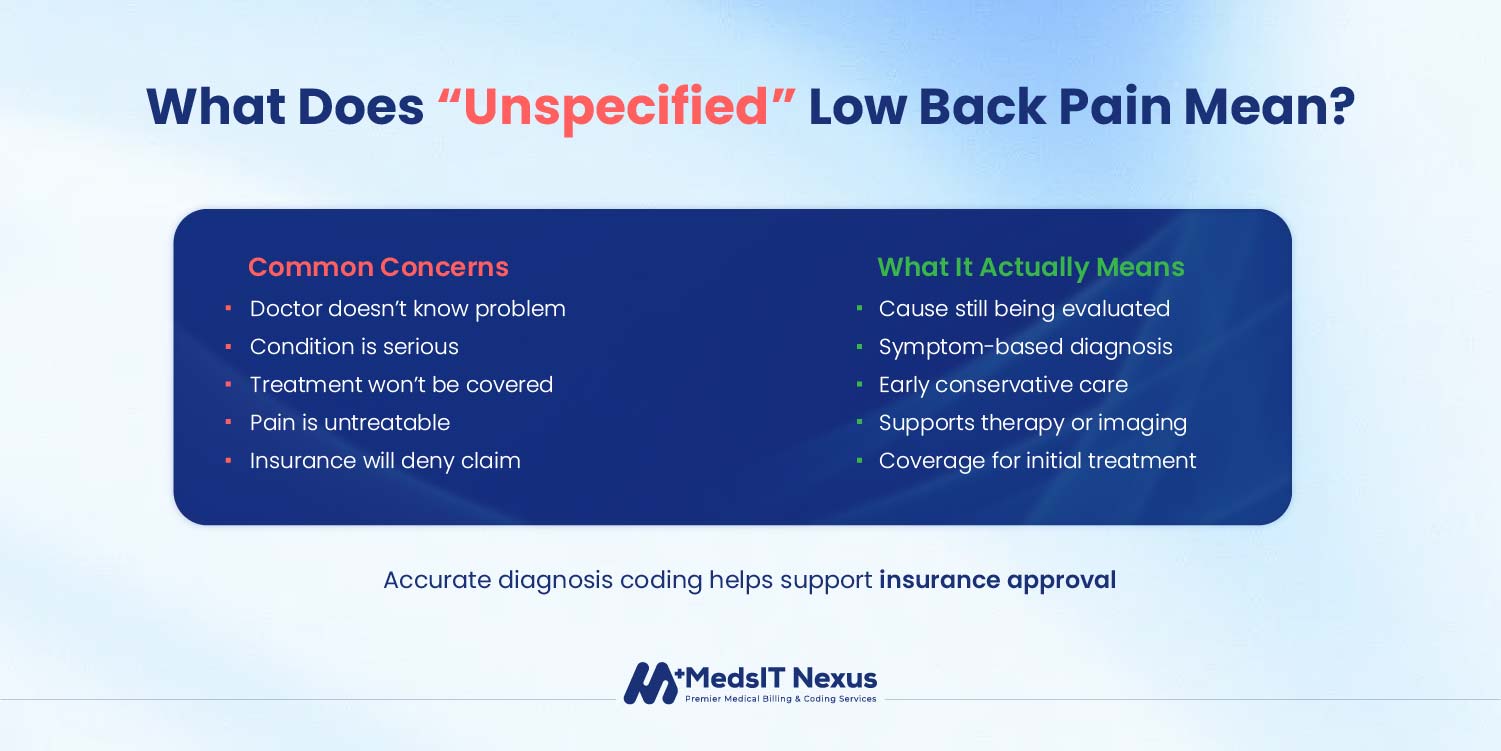
The word "unspecified" in the M54.50 diagnosis code description can sometimes worry patients. It sounds vague, like the doctor doesn't know what is wrong.
Don't panic. "Unspecified" doesn't mean "unknown" or "untreatable." It often just means the doctor is treating the symptom of pain right now. In many cases of back pain, the exact anatomical cause (like a tiny tear in a muscle fiber) isn't visible on a standard exam.
In addition, because low back pain is such a common reason for medical visits, the way it's documented and billed can directly affect whether your insurance covers services like imaging or physical therapy. That’s why accurate coding and medical billing services play an important role in avoiding claim delays or denials.
Doctors often start with conservative treatment for the m54.50 diagnosis code. This might include rest, physical therapy, or over-the-counter medication. If the pain goes away, no further specific coding is needed. "Unspecified" is simply a categorization tool, not a reflection of the quality of your care.
Symptoms Associated with Code m54.50
When the m54.50 diagnosis code is used, they are just writing down whatever you have told them you complained about. You might be experiencing:
-
Dull: A constant ache in the lumbar (lower) back.
-
Stiffness: Difficulty moving or standing up straight after sitting.
-
Localized Pain: Pain that stays in the lower back and doesn't travel far down the legs.
-
Muscle Tension: The feeling that the muscles in your lower back are tight.
If your symptoms change, for example, if you start feeling numbness in your toes, you should tell your doctor. Now your diagnosis might change, from the m54.50 diagnosis code to one that is more specific, related to nerve damage.
Seeing This Code Through The Eyes Of Insurance Companies
A diagnosis code m54.50 is quite common from an insurance carriers stand point. As it is so common, most plans tend to cover initial visits, evaluations, and basic treatments such as chiropractic adjustments or physical therapy sessions.
However, because it is an "unspecified" code, some insurance plans may have limits. They might question long-term treatment if the diagnosis remains "unspecified" for months. Perhaps they feel that, after a reasonable amount of time, the doctor would have treated it or discovered something more specific for which another code is needed.
If you are denied coverage for a treatment, check your paperwork. If the m54.50 diagnosis code is listed for a complex procedure, the insurance company might need a more specific code to justify the cost.
What Should You Do If You See This Code?
If you see the diagnosis code M54.50 on your paperwork, typically, you don’t have to do anything. It's just a routine, systematic part of you being there.
But you can use this information to take your health into your own hands:
-
Double Check: Confirm the code reflects your experience. If you came in for neck pain and are billed under a low back pain code, if it’s not corrected at the billing department level, note it and appeal that aspect of your bill later.
-
Ask Questions: The code can serve as a jumping-off point for discussion. Ask your doctor, "I see we are using the code for unspecified low back pain. "Do we need to do more tests to find out what's wrong, or is the usual treatment enough?"
-
Keep Records: Keep your explanation of benefits (EOB) forms. It can be helpful to know if your back pain was coded the same way before, if it comes back in a year.
Conclusion
Seeing M54.50 on your medical paperwork can feel confusing at first, but it simply refers to unspecified low back pain, one of the most common reasons people visit a doctor. This code helps providers document your symptoms, guide early treatment, and ensure insurance companies understand the purpose of your care.
In most cases, it is a routine and valid diagnosis that supports conservative treatments like rest, physical therapy, and follow-up evaluations. If you ever have questions about how this code affects your coverage or billing, don’t hesitate to ask your healthcare provider or billing team for clarification.
Frequently Asked Questions
Q1. What is the difference between M54.5 and M54.50?
Ans. The medical coding system had an update in October 2021. The old code M54.5 for low back pain was taken out and replaced with a more specific one. Now, providers must use the m54.50 diagnosis code for unspecified low back pain.
Q2. Does the m54.50 diagnosis code mean I have a serious back injury?
Ans. No, not necessarily. The code simply describes the symptom of pain in the lower back. It does not indicate the severity. You might use it for a mild backache you get from sleeping on a bad mattress, or you might use it for serious back pain that prevents you from getting out of bed.
Q3. Will my insurance pay for physical therapy using the m54.50 diagnosis code?
Ans. Generally, yes. Initial physical therapy for low back pain coded as M54 is generally covered by most insurance plans, but a physician referral might be required in certain instances. 50.
Q4. Can m54.50 be a primary diagnosis code for an MRI scan?
Ans. Yes, can m54.50 be a primary diagnosis code for imaging? It can be, but insurance companies often require justification.
They may want to see that you have tried conservative treatments (like rest or therapy) for the m54.50 diagnosis code for a few weeks before they will pay for an expensive MRI.
Q5. What if my doctor uses a different code alongside m54.50?
Ans. It is very common to have multiple codes. Your doctor might use the M54.50 diagnosis code along with a code for muscle spasms (M62.838) or a code for body mass index (BMI).
This helps paint a complete picture of your health for the insurance company. The m54.50 diagnosis code description covers the pain, while other codes cover contributing factors.
Table of Contents

Services
- Medical Audit Services
- Medical Billing Services
- Medical Credentialing Services
- Medical Coding Services
- Accounts Receivable Management
- Medical Insurance Verification
- Denial Menagement Services
Who we serve
- Private Practices
- Small Practices
- Hospitals & Healthcare
- Physicians
- Medical Equipment
- Outpatient Facilities
Get in Touch
Let's start talking about getting you credentialed