Calculate Your Savings


POS 10 in Medical Billing: A Complete Guide for Telehealth
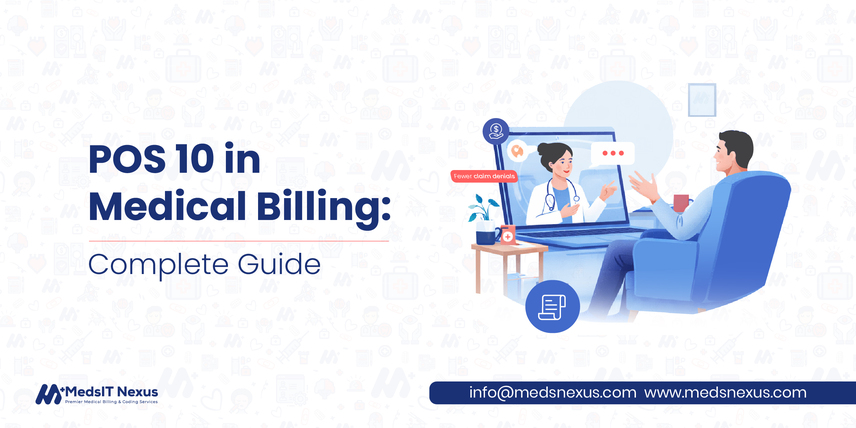
A mere two-digit code stands between you and thousands in delayed telehealth payments.
Telehealth billing has now become a permanent part of healthcare to code. However, getting paid correctly for virtual visits and check-ups depends on one small detail that most practices don’t fully understand.
It is called the Place of Service code, and making the wrong choice can delay and take up months before your payment gets cleared.
If you have ever thought and submitted a telehealth claim only for it to get denied because of a location code error, you know exactly how frustrating this can be. If you’ve ever thought, “What is POS 10?” this guide breaks down everything about POS 10 in medical billing so you can bill telehealth visits correctly, and get paid faster for your services.
Key Takeaways:
-
POS 10 is used when a telehealth patient is located at home, not in a clinic or workplace.
-
POS 10 and POS 02 are not interchangeable; the patient’s physical location determines the correct code.
-
Using the wrong POS code leads to denials, downcoding, or refunds from payers.
-
POS 10 claims are reimbursed at non-facility (in-person) rates when billed correctly.
-
CMS requires POS 10 for Medicare home-based telehealth, with specific geographic and service exceptions.
-
Accurate documentation of patient location and technology used is mandatory to support POS 10.
-
Following a consistent POS 10 billing workflow reduces errors and speeds up payments.
What Is POS 10 in Medical Billing?
POS 10 is a double-digit code that tells insurance companies where a telehealth service happened. Specifically, it means the patient was at home during the virtual visit. This is not the same as an in-person visit or a telehealth call from another location.
The code exists because payers need to know if the service was delivered through a screen rather than the traditional face-to-face before they can make the payment.
Every medical claim requires a Place of Service code. These codes help insurance companies decide how much to pay and whether the claim is valid. POS 10 became mandatory after the COVID-19 pandemic, when telehealth services saw an increase in demand. Before that, most telehealth visits used different codes or were not covered at all.
The Centers for Medicare and Medicaid Services (CMS) made POS 10 an official requirement in 2022. Since then, it has been the standard for home-based telehealth across most payers. If you bill telehealth without using the code POS 10, your claim will either get denied or paid incorrectly.
Understanding POS 10 Description: Made Simple
The POS 10 description in medical billing is easy to understand. The only thing you should keep in mind is that it’s basically used to distinguish a healthcare service that is delivered using telecommunication technology.
The telecommunication technology is used because the patient is physically located in their home and cannot attend a face-to-face meeting. That “home” can be a house, an apartment, or even a temporary residence like a rented hotel room. It cannot be a hospital room, a nursing home, or a doctor's office.
According to the CMS guidelines that were updated in 2026, POS code 10 is required for all Medicare telecommunication-related claims when the patient is at home. This includes video visits, phone calls (in limited cases), and any remote consultation with the provider that happens outside a medical facility.
Here is what the POS 10 description in medical billing is:
-
The patient connects with the provider from their private residence
-
The service uses real-time audio and video technology for communication
-
The provider is in a different location from the patient during the visit
-
The meeting completely meets all the telehealth billing requirements
Tip: The code does not apply if the patient is sitting in a clinic waiting room during a video call. It also does not apply if the patient is in a workplace or school. Those situations require different POS codes.
What is a “Home” when it comes to POS 10?
Any private residence falls under the category of a “home”. The following count as a private residence:
-
Single-family houses
-
Apartments and condos
-
Temporary housing, like hotels or Airbnb rentals
-
Homeless shelters (in some state Medicaid programs)
The following are excluded:
-
Hospitals or inpatient facilities
-
Nursing facilities
-
Assisted living centers
-
Clinics or outpatient centers
If the patient is in any institutional setting, you cannot use POS 10. You must choose a different code based on where they are located.
POS 10 vs 02: Key Differences Explained
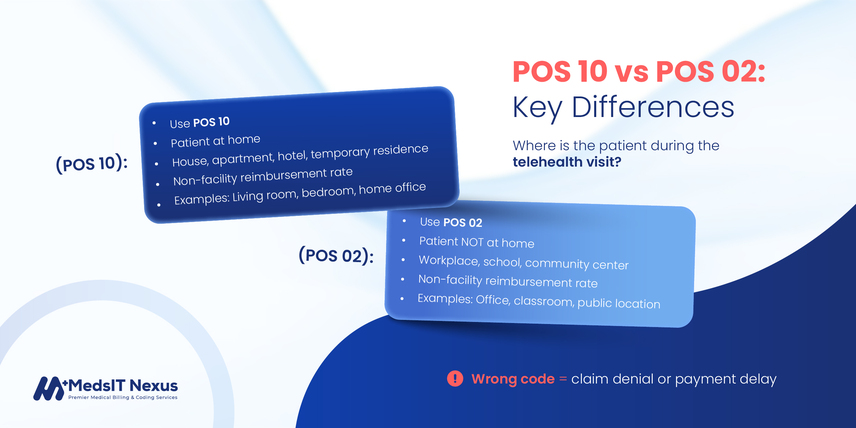
Many billers are quick to get confused when it comes to POS 02 vs POS 10. This is because both codes are used for telehealth. But they cannot be used instead of each other; they’re not interchangeable. Using the wrong one will cause your claim to be denied or delayed.
POS 02 is used when the patient is getting telehealth services from any location other than their home. This could be anything from a workplace, a school, a community center, to even a different healthcare facility. The key element that needs to be analyzed is the patient's physical location during the visit.
POS 10 is used only when the patient is at home.
Here is a quick comparison:
|
Feature |
POS 10 |
POS 02 |
|
Patient Location |
At home |
Not at home (workplace, school, etc.) |
|
Telehealth Type |
Audio-video or audio-only (limited cases) |
Audio-video or audio-only (limited cases) |
|
Medicare Coverage |
Yes, with geographic restrictions |
Yes, with geographic restrictions |
|
Reimbursement Rate |
Non-facility rate (same as in-person) |
Non-facility rate (same as in-person) |
Real-World Example: POS 10 vs 02
Let's say a patient has a video visit with their psychiatrist. If they connect from their living room, you use POS 10. If they connect from their employer's office during lunch break, you use POS 02. Same service, same provider, different location code.
Getting this right matters because some payers have different coverage rules, especially when it comes to POS 02 vs POS 10. They have different rules for POS 02 than they do for POS 10.
Medicare, for example, requires a set of documentation to prove where the patient was located during the visit.
When to Use POS Code 10 (and When Not To)
You should use POS code 10 every time a patient attends a telehealth visit from their home. This applies to all types of care that is done virtually, or more specifically, through a telecommunication technology-based meeting, which involves:
-
The usual follow-up visits
-
Mental health-based counseling
-
Chronic disease management
-
Medication management appointments
-
Post-operative check-ins
You should not use POS 10 if:
-
The patient is physically present in your office (use POS 11)
-
The patient is at work or school (use POS 02)
-
The patient is in a hospital or nursing facility (use the appropriate facility code)
-
The service is not delivered via real-time communication (use telephone visit codes instead)
Latest CMS Updates for POS 10
CMS released major updates in the last year in the Medicare Physician Fee Schedule Final Rule. These changes affect how you use POS 10 in medical billing going forward.
Key Changes
Geographic Restrictions Are Back: Medicare will once again limit telehealth coverage to patients in certain areas. This includes:
-
Health Professional Shortage Areas (HPSAs)
-
Rural census tracts
-
Counties outside Metropolitan Statistical Areas
If your patient lives in a city, they may not qualify for Medicare telehealth reimbursement unless the service falls under a specific exception.
Mental Health Services Are Exempt
Behavioral and mental health telehealth services are permanently exempt from geographic restrictions. You can use POS 10 for these visits regardless of where the patient lives.
Audio-Only Is Now Permanent
Starting January 31, 2026, audio-only is permanently available ONLY for behavioral and mental health services, provided the clinician is technically capable of using video, but the patient cannot or does not consent to video technology. You must document why the video was not used and obtain patient consent for audio-only care.
Provider Location Flexibility Extended
Providers can continue using their enrolled practice location instead of their home address for Medicare telehealth services provided from their home.
What This Means for Your Practice
If you bill Medicare telehealth using POS 10, then check your patients' ZIP codes. If they live outside the approved areas, verify to confirm if their service falls under the category of any exception. Mental health visits, for example, are still fully covered.
For Medicaid and commercial payers, rules depend on the state and plan in question. Always confirm and verify the coverage before you make the visit final.
How POS 10 Affects Telehealth Reimbursement
Using the correct Place of Service code directly impacts how much you get paid. Claims that are billed with POS 10 are paid at the same rate you would receive for an in-person office visit; they are also known as the non-facility rates.
This is great news for providers. It means telehealth visits are paid at around the same rates as traditional visits, as long as the service is medically necessary, properly documented, and properly claimed.
Reimbursement Rates by Payer
Medicare: POS 10 claims are paid at the non-facility rate listed in the Medicare Physician Fee Schedule. You can verify rates using the Medicare Physician Fee Schedule Lookup Tool on the CMS website.
Medicaid: Payment mostly varies by state. Some states pay the same rate for telehealth and in-person visits. Others might pay less. Check your state Medicaid telehealth policy for confirmation of payment or reimbursements.
Commercial Payers: Most commercial insurers follow Medicare's lead and pay telehealth at the non-facility rate when you use POS 10. However, some other plans need pre-authorization or have a certain specified number of visits as a limit. This means you attend more visits than the specified amount since it's a limit ordained under the plan.
What Happens If You Use the Wrong Code
If you submit a wrong code, or for example, if you claim with POS 11 (office visit) when the service was actually telehealth from home, the payer may:
-
Deny the claim for incorrect coding
-
Downcode the service to a lower-paying telehealth code
-
Request a refund if they have already paid you
Using POS 10 the right way brings a lot of benefits. For starters, it protects your revenue and also keeps you compliant with payer rules.
Step-by-Step Guide to Bill Using POS Code 10
Here’s what to do each time you bill a telehealth visit with POS 10.
Step 1: Verify Patient Location
Before the visit starts, confirm the patient is at home. Document this in your EHR.
Step 2: Conduct the Telehealth Visit
Deliver the service using compliant audio-video technology. If using audio-only, document why video was not used.
Step 3: Document the Meeting
Record the date, time, start and end times, technology used, patient location, and clinical notes.
Step 4: Use the Right Codes
Use the right E/M code (e.g., 99213), add POS 10 as the Place of Service code, and include modifier 95 (or 93 for audio-only).
Step 5: Verify the Payer Coverage
Check that the patient's insurance covers telehealth and that they meet eligibility requirements.
Step 6: Submit the Claim
Send the claim with all required information. Keep a copy of the documentation in case of an audit.
Step 7: Follow-up on any Denials
If any of your claims are denied, the first and foremost action you must take is review and understand the reason for your claim’s denial. If it is a POS code error, simply correct it and resubmit the claim.
Following this process reduces errors and speeds up payments.
Conclusion
POS 10 is a short code that has a long impact on your revenue stream. Getting it right means you get faster payments, fewer denials, and full compliance with payer rules. Getting it wrong automatically means you have to face claim rejections, audits, and lost income.
This guide gives you everything you need to use POS 10 correctly for every telehealth visit. If you bill telehealth, make sure your team knows these rules, double-checks every claim, and documents every visit properly. Your revenue cycle’s efficiency depends on how accurate and correct everything is during this process.
FAQs:
Q. Can I use POS 10 for audio-only telehealth visits?
Yes. you can use POS code 10 for audio-only visits if video was available, but the patient couldn't or wouldn't use it. You must add modifier 93 and document why the video wasn't used, plus obtain patient consent.
Q. What is the main mistake providers make with POS 10 vs POS 02?
Yes. The most common mistake is using POS 10 when the patient isn't at home. If a patient connects from work or school, you must use POS 02. Getting POS 02 vs POS 10 wrong causes claim denials.
Q. Does POS 10 in medical billing affect how much I get reimbursed?
Yes. POS code 10 claims are reimbursed at the non-facility rate, the same as in-person visits. Using the wrong POS code results in downcoding, denials, or refund requests from payers.
Q. Do I need modifier 95 when billing POS 10?
Yes. Most payers, including Medicare, require modifier 95 for telehealth services billed with POS 10 to indicate the service was delivered via real-time audio-video technology.
Q. Can POS 10 be used if the provider is working from home?
Yes. POS 10 is based on the patient’s location, not the provider’s. As long as the patient is at home during the telehealth visit, POS 10 is appropriate, regardless of the provider's location.
Table of Contents

Services
- Medical Audit Services
- Medical Billing Services
- Medical Credentialing Services
- Medical Coding Services
- Accounts Receivable Management
- Medical Insurance Verification
- Denial Menagement Services
Who we serve
- Private Practices
- Small Practices
- Hospitals & Healthcare
- Physicians
- Medical Equipment
- Outpatient Facilities
Get in Touch
Let's start talking about getting you credentialed