Calculate Your Savings


Type 2 Diabetes ICD 10 Code E11.9 Diagnosis Code: Complete Guide
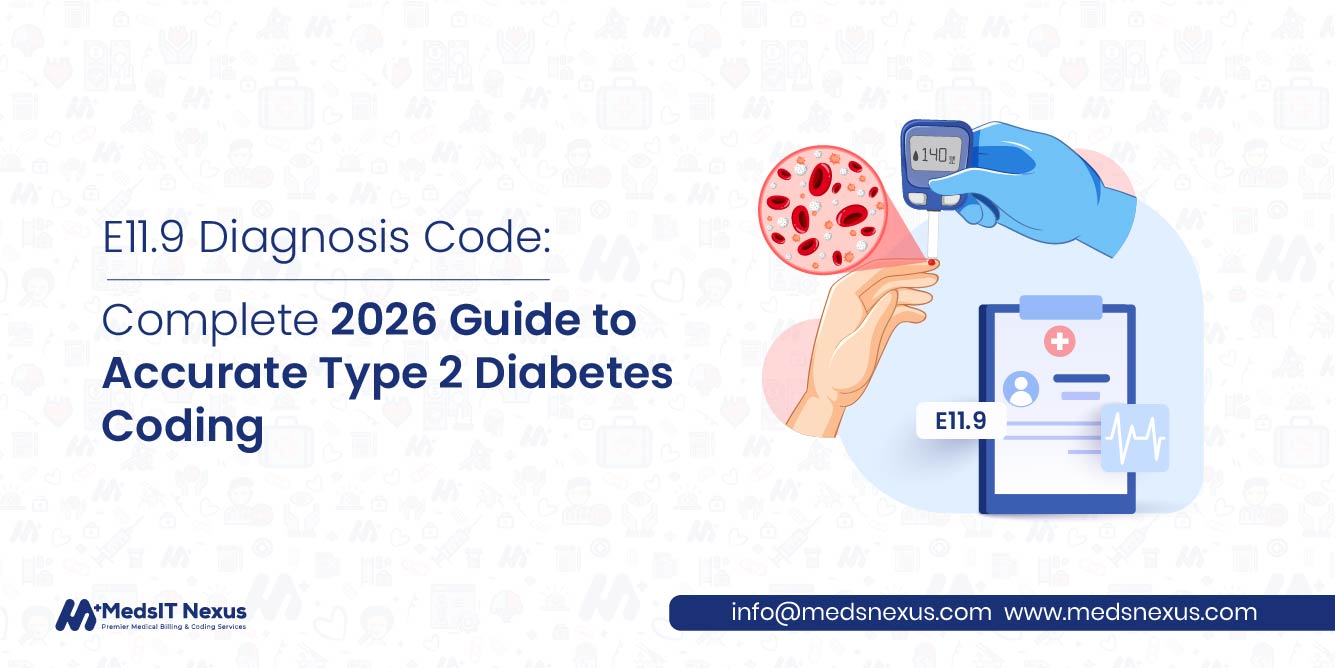
E11.9 Diagnosis Code: Complete 2026 Guide to Accurate Type 2 Diabetes Coding
E11.9 Diagnosis Code is among the most commonly miscoded diabetes codes in clinical practice. In primary care, diagnosis-related errors account for 15-20% of claim denials. This results in thousands of dollars in preventable revenue loss each year.
In this sense, it can be seen that the latest amendments to the 2026 ICD-10-CM are very significant. Nevertheless, these problems can be overcome by learning the documentation requirements on E11.9. This allows providers to improve the billing process in a much more efficient and transparent way.
At MedsIT Nexus, our certified medical coding specialists ensure precision in diabetes coding and documentation alignment. We give you a roadmap for making the most of diabetes coding, achieving prompt reimbursement from your payers, and improving your knowledge.
Key Takeaways
- This code is only to be used when there are no complications.
- Support the diagnosis using lab data and active management.
- Add Z-codes of medication.
- Do not have conflicting documentation of charts.
- continuous monitoring and automated coding audits for ICD-10 changes in 2026.
What is Diagnosis Code E11.9
The code of ICD-10-CM for type 2 diabetic mellitus and no complications is E11.9. It establishes that the patient is diabetic with Type 2 and no complications were reported in the encounter. The Diagnosis Code E11.9 represents type 2 diabetes, and the 9 demonstrates that the patient does not have any complications.
- E11.9 refers to non-insulin-dependent diabetes in adults without kidney, nerve, eye, and other complications.
- The lack of complications should be explicitly written down.
- Only assumptions should not be accepted.
How to Use E11.9 Diagnosis Code in Medical Billing?
Apply the E11.9 code to the cases where the adult is known to have Type 2 diabetes without any further complications. It suits regular follow-ups, which monitor blood sugar level, HbA1c, drug adherence, and changes in lifestyle.
For example, the E11.9 code should be designated to an adult whose HbA1c is 6.8 percent and who takes oral treatment and has no neuropathy or kidney damage.
If the chart records hyperglycemia or diabetic neuropathy, a more specific ICD-10 code is required in this instance. Moreover, the adult population is the target of this code since Type 2 diabetes develops most commonly after the age of 18, which is the standard set of diabetes ICD-10 adult classification.
Clinical Criteria
- Age group: adults (commonly ≥18 years)
- Un-complicated
- Follow-ups
- Controlled
- Accuracy
- Lifestyle
- Medical Record
E11.9 Coding Criteria
|
Coding Element |
Criteria for using e11.9 |
Criteria for using other codes |
|
Patient Population |
Adults (18 years and older) |
Patients under 18, unspecified diabetes types |
|
Complication Status |
No record of complications |
Complications record |
|
Reason for Visit / Focus |
Routine Follow-ups |
Acute Issues or Specific Symptoms |
Diabetes ICD-10 Guidelines
- A suitable instance of E11.9 case is a patient with an HbA1c of 6.8% who is under oral medication and has no additional issues (evidence of neuropathy or kidney injury).
- In case the medical record indicates certain conditions, e.g., hyperglycemia or diabetic neuropathy, then E11.9 cannot be used, and the much narrower ICD-10 code is to be assigned.
- E11.9 code is mainly aimed at adults since Type 2 diabetes is most likely to develop after 18 years of age (adhering to the conventional ICD-10 adult category).
E11.9 Diagnosis Code Meaning in Medical Billing
E11.9 is not just a billing code, but it indicates the medical requirement of laboratory testing, drug, analysis, and treatment (E/M) services. Payers ensure that the diagnosis exists. In this regard, to justify the code, mention active diabetes management, check blood sugar, review lab, change medication, and ensure that lifestyle is recorded.
It is not enough to say that diabetes was diagnosed without any records of its checking and treatment. Documentation must follow Healthcare coding compliance e11.9 and should be guided by MEAT, which is Monitoring, Evaluating, Assessing, and Treating. Audits are passed with properly documented E11.9.
EMR documentation for diabetes ICD Codes
The standard documentation requires proper, thorough charting. The assessment should clearly mention the provider, indicating that it is Type 2 diabetes mellitus without complications. Findings should support the absence of complications.
- Add recent lab tests such as HbA1c, hyperglycemia status notes, and treatment plan.
- Record the use of medications, either oral, insulin, or injectable treatment.
- Compliance and reimbursement are safeguarded by good EMR documentation.
Step-by-step guide to E11.9 coding for claims
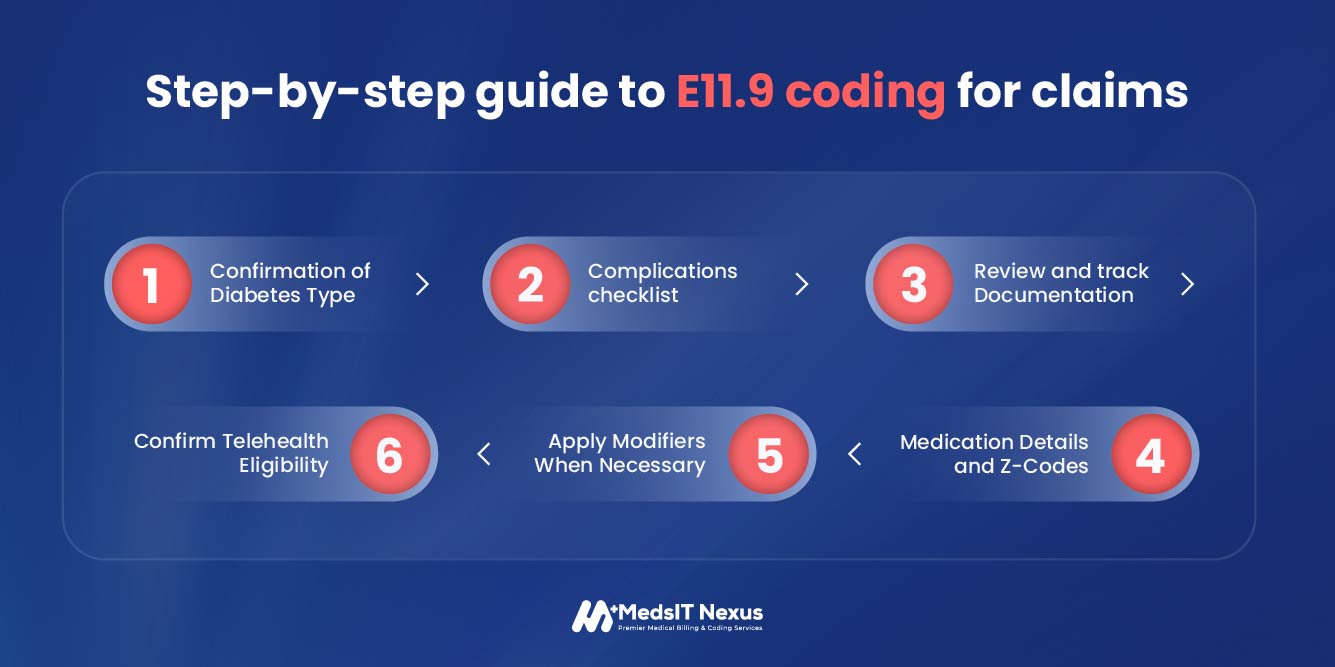
Step 1: Confirmation of Diabetes Type
Before utilizing this code, it is very important to ensure that the patient has Type 2 diabetes; otherwise, Type 1, gestational, and unspecified diabetes cannot be applied to this code.
Step 2: Complications checklist
Consider the medical record to confirm that there is no history of complications like neuropathy, nephropathy, retinopathy, etc., since e11.9 can only be used in simple cases.
Step 3: Review and track Documentation
It is noteworthy to state that all the active management notes, lab results (HbA1c), and treatment plans are well-written to address the medical necessity.
Step 4: Medication Details and Z-Codes
Record whether the patient is on long-term insulin or oral hypoglycemics. Add relevant Z-codes, such as Z79.4 for long-term insulin use, to reinforce medical need.
Step 5: Apply Modifiers When Necessary
In case procedures or other services are undertaken on the visit, apply non-procedural modifiers (e.g., modifier 25, a significant, separately identifiable E/M service).
Step 6: Confirm Telehealth Eligibility
Telehealth visits that are related to managing diabetes can be done using E11.9, but the documentation must address the payer requirements, and the encounter should be billed accordingly.
Common mistakes using diagnosis code E11.9
- E11.9 is often misused. The most common error is to code in the presence of complications. In case neuropathy is observed, code the complication in particular rather than E11.9.
- Missing evidence, e.g., active management notes or laboratories, is another problem. Payers require an assurance that the condition is under control.
- E11.9, E11.8, and E11.65 may be confused. E11.8 represents unspecified complications, whereas E11.65 represents hyperglycemia. Select the matching code of documentation.
Standard Approach vs. MedsIT Nexus
|
Feature |
Standard Billing Companies |
MedsIT Nexus |
Impact |
|
Coding Philosophy |
Treats E11.9 as a routine administrative task |
Treats E11.9 as a critical revenue integrity data point |
15% average revenue |
|
Documentation Review |
Passive back-end processing |
Real-time documentation gap analysis |
99% coding accuracy rate |
|
Error Preventation |
Relies on basic ICD-10 look-up tables |
Three-tier validation system |
Prevents up to 85% of claim denials |
|
Outcome |
Higher risk of denials |
Faster, cleaner claims, improved accuracy |
100% client satisfaction rating & HIPAA compliant |
The above details speak for themselves as MedsIT Nexus has successfully established a trusted bond with its clients with 95% coding accuracy, prevention of up to 85% of claim denials, and a 15% average revenue increase. Our approach delivers faster claims, cleaner submissions, and maximized reimbursement.
E11.9 Coding With Co-Morbidities and Modifiers
E11.9 enables you to provide other chronic condition management. Separately, code hypertension, obesity, or dyslipidemia. In the case of co-morbidity caused by diabetes (e.g., diabetic neuropathy), a specific complication code should be used, not E11.9. Proper sequencing and documentation are in line with ICD-10.
Proper modifiers should be added to telehealth visits or complex visits. The diagnosis continues to be E11.9 when no complications are reported.
E11.9 Coding Do's & Don'ts
|
Do’s |
Don’ts |
|
Document MEAT |
Don't just list "diabetes." |
|
Mention "no complications" explicitly |
Don't use if complications exist |
|
Attach recent labs (HbA1c) |
Don't skip lab evidence |
|
Note medications + Z-codes |
Don't exclude treatment details |
|
Follow 2026 guidelines |
Don't ignore payer rules |
Accurate Coding of E11.9 Revenue Cycle
In revenue cycle management diabetes coding, the correct employment of the E11.9 diagnosis code will minimize the risk of denial and enhance the accuracy of reimbursement.
Diabetes is a chronic condition that may be treated with value-based care models. Risk-adjustment scoring and population-health reporting are supported by accurate coding.
Clinical reality should be reflected in healthcare coding and billing of Type 2 diabetes. The under-documentation or overworking of E11.9 may have a damaging effect on the payer relations and audit results. Payers have a lot of scrutiny on chronic condition management, whereby it will be observed repeatedly without any documentation.
Internal audit practices that strengthen diabetes ICD-10 guidelines tend to have their claims submitted easily, and compliance is increased.
- The proper application of E11.9 in revenue cycle management reduces the risks of denials.
- Coding has to be based on the clinical reality of the situation of the patient.
- The under-documentation or overuse of E11.9 may be harmful to payer relationships and cause bad audit outcomes.
- Claims made by the same patient with no supporting documentation are highly subject to scrutiny by payers, who consider chronic disease coding as one of them.
- Effective internal audits based on the ICD-10 guidelines facilitate the submission of claims and also enhance compliance
Conclusion
E11.9 diagnosis code might appear to be no more than a routine application. Yet, it does require a great deal of documentation and strict adherence to the rules of ICD-10 classification of diabetes. The E11.9 code is a valuable asset to your revenue cycle when properly stored and used- enhancing compliance, improving reimbursement, and providing high-quality care of chronic diseases. Correct coding is not only a billing issue, but it is also a clinical integrity and improved patient outcomes issue.
Frequently Asked Questions
Q. What does the diagnosis code e11.9 meaning?
The Type 2 diabetes ICD code is not as complicated as the first one, E11, which indicates Type 2 diabetes, and the second, which is a number 9, depicts that there are no signs of complications during the visit.
Q. Who Does It Belong To? Type 1 vs. Type 2
Only Type 2 diabetes is treated with E11.9, while Type 1 diabetes without complications is separately coded, E10.9.Type 1 is caused by autoimmune assault, which completely halts the production of insulin, whereas Type 2 is characterized by insulin resistance. The mix-up of the two codes may result in wrong treatment regimes and billing errors, like the mixture of apples and oranges.
Q. Can E11.9 Be Used for Telehealth?
Yes, the code is a reflection of the diagnosis and not the care setting. E11.9 is the right code in case a patient is being provided a video visit to check blood-sugar logs, discuss diet, and change medication.
Q. How would E11.9 and E11.65 differ?
E11.9 refers to diabetes without complications, and E11.65 refers to Type 2 diabetes with hyperglycemia. One of the factors that defines the code used is documentation.
Table of Contents

Services
- Medical Audit Services
- Medical Billing Services
- Medical Credentialing Services
- Medical Coding Services
- Accounts Receivable Management
- Medical Insurance Verification
- Denial Menagement Services
Who we serve
- Private Practices
- Small Practices
- Hospitals & Healthcare
- Physicians
- Medical Equipment
- Outpatient Facilities
Get in Touch
Let's start talking about getting you credentialed