Calculate Your Savings


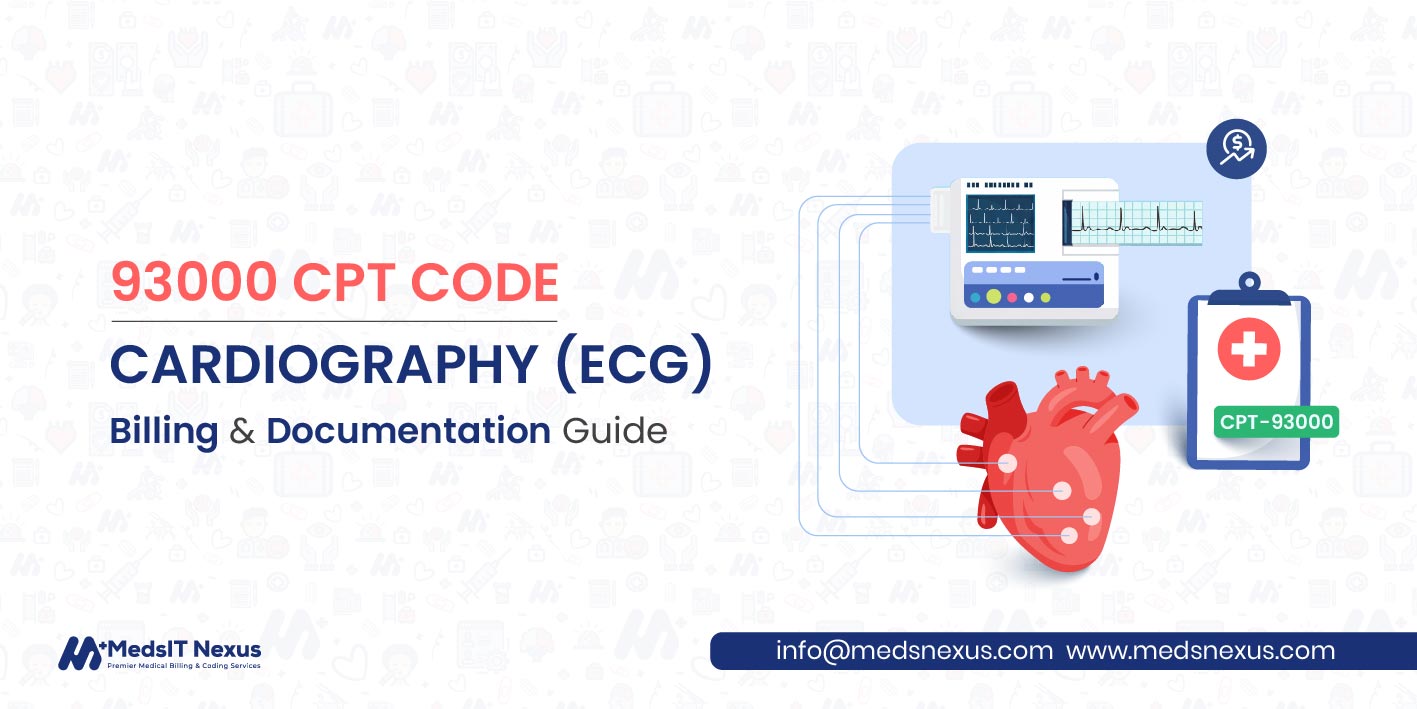
93000 (ECG/EKG) CPT Code - Cardiography Billing & Documentation Guide
In healthcare, correct CPT coding is as important as clinical practice. Depending on the type of mistake made, coding mistakes can result in decreased reimbursements and a higher risk of compliance issues, as claim denials often arise from billing errors, incorrect codes, and absent modifiers.
Ensuring proper coding not only allows healthcare providers to properly optimize reimbursement but is also critical in preventing claim denials. Cardiology practices, in particular, often lose revenue as a result of billing and audit failures. Missing documentation or an incorrect modifier can result in audits, fines, and denials. In this blog, we will be exploring common billing and coding issues as well as how to avoid them.
Medical Billing code 93000 is particularly important in cardiology. It is used for electrocardiograms, or ECGs (or EKGs), which are tests that reveal the heart’s rhythm and electrical activity. Confusion is common between CPT 93000, 93005, and 93010, each indicating a separate component of the service. This blog details these codes and provides tips for avoiding the billing mistakes that often come along with them.
What is the 93000 CPT Code?
A complete electrocardiogram (ECG) procedure is represented by CPT code 93000. It provides a routine 12-lead ECG, which records the electrical activity of the heart, along with an interpretation from the physician and a formal report. It also tests for irregularities such as Arrhythmias.
Clinical and Billing Context of 93000 CPT Code
CPT code 93000 is a global service, which includes both technical and professional components. The technical part is putting the ECG leads, obtaining the tracing, and operating the equipment. Included in the professional fee is interpretation of the results by a qualified physician and preparation of a written report.
CMS explains that global billing is used when both technical and professional services are from the same entity. Modifiers 26 (professional component) and TC (technical component) are not needed in those situations.
ECG 93000 CPT Code Series
90844 and 99246 through 99556 are part of that series, along with CPT codes for various types of electrocardiogram (ECG) procedures assessing the heart's electrical activity. The codes are used for billing and insurance reimbursement, placing ECG procedures into categories based on complexity, type of procedure performed, and method of performance.
-
CPT Code 93000 - Routine electrocardiogram, ECG or EKG
This is the most frequently performed ECG and is used as a standard 12-lead electrocardiogram for routine diagnostic use. It encompasses electrode placement, recording, and physician interpretation. This code is usually used to assess heart rhythm, rate, and other electrical activity. -
CPT Code 93005 - Electrocardiogram, With Interpretation and Report
This code is relevant when the ECG is performed, and a healthcare provider reads it. That includes both the recording of the electrocardiogram, as well as a formal interpretation and written report, so it is a more complete service than CPT 93000. -
CPT Code 93010 - Electrocardiogram Performing Exercise (Treadmill or Bicycle)
This code is for an exercise EKG, which directly measures the heart under physical duress to assess coronary artery disease. Commonly used in cardiac stress tests to observe the heart's response during activity. -
CPT Code 93016 - Electrocardiogram, Telemetry (Continuous Monitoring)
This is the code for long ECG monitoring in the hospitals. It is relevant when patients are monitored continuously over long periods, either in the inpatient or outpatient setting. Telemetry allows for immediate analysis and intervention when abnormalities occur. -
CPT Code 93015 - Electrocardiogram, Ambulatory
Holter monitoring consists of continuous recording of the ECG for 24 hours (or more) to identify any abnormal heart rhythms that may not present in a standard ECG. This longer recording time can detect intermittent arrhythmias or acute problems that a single ECG may not capture.
Accounting for ECG CPT Codes in Billing
CPT 93000 is claimed when the entire provider service is provided by one company. Billing is based on who did the test and who read it. This scenario is quite common in cardiology medical billing, especially with ECG tracing and interpretation being done at different locations.
If the same provider who follows up a 93000 level CPT code is performing both technical and professional components. But when different providers perform each part, a payer can mandate the service or its components be split with CPT 93005 (technical component) and CPT 93010 (professional component).
ECG CPT codes depend on what portion of the service is performed. Clinics frequently bill CPT 93005 when they perform the tracing but refer it elsewhere for interpretation.
CPT global vs split billing (modifiers 26 versus TC)
.jpg)
The billing for CPT code 93000 depends upon whether the technical and professional components are performed by the same or a different provider. Reimbursements and compliance require understanding key differences between global and split billing.
Global Billing
Global billing is when the same provider renders both the technical and professional components of the ECG service. In this case, the entire service is billed through one claim.
-
There’s one claim for the entire ECG procedure
-
Common when physicians perform ECGs in the office
Split Billing
Split billing is used when the technical and professional components are provided by different providers. A suitable modifier is used when billing each component.
-
Modifier TC (Technical Component): Made for the technical part tracing, equipment use, and staff time. This is customarily billed with CPT 93005.
-
Modifier 26 (Professional Component): When only the professional interpretation is performed. This is usually charged with CPT 93010.
-
Common in: Outpatient departments, IDTFs, and settings with separate physician interpretation.
Modifier TC is reported when a technical component, covering the tracing of the heart, use of equipment, and staff time is performed, such as CPT 93005 only. When the interpretation is performed alone and reported separately, use top Mod 26.
CPT 93000 is frequently used in the physician office setting that performs ECGs in-house, while split billing occurs more often in hospital outpatient departments and IDTFs, where tracings are typically performed off-site with physicians billing separately for interpretation.
Clinical Situations for CPT 93000
It also indicates that the relevant code to report outpatient standard diagnostic ECGs for cardiac evaluations is CPT 93000. It assists in evaluations for chest pain, palpitations, syncope, arrhythmias, dizziness, hypertension, and ventricular hypertrophy.
This code also applies to emergency ECGs performed in acute care settings and follow-up ECGs used for disease progression or treatment response. If there are changes to the patient’s clinical condition, repeat ECGs may be clinically indicated. In general, CPT 93000 should not be billed for asymptomatic patients who have no known heart disease and are being screened regularly.
Impact of Place of Service on CPT 93000 Billing
The place of service (POS) where the ECG is performed has a direct impact on billing. For outpatient ECGs, POS 11 is applicable for physician offices. There are codes generated for hospital outpatient departments (POS 19 and POS 22), each with unique outpatient billing rules. POS 21 stands for inpatient services; this includes ECGs as part of hospital admission care.
Choosing the incorrect POS will lead to denied claims, delayed payments, and lower reimbursement. The more common question is denial trends, as many practices have recurring denials related to POS that require dedicated review and correction.
Do You Use a Modifier for CPT 93000?
Yes. Modification of CPT 93000 Under Special Circumstances Modifiers that are frequently used include 26, TC, 59, 76, 77, and 91. These modifiers indicate which entity performed each element and serve to mitigate duplicate billing.
Appropriate modifier usage is required by CMS as well as the AMA CPT guidelines to limit claim duplications. In the presence of a clear medical necessity, repeat ECGs should be justified. Solid documentation is found in patient identifiers, signed interpretation reports, clinical notes, and a justification for the ECG to show medical necessity.
ICD-10 Diagnosis Codes Options for Use with CPT 93000
Patients assume symptoms described will match documented diagnoses. Medically necessary ECG can be performed in patients with heart conditions like arrhythmias, coronary artery disease, heart block, pulmonary embolism, sinus tachycardia, and ST-T changes.
One of the most common reasons for claim denials comes from a disconnect between the diagnosis and the service provided. The link between symptoms, physician orders, and ICD-10 codes must be clear for medical necessity.
Reimbursement at Payer and Medicare for CPT 93000
The reimbursement for CPT 93000 under the Medicare Physician Fee Schedule (MPFS) varies depending on geographic location, as well as individual payer contracts.
Requirements for prior authorization under Medicare Advantage plans can differ from those in traditional Medicare. Potential underpayment risks include missed component billing and miscalculated contractual allowances. Moreover, CMS frequency restrictions and Local (LCD) and National (NCD) Coverage Determinations further limit the use of repeat ECGs. The restrictions on ECG screening apply only to asymptomatic patients.
Best Practices for Billing CPT 93000
Providers may report CPT 93000 alongside Evaluation and Management (E/M) services such as 99214 by appending modifier 25, provided the services are separately identifiable and medically necessary.
Cardiac stress tests (CPT 93015–93018) include ECG monitoring and should not be billed separately. Holter monitoring (CPT 93224–93227) and pacemaker evaluations (CPT 93279–93298) may be reported separately with modifier 59 when appropriate. Avoid bundling or unbundling errors under the National Correct Coding Initiative (NCCI). Implementing internal workflow checklists helps ensure claims are reviewed for accuracy in coding, modifiers, and documentation before submission.
Common Causes of Denials in CPT 93000 Billing
The following mistakes frequently result in claim denials:
-
Missing modifier 26 or TC
-
Unsigned interpretation reports
-
Diagnosis mismatch
-
Exceeding frequency thresholds
-
Incorrect place of service selection
-
Improper component billing
Audit and Compliance Risks
High-volume ECG billing increases the likelihood of audits. Incomplete records and improper modifier use often trigger duplication flags. CMS and OIG audits frequently identify unsigned or inaccurate documentation as compliance issues.
To remain compliant, practices must ensure accuracy, maintain complete records, and adhere to AMA CPT guidelines and payer-specific requirements.
Conclusion
Proper cardiology billing and getting paid on time is only possible once you correctly enter CPT code 93000. Several factors contribute to the risk of claim denial, but spending some time getting a clear understanding of global and split billing, correct modifiers, and place-of-service selection can greatly reduce your risk.
Compliance with CMS, LCD, and NCD will help Providers avoid being regularly audited and being paid less than they deserve. Even small mistakes, like not signing reports or neglecting to add modifiers, can create major billing problems. Routinely recovering from such issues usually necessitates assistance with ECG claim denial recovery and general billing workflow optimization.
By following NCCI principles and industry best practices, healthcare practices can safeguard their revenue stream and stay compliant. When considering proper billing for CPT 93000, it’s not just about getting paid; it is about maintaining a compliant and productive revenue cycle.
FAQs
-
Can you bill CPT 93000 along with an E/M service?
Yes, as long as both services are medically necessary and separately identifiable. Modifier 25 should be appended to the E/M code to indicate a significant, separately identifiable service. -
When is it better to use 93000 instead of 93005 or 93010?
CPT 93000 is appropriate when the same provider performs both the technical component (tracing) and the professional component (interpretation). If different providers perform these components, split billing using 93005 and 93010 is required. -
What documentation is needed for CPT 93000?
Supporting documentation should include clinical history, a physician's order, a signed interpretation report, and the appropriate ICD-10 diagnosis code establishing medical necessity.
-
Do the same rules apply to Medicare Advantage?
Not always. Medicare Advantage plans often have payer-specific billing rules, prior authorization requirements, and documentation standards that may differ from traditional Medicare. Providers should verify individual plan guidelines.
Table of Contents

Services
- Medical Audit Services
- Medical Billing Services
- Medical Credentialing Services
- Medical Coding Services
- Accounts Receivable Management
- Medical Insurance Verification
- Denial Menagement Services
Who we serve
- Private Practices
- Small Practices
- Hospitals & Healthcare
- Physicians
- Medical Equipment
- Outpatient Facilities
Get in Touch
Let's start talking about getting you credentialed
Related Posts
New Patient Visit CPT Codes in Urgent Care Billing