Calculate Your Savings


99214 CPT Code Explained: Guidelines, Time and When to Use

Cpt Code 99214 definition
99214 CPT code is one of the highly charged outpatient visit codes nationwide. However, the only reason why it is popular does not imply that everyone uses it properly.
The issue with many providers is that it is difficult to find the boundary point of when a visit or a visit became moderate. So what is it like in the real world? What do you want in your documentation? Would it make a difference once the visit had been video-based?
These small uncertainties often lead to hesitation and result in undercoding, lost revenue, or denials when payers push back.
This guide is a reference that will take you step by step on what you need to know in order to assign 99214 confidently. You will learn how to satisfy the requirements, either in time or in medical determination, use modifiers correctly, and give claims that can reliably represent the care that you provided.
What is CPT Code 99214?
99214 CPT code description is used to describe an evaluation and management visit of an already existing patient in an office or outpatient practice. In simple terms, it is the visit in which there is a bit more involvement. It lies in the middle ground of patients who require additional concern, additional thinking, and planning. There are two ways to defend this code:
Medical Decision-Making
The difficulty in this case is moderate. It implies that the doctor is not merely paying a visit. They are managing at least two stable or one worsening condition, reviewing test results, adjusting treatment plans, or navigating risks that require solid clinical judgment. It's not black and white; it's the gray area where experience kicks in.
Time
When you want to code according to time, then you can see the rule. The doctor should take a minimum of 30 minutes and a maximum of 39 minutes with the patient on the day of the visit. And that time includes everything, for instance,
-
Chart review
-
Ordering labs
-
Coordinating with other providers
-
Documenting every minute counts toward that total
The AMA and other major medical organizations claim that the reason 99214 has been introduced is that they want to obtain the number of visits that are located somewhere in between.
It is aimed at patients who require not a full-scale crisis management but rather a follow-up. It is placed directly between the lower level visit (99213) and the maximum level of complexity (99215), so you also have an option of charging for what work you did not actually do.
Who Qualifies for a 99214 Visit?
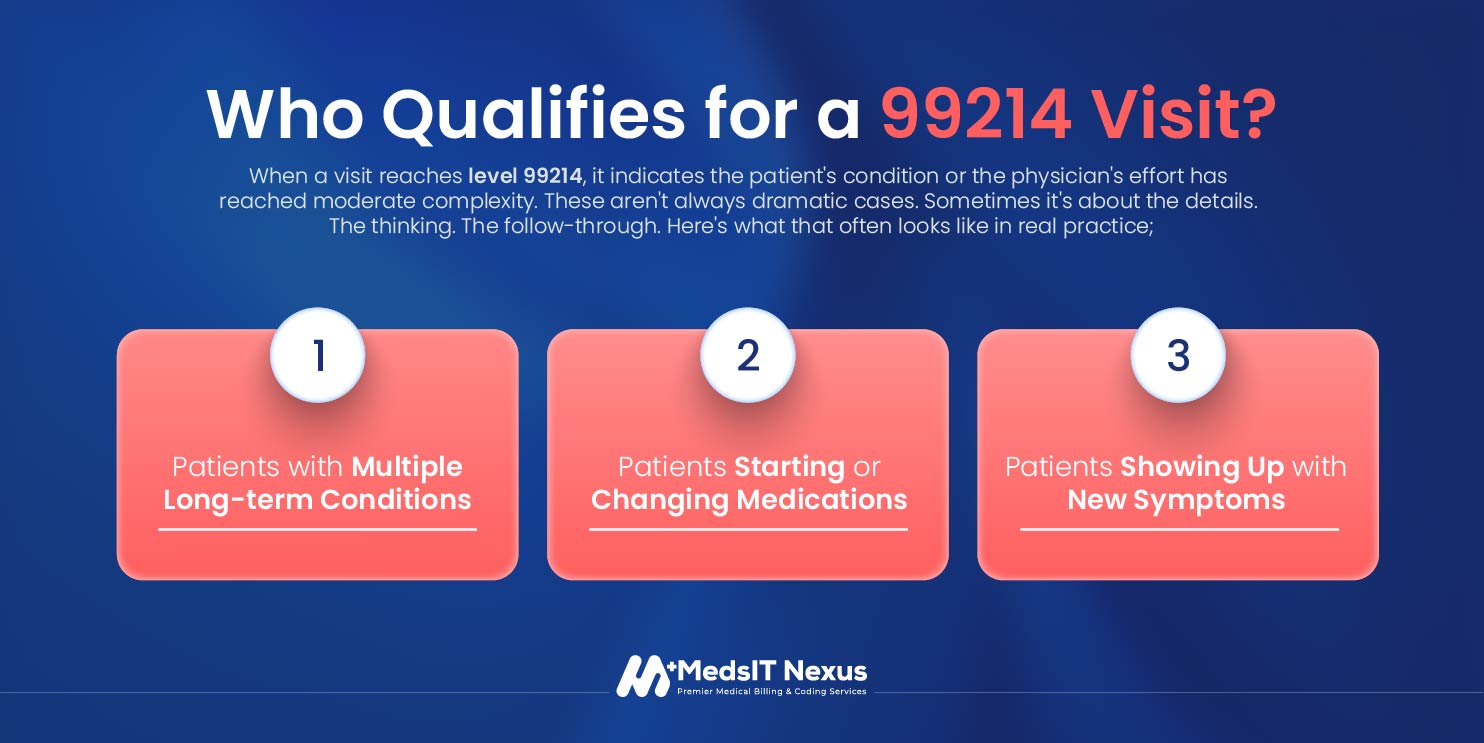
When a visit reaches level 99214, it indicates the patient's condition or the physician's effort has reached moderate complexity. These aren't always dramatic cases. Sometimes it's about the details. The thinking. The follow-through. Here's what that often looks like in real practice;
-
Patients with Multiple Long-term Conditions
-
Patients Starting or Changing Medications
-
Patients Showing Up with New Symptoms
Patients with Multiple Long-term Conditions
Some patients come in with multiple issues. A crisis is not necessarily needed, but something to get you going. Once it happens that a patient has two or more chronic types of diseases that require frequent care, drug adjustments, lab tests, and symptom observation, then the visit will obviously require more of you.
Real-world examples:
-
A patient with diabetes and high blood pressure whose numbers are drifting
-
A patient with COPD and heart failure, watching for warning signs
-
A person with chronic kidney disease with type 2 diabetes
During such visits, you're not just checking a box. You're connecting dots. That takes time, and that time matters.
Patients Starting or Changing Medications
Sometimes a patient looks fine on paper, but something underneath is shifting. Maybe you're starting a new drug. Maybe you're adjusting an old one. Either way, there's now an element of risk that wasn't there before.
Although it appears that the condition may be stable, the decision to prescribe or make amendments comes along with a new set of responsibilities. You'll need to follow up and monitor the response of the body.
Real-world examples:
-
Starting someone on an antidepressant and planning to check in on side effects
-
Adjusting insulin levels due to a lack of control in blood sugar levels
-
Making blood pressure pills after readings increase
-
Start a steroid taper that will need close attention
The patient might feel fine today. But your job is to think ahead. That forward-looking judgment is what lifts the visit into moderate complexity.
Patients Showing Up with New Symptoms
Then there are the visits where nothing is chronic. Nothing is managed. But something is wrong. The patient walks in with a new symptom, vague maybe, but concerning enough that you can't just send them home without answers.
These are the visits where you become a detective. You weigh possibilities. You order tests. You think through worst-case scenarios while keeping your calm.
Real-world examples:
-
Someone with chest pain that doesn't scream heart attack, but also doesn't feel right
-
The patient complains of a numbing sensation or dizziness without an apparent cause
-
Abdominal pain that raises eyebrows red flags you can't ignore
-
A headache that's different from their usual, enough to order imaging
In these moments, you're not treating a diagnosis. You're hunting for one. That process, the gathering, the ruling out, the clinical judgment, fits squarely in the moderate complexity lane.
Two Paths to 99214: MDM or Time
Back in 2021, the AMA made things a little simpler for providers. They did not need to consider various factors before settling on the correct code; they were reduced to 2 unmistakable paths. To come to 99214, you now have two options:
You can base it on the complexity of your medical decision-making during the visit, or you can base it on the total time you spent caring for that patient on that day. That's it. Two lanes. Both lead to the same place.
How to Know If You Have Earned 99214
This is what the AMA clarified: history and exam continue to play a role in patient care. However, they no longer define your level of code. So that you do not need to worry about whether you asked enough questions or checked enough boxes. The only question now is this:
Was the complexity of this visit moderate? Or did I spend 30 to 39 minutes with this patient today? This is probably 99214 when the answer is yes, and your notes can support this.
Activities Counted Toward Total Time
|
Phase |
Included Tasks |
|
Preparation |
Reviewing charts, lab results, and imaging before the visit |
|
Encounter |
Performing the history and physical examination |
|
Coordination |
Writing prescriptions, ordering tests, and consulting specialists |
|
Documentation |
Recording the visit and clinical reasoning in the EHR |
At 30 to 39 minutes, you are at the time limit of 99214. It is unrelated to the complexity of medical decision-making. Time alone can get you there.
Sample:
I spent 32 minutes attending to this patient today. That involved reviewing the most recent labs, the face-to-face visit, discussing treatment options, ordering follow-up tests, and completing my documentation.
Choosing Moderate MDM for the 99214 CPT code
Selecting CPT code: 99214 , when calculating it according to the Medical Decision Making (MDM) rather than time, the providers must decide whether the encounter may be characterized as the moderate complicated case or not.
Moderate MDM will generally be evaluated based upon the overall image of the visit- the issues that are discussed, the data that is looked at, risk that is involved in management. When a combination of these three elements exceeds the minimal effort, the encounter usually qualifies as moderate MDM and justifies the utilization of 99214. The common demonstration of moderate MDM in clinical practice is as follows:
Types of Problems Managed
Conditions requiring more than minimal effort (99214-Level Problems). Moderate complexity often begins with the nature of the problems being treated. These may include:
-
Dealing with two or more chronic conditions simultaneously
-
A long-term illness that is growing or poorly managed
-
New symptoms that might indicate a more severe issue and need additional assessment
Such cases will require more clinical reasoning and decision-making and justify a 99214-level visit.
Types of Data Reviewed
Preparation of Relevant Data (99214-Level Data). Moderate MDM also means the review and analysis of data, which directly affects clinical decision-making. This may include:
-
Assessment of laboratory outcome patterns
-
Reviewing hospital discharge summaries or specialist reports
-
Interpreting imaging studies
-
Requesting several diagnostic or lab tests
When multiple sources are needed to inform care, this is an indicator of moderate data complexity.
Risk of Management
Decisions with Significant Risks (99214-Level). Another important factor is the degree of patient management risk. A common moderate risk would involve:
-
Initiating or modifying prescription drugs
-
Requesting tests with follow-up and interpretation.
-
Escalating care or referring the patient to a specialist
As prescription drug management is usually characterized as moderate risk by itself, numerous adjustments in medications automatically facilitate billing code 99214.
Most Common Issues Involving 99214 Coding and Billing
Below are some of the most frequent mistakes providers make when coding 99214, along with practical ways to improve accuracy, maintain compliance, and stay audit-ready:
Undercoding Due to Fear of Audits
A common issue is “fear-based” undercoding, where providers default to 99213 even when the visit meets 99214 criteria. This often stems from concern about payer audits.
However, it’s important to understand that 99214 is not inherently high risk when supported by moderate medical decision making or 30–39 minutes of total time; it is simply accurate coding.
Use a quick self-check at the end of each visit to fix it:
-
Did I manage multiple conditions?
-
Did I review meaningful clinical data?
-
Did the visit exceed 30 minutes?
If the answer is “yes” to any of these, 99214 is likely appropriate. Building this habit increases confidence and helps prevent lost revenue from undercoding.
Overcoding Without Documentation
On the other hand, some providers select 99214 based on perceived complexity or time spent, but fail to document adequately. Auditors evaluate documentation, not workload or intent.
How to fix it:
-
Decide upfront whether you’re coding based on MDM or time.
-
Ensure documentation clearly reflects that choice.
-
Include a concise assessment and plan, or a clear time statement.
When your clinical reasoning is documented, the selected code becomes easy to justify.
Denial of Telehealth Claims
Telehealth-related denials are a frequent issue with 99214, often due to technical errors rather than clinical ones, such as missing modifiers, incorrect POS codes, or a lack of payer-specific knowledge.
How to fix it:
-
Create a simple payer reference (cheat sheet)
-
Track which payers require Modifier 95, allow Modifier 93, and their POS preferences (POS 02 vs 10)
-
Clearly document whether the visit was audio-video (AV) or audio-only (AO)
FAQs
What is the 99214 CPT Code?
CPT code 99214 is used for outpatient visits that involve moderate complexity medical decision-making or require 30–39 minutes of total provider time.
What is the difference between CPT code 99213 vs 99214?
The difference is that 99213 represents low-complexity visits, while 99214 is used for moderate-complexity visits requiring more detailed evaluation, decision-making, or 30–39 minutes of total time.
Can 99214 be used for telehealth visits?
Yes. Most major payers, including Medicare, allow 99214 for telehealth services as long as all requirements are met.
What does CPT code 99214 mean?
CPT code 99214 meaning is when a patient visit requires moderate-level medical decision-making or about 30–39 minutes of provider time.
Does a 99214 visit always require a detailed history and exam?
No. Under the 2021 and later E/M guidelines, 99214 is determined by MDM or total time, not by the extent of history and exam.
Table of Contents

Services
- Medical Audit Services
- Medical Billing Services
- Medical Credentialing Services
- Medical Coding Services
- Accounts Receivable Management
- Medical Insurance Verification
- Denial Menagement Services
Who we serve
- Private Practices
- Small Practices
- Hospitals & Healthcare
- Physicians
- Medical Equipment
- Outpatient Facilities
Get in Touch
Let's start talking about getting you credentialed
Related Posts
New Patient Visit CPT Codes in Urgent Care Billing