 Calculate Your Savings



Healthcare credentialing is the process of verifying a provider’s education, training, licenses, certifications, work history, and professional competence to ensure patient safety, regulatory compliance, and eligibility for hospital privileges and insurance networks. It helps healthcare facilities, medical practices, insurance payers, and other healthcare organizations determine whether providers meet applicable professional and regulatory requirements.
Healthcare credentialing involves two main types, facility credentialing and payer credentialing, depending on whether a provider seeks clinical privileges at a healthcare facility or participation in an insurance network. This process includes collecting provider documents, conducting primary source verification, reviewing qualifications, screening professional backgrounds, submitting applications, and obtaining approval from the relevant organization. Providers must submit accurate information, including active licenses, board certifications, education, applicable NPI details, and professional history.
Credentialing also involves distinct activities such as licensing, privileging, payer enrollment, and contracting, each serving a different purpose. Hospitals, medical staff offices, credentialing specialists, committees, governing bodies, and insurance payers share responsibility for these activities. Credentialing timelines, recredentialing requirements, and ongoing compliance affect provider eligibility. Delays or errors can restrict insurance billing, cause claim denials, and disrupt revenue. Healthcare organizations can reduce these risks through accurate records, consistent application tracking, and effective in-house or outsourced credentialing management.
Why Is Credentialing Important in Healthcare?
Credentialing is important in the healthcare ecosystem because it serves as a foundational safeguard for clinical integrity and revenue cycle health by reducing the risks associated with unqualified practitioners, fraudulent credentials, and adverse patient outcomes. Healthcare organizations rely on credentialing for the reasons discussed below.
1. Patient Safety
Healthcare credentialing protects patients by verifying providers’ education, training, licenses, and certifications to identify unqualified practitioners and reduce medical errors and malpractice risks.
2. Primary Source Verification
Credentialing strengthens verification accuracy by obtaining confirmation directly from medical schools, residency programs, certification boards, and state licensing boards rather than relying solely on provider-submitted documents.
3. Regulatory Compliance
Healthcare credentialing helps ensure providers meet state and federal licensing requirements and applicable standards set by The Joint Commission and CMS.
4. Payer Reimbursement
Provider credentialing and payer enrollment allow healthcare providers to join insurance networks, bill for covered services, and receive reimbursement from commercial insurers, Medicare, and Medicaid.
5. Risk Management
Healthcare credentialing identifies providers with disciplinary records, restricted licenses, malpractice claims, or sanctions, reducing institutional liability and patient safety risks.
Who Needs Credentialing in Healthcare?
Healthcare credentialing is required for professionals and organizations that need to prove they are qualified, licensed, and eligible to provide care or bill health plans. It is especially important before joining payer networks or starting work at a healthcare facility.
Healthcare providers who need credentialing are given below.
Physicians
Primary care doctors, surgeons, and other medical specialists require credentialing to verify their qualifications and clinical competence.
Advanced Practice Providers
Nurse practitioners, clinical nurse specialists, nurse-midwives, and physician assistants undergo credentialing to establish their eligibility to provide patient care.
Anesthesia Providers
Certified registered nurse anesthetists (CRNAs) and anesthesiologist assistants need credentialing to demonstrate their qualifications for anesthesia-related services.
Allied Health Professionals
Physical therapists, occupational therapists, podiatrists, chiropractors, and speech-language pathologists may require credentialing to provide services and participate in healthcare networks.
Behavioral Health Providers
Psychologists, clinical social workers, and professional counselors need credentialing to verify their qualifications for delivering mental health services.
Dental and Vision Providers
Dentists, oral surgeons, and optometrists may need credentialing to obtain facility privileges or participate in insurance networks.
What Are the Types of Credentialing in Healthcare?
Healthcare credentialing is not a single process. Different types are used depending on whether the goal is to verify a provider, approve insurance participation, grant hospital privileges, or confirm an organization’s compliance. The table below explains the main types of credentialing, who they apply to, what they verify, and why each one matters.
| Type of credentialing | What it verifies | Who it applies to | Why it matters | Key items reviewed |
|---|---|---|---|---|
| Provider credentialing | Confirms that an individual clinician is qualified to practice | Physicians, NPs, PAs, dentists, therapists, chiropractors, and other clinicians | Establishes professional eligibility before employment, network participation, or clinical practice | Education, training, state license, DEA registration where applicable, board certification, work history, malpractice history, sanctions, and exclusions |
| Payer credentialing | Verifies a provider before an insurance company approves network participation | Individual providers and group practices | Allows the provider to become credentialed with commercial or government health plans and supports in-network reimbursement | NPI, CAQH profile, licenses, malpractice coverage, W-9, practice locations, ownership details, certifications, and payer applications |
| Facility credentialing | Evaluates whether a healthcare organization meets required operational and regulatory standards | Hospitals, clinics, ASCs, laboratories, imaging centers, home health agencies, and other facilities | Helps facilities qualify for payer participation, accreditation, and regulated healthcare operations | Facility licenses, ownership, accreditation, policies, staffing, compliance records, safety standards, and regulatory certifications |
| Hospital credentialing | Reviews a clinician before granting medical staff membership | Physicians and other practitioners seeking hospital affiliation | Confirms that the provider meets the hospital’s medical staff requirements | Training, experience, licensure, board status, references, malpractice history, peer review information, and professional conduct |
| Privileging | Determines which specific clinical services a provider may perform | Clinicians working within hospitals or other facilities | Prevents providers from performing procedures outside their verified scope or competency | Procedure-specific training, case logs, experience, competency, certifications, peer recommendations, and facility criteria |
| Recredentialing | Rechecks a provider after initial approval | Providers already participating with payers or facilities | Maintains continued eligibility and identifies expired licenses, sanctions, or other changes | Current licenses, malpractice coverage, exclusions, disciplinary history, certifications, work status, and updated practice information |
| Delegated credentialing | Allows an approved organization to credential providers on behalf of a payer | Large medical groups, health systems, MSOs, and delegated entities | Reduces duplicate credentialing when the payer accepts the organization’s credentialing process | Credentialing policies, primary source verification, audit standards, committee oversight, files, and regulatory compliance |
| Organizational credentialing | Verifies the qualifications of a healthcare entity rather than one clinician | Group practices, facilities, agencies, and ancillary providers | Confirms that the organization is properly licensed, structured, and eligible for payer participation | Ownership, tax ID, licenses, accreditation, insurance, service locations, compliance records, and organizational policies |
The most important distinction is this: credentialing verifies qualifications, payer enrollment connects the provider to a health plan for billing, and privileging defines what the provider is allowed to do inside a facility.
What Information and Documents Are Required for Credentialing?
Credentialing requires proof of identity, education and training, licensure, and professional history. Providers typically need to submit government-issued identification, an NPI number, professional school diplomas, residency or fellowship records, active state licenses, DEA registration (when applicable), board certifications, an updated CV, peer references, and malpractice history. These provider credentialing requirements form the basis of a credentialing checklist.
What Core Information and Documents Do You Need for a Credentialing Application?
Healthcare providers need the following documents to complete a credentialing application.
Identity details
Government-issued photo ID, Social Security Number (SSN), and current contact information.
NPI number
Individual National Provider Identifier (Type 1) and its confirmation documentation.
Medical school
Medical or professional school diploma and relevant transcripts.
Residency and fellowship
Completion certificates or records documenting postgraduate residency and fellowship training, where applicable.
State license
Copies of current, active state professional licenses.
Board certification
Specialty board certification certificate, where applicable.
DEA registration
Current Drug Enforcement Administration (DEA) registration and state controlled substance registration, where required.
What Additional Documents May Be Required for Credentialing?
Healthcare providers may need the following additional information and records depending on their specialty, payer, and healthcare facility.
Work history
An updated CV listing previous employers, positions, and employment dates.
Professional references
Names and contact details of colleagues who can attest to the provider’s professional experience.
Malpractice history
Current professional liability insurance certificate and records of previous malpractice claims.
Disclosure and authorization forms
Signed forms disclosing disciplinary actions, sanctions, and authorizing background checks.
CAQH profile
Active CAQH ProView profile, CAQH ID, and current attestation when required by the payer.
Clinical activity records
Recent case or surgical logs and continuing medical education (CME) certificates, when requested.
Health and safety records
Immunization records, tuberculosis (TB) screening results, and required life support certifications such as BLS, ACLS, or PALS.
ECFMG certificate
Valid Educational Commission for Foreign Medical Graduates certificate for applicable international medical graduates.
Practice and tax documents
Signed IRS Form W-9, Tax Identification Number (TIN) confirmation, and practice details for group or independent practices.
Payment information
Electronic Funds Transfer (EFT) authorization and supporting bank documents, when required.
Role-specific agreements
Collaborative practice or supervision agreements for nurse practitioners and physician assistants, where required by state law or facility policy.
What Is Primary Source Verification in Credentialing?
Primary source verification (PSV) is the direct confirmation of a healthcare provider’s credentials with the original issuing organization or its authorized agent. It establishes whether the provider’s education, training, licenses, and certifications are authentic and currently valid.
The common credentials and their respective verification sources are written in the table given below.
| Credential | Verifying source |
|---|---|
| Medical school degree | Medical school or university registrar |
| Residency and fellowship training | Residency or fellowship training program |
| State medical license | State licensing board |
| Board certification | Specialty certifying board, such as an ABMS member board |
| DEA registration | Drug Enforcement Administration (DEA) |
| State controlled substance registration | Relevant state regulatory authority |
What Are NPDB, OIG, and SAM Checks?
NPDB, OIG, and SAM are three separate background screening and compliance checks credentialing teams use to identify professional misconduct, disciplinary actions, and federal program exclusions.
NPDB Check
A search of the National Practitioner Data Bank (NPDB), a confidential federal repository, to identify reported medical malpractice payments and adverse actions involving a healthcare provider. These may include license suspensions, restrictions, and certain hospital clinical privilege actions.
OIG Check
A screening against the Office of Inspector General’s (OIG) List of Excluded Individuals and Entities (LEIE) to determine whether a provider or organization is excluded from participating in federal healthcare programs, including Medicare and Medicaid.
SAM Check
A screening against the System for Award Management (SAM) to identify individuals or entities suspended or debarred from federal contracts, grants, and other government assistance programs.
How Does the Credentialing Process Work in Healthcare?
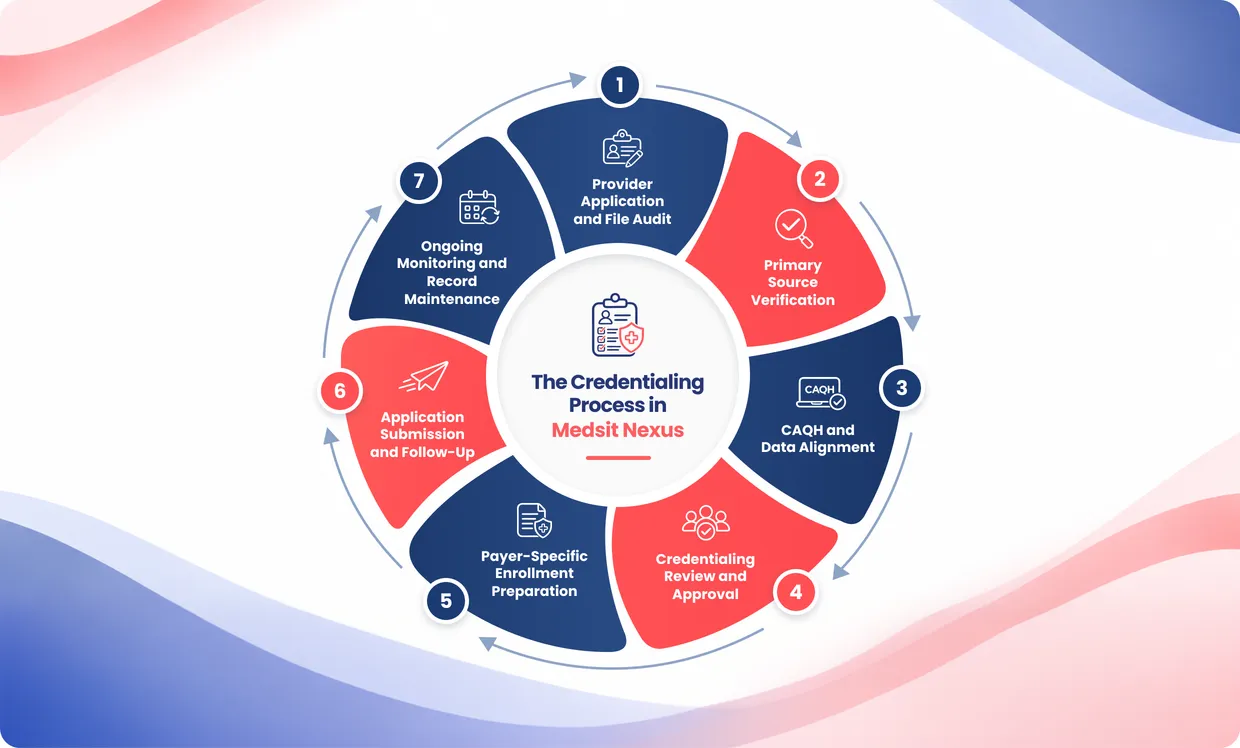
The credentialing process works through seven stages, from the initial provider file review and credential verification to payer application submission, approval, and ongoing record maintenance. Facility and payer credentialing follow different workflows, so their review and approval requirements may vary.
Provider Application and File Audit
The provider submits an application, and the credentialing team reviews its completeness and supporting records.
Primary Source Verification
Credentialing specialists verify licenses, education, training, certifications, and professional history against authoritative sources.
CAQH and Data Alignment
The team reconciles CAQH profiles, NPI details, taxonomy codes, practice locations, and group affiliations across systems.
Credentialing Review and Approval
Facility committees or payer reviewers evaluate provider qualifications and determine eligibility for medical staff membership or network participation.
Payer-Specific Enrollment Preparation
The credentialing team prepares application packets according to payer requirements, including forms, signatures, and supporting information.
Application Submission and Follow-Up
The team routes applications to the appropriate payer, tracks responses, resolves requests, and confirms approval and effective dates.
Ongoing Monitoring and Record Maintenance
The organization monitors provider credentials, updates records, tracks expirations, and manages recredentialing cycles.
What Is CAQH ProView in Credentialing?
CAQH ProView, now known as the DataSpring Provider Data Portal, is an online platform where healthcare providers maintain and share their credentialing information with authorized healthcare organizations. Providers choose which participating health plans can access their profiles, allowing them to share the same information with multiple payers instead of completing separate applications.
CAQH does not approve providers for insurance networks or enroll them in Medicare. Providers must complete the relevant payer approval process and use PECOS for Medicare enrollment. Providers must review and re-attest their profiles every 120 days, or every 180 days in Illinois, under CAQH guidance.
A CAQH provider profile typically contains the following information.
Provider details
Name, NPI, contact information, education, training, licenses, DEA registration, and board certifications.
Professional history
Work history, hospital affiliations, malpractice coverage, and claims history.
Practice information
Practice locations, contact details, and supporting documents, such as a CV.
Who Is Responsible for Credentialing in Healthcare?
The key stakeholders responsible for healthcare credentialing include the following entities, each with a distinct role in supplying information, verifying qualifications, reviewing applications, or making approval decisions.
Healthcare Providers
Submit accurate, up-to-date documents covering education, training, licenses, certifications, work history, and malpractice disclosures.
Hospitals and Healthcare Organizations
Oversee facility credentialing to verify provider qualifications, protect patient safety, and meet regulatory requirements.
Medical Staff Office (MSO)
Coordinate applications, collect documents, perform primary source verification (PSV), maintain records, and track credential renewals. Medical staff services professionals manage these activities.
Credentialing Committee and Medical Executive Committee (MEC)
Review verified qualifications, malpractice claims, and disciplinary history, then recommend medical staff appointments and clinical privileges.
Governing Body
Make final decisions on medical staff appointments and clinical privileges under facility bylaws.
Insurance Payers
Verify provider qualifications, screen for sanctions, and determine eligibility for participation in their networks.
Credentialing Verification Organizations (CVOs)
Perform primary source verification and background checks on behalf of hospitals or payers but do not make final approval decisions.
How Long Does Credentialing Take?
Healthcare credentialing typically takes 60 to 120 days after a complete application is submitted, although some cases can extend to 180 days or longer depending on the payer, provider type, and state requirements. These are estimated timelines rather than fixed deadlines because facility credentialing, payer credentialing, and provider enrollment follow different review processes and may overlap. Hospital credentialing can take longer when clinical privileges require additional verification and committee approval. Payer credentialing may also involve separate enrollment steps, so approval does not always mean the provider is immediately active for billing.
The key factors that affect healthcare credentialing timelines and the ways they influence processing time are discussed in the table below.
| Factor | Effect on time |
|---|---|
| Document completeness | Missing information, expired credentials, or outdated CAQH profiles delay application review. |
| Payer or facility | Medicare, Medicaid, commercial insurers, and hospitals follow different review procedures and processing schedules. |
| Verification response time | Delayed responses from licensing boards, medical schools, and previous employers extend primary source verification. |
| Provider type | Specialists and providers requiring additional licensing, training, or clinical privilege checks may take longer. |
| Committee schedules | Infrequent hospital credentialing committee meetings can delay final approval. |
What Is Recredentialing in Healthcare?
Recredentialing is the periodic process through which hospitals, healthcare organizations, and insurance payers reverify a provider’s qualifications, active licenses, certifications, clinical competence, and professional standing. This process helps organizations ensure that providers continue to meet patient safety and regulatory standards and remain eligible for hospital privileges and insurance network participation.
How Often Is Recredentialing Required?
The required recredentialing and revalidation intervals vary by healthcare organization, insurance payer, and applicable regulatory standards.
Commercial health plans
Commercial health plans following NCQA-aligned credentialing standards generally require recredentialing every 36 months.
Hospitals
Hospitals commonly require medical staff reappointment and clinical privilege reviews every 24 months.
Medicare and Medicaid
Medicare generally requires provider enrollment revalidation every five years, while Medicaid revalidation schedules vary by state and provider type.
What Does Recredentialing Review?
Healthcare organizations reassess providers’ qualifications and professional standing during recredentialing.
1. Professional credentials
Verification confirms that providers maintain active state licenses, valid board certifications, DEA registration, and state controlled substance credentials, where applicable.
2. Professional standing
Reviewers examine new malpractice claims, confirm current liability coverage, and check for sanctions, exclusions, and disciplinary actions.
3. Clinical performance
Peer reviews, patient complaints, and quality-of-care data help assess providers’ ongoing clinical competence.
How Does Credentialing Affect Medical Billing and Revenue?
Credentialing affects medical billing and revenue by determining whether healthcare providers qualify to participate in insurance networks and receive reimbursement for covered services. Delayed or incomplete credentialing can restrict billing eligibility, trigger claim denials, and disrupt reimbursement.
Credentialing affects the revenue cycle in several ways given below.
Insurance Network Participation
Payer approval allows providers to join insurance networks and receive in-network reimbursement for covered services.
Claim Denials
Claims may be denied when providers lack required payer approval, are not linked to the correct billing group, or render services before their approved effective date.
Billing Activation
Delayed credentialing can prevent newly hired providers from billing under required payer arrangements, even after they begin seeing patients.
Reimbursement Eligibility
The payer's effective date determines when a provider can receive payment for covered services, while reimbursement for earlier services depends on the payer's retroactive billing policy.
Cash Flow and Accounts Receivable (AR)
Denied or delayed claims increase outstanding AR, disrupt cash flow, and require billing teams to investigate, correct, and resubmit eligible claims.
Revenue Cycle Management (RCM)
Accurate credentialing records help RCM teams verify provider participation, billing group affiliations, and effective dates before claim submission, reducing avoidable denials and administrative rework.
What Are Common Credentialing Mistakes and Delays?
The most common credentialing delays result from incomplete applications, inconsistent provider information, expired credentials, and poor application tracking. These errors interrupt primary source verification, trigger additional payer requests, and delay approval.
The table below covers common credentialing mistakes, why they cause delays, and how to fix them.
| Common mistake | Why it delays credentialing | How to fix it |
|---|---|---|
| Incomplete applications: Missing documents, blank fields, or unsigned forms. | Payers return incomplete applications or request additional information. | Complete every required field and attach all supporting documents before submission. |
| Inconsistent provider information: Mismatched names, addresses, taxonomy codes, or individual NPI Type 1 and organizational NPI Type 2 details across records. | Payers cannot reliably match provider and billing group information. | Reconcile application details, NPI records, and CAQH profiles before applying. |
| Expired credentials: Expired licenses, DEA registrations, board certifications, or malpractice insurance documents. | Reviewers cannot confirm current professional qualifications and coverage. | Renew credentials before expiration and submit updated documents. |
| Incomplete professional history: Unexplained employment gaps or discrepancies in malpractice disclosures and claims history. | Reviewers need clarification before completing background and professional history checks. | Provide complete work history, explain gaps, and reconcile malpractice records. |
| Outdated CAQH profile: Missing information or overdue provider attestation. | Payers may be unable to access current, authorized information. | Update the profile and complete re-attestation within the required period. |
| Poor application tracking: Late submissions, missed revalidation deadlines, and inadequate payer follow-up. | Applications remain unresolved, while missed deadlines can interrupt enrollment or billing eligibility. | Start applications early, prioritize payer requirements, track deadlines, and follow up regularly. |
Should Providers Outsource Credentialing or Handle It In-House?
Outsourcing is a better option when your practice has high or growing provider volume, limited staff capacity, or complex payer requirements. In-house credentialing is preferable when provider volume is manageable, and you have experienced staff with enough time to handle applications and follow-ups consistently.
You can choose the right credentialing approach for your practice by comparing the key factors in the table below.
| Factor | In-house credentialing | Outsourced credentialing |
|---|---|---|
| Provider volume | Better for practices with manageable, predictable provider volume. | Better for practices with high or growing provider volume. |
| Payer mix | Works well when internal staff understands the practice’s payer requirements. | Provides access to expertise across different payer requirements. |
| Staff time | Requires dedicated staff to manage applications and follow-ups. | Reduces the administrative workload on internal staff. |
| Tracking | Requires reliable internal systems and consistent follow-ups. | Provides additional support for application tracking and follow-ups. |
| Control | Offers direct oversight of credentialing activities and records. | Requires clear communication and regular vendor oversight. |
Conclusion
Credentialing verifies your education, licenses, and professional history so you can treat patients and bill insurance payers. Most delays come from incomplete applications, expired credentials, and outdated CAQH profiles, so keep your records current and track every deadline. Approval typically takes 60 to 120 days, so start early. You can hire medical credentialing service providers to manage your applications, CAQH updates, and payer follow-ups, so you can focus on patient care while your credentialing protects your compliance standing and revenue.