

70+
Specialties
Expertise
Expertise
 Calculate Your Savings


Behind every clean claim, our specialists handle:



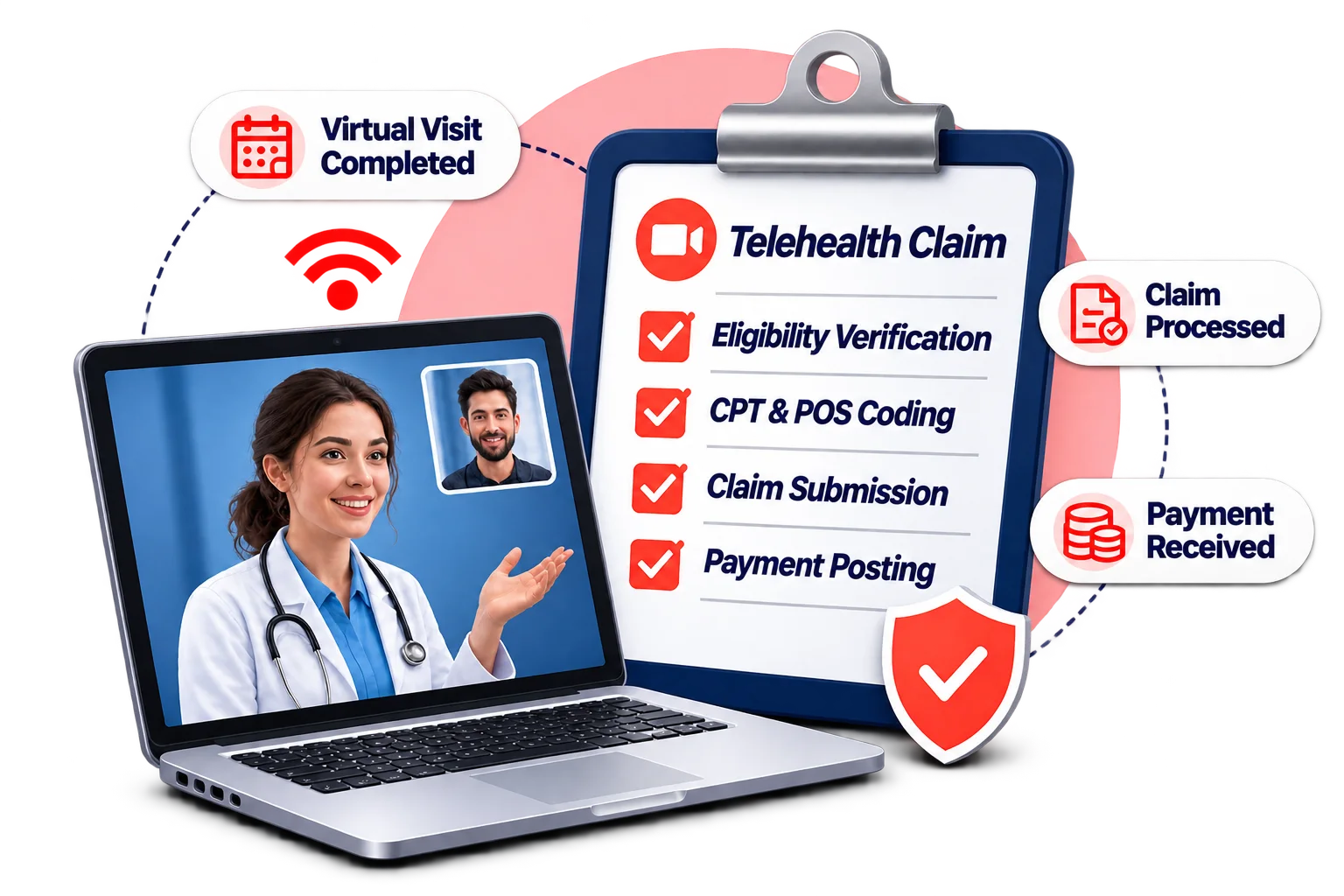


Telehealth claims require specialized billing because the same virtual visit can be paid differently depending on where the patient was and which payer is billed. Practices often lose revenue when a visit is reported with the wrong POS, leading to underpayments or denials that are easy to miss. Billing specialists make this process smoother by matching each documented patient location to the payer's POS rule before the claim goes out.
Audio-only services can slow down your billing process if they aren't billed accurately. Each payer determines which services it will reimburse when delivered by telephone, and these policies are updated frequently. Consequently, an audio-only visit covered by one payer may be denied by another. With payer-specific knowledge, billing experts identify coverage restrictions and help reduce unnecessary reimbursement delays.
Telehealth billing rules may keep changing, but your reimbursement should remain consistent. That's exactly what specialized telehealth billing experts aim to deliver. Their attention to billing accuracy helps turn delivered care into earned revenue. Our telehealth RCM services put this expertise into action, helping your practice reduce claim denials and increase revenue by up to 35%.

Outsourced Telehealth Billing Services
Telehealth claims follow their own payer policies at every stage, from benefit verification to final payment. Therefore, our team manages the full revenue cycle for your telehealth visits. As a result, each claim meets current payer requirements and your practice is paid without avoidable delays.
Before each visit, our team confirms the patient’s active coverage, telehealth benefits and cost-share responsibility. We also check whether the payer covers the visit as video or audio-only, and verify the provider’s network status and enrollment with the patient’s plan, including plans in other states. We flag any coverage limits in advance, so your practice can address them before the encounter.
Telehealth visits are often held outside your regular billing system, so a completed visit may never be recorded as a charge. We reconcile every completed telehealth encounter against the charges in your system, so no finished visit goes unbilled. Any missing notes or unsigned documentation are returned to your providers, so every encounter is ready for coding.
Once charges are captured, our coders confirm the patient’s location documented at the time of service and assign the matching place-of-service code. They select the correct service codes, apply modifiers such as 95 or 93 when the payer requires them. Moreover, they also confirm the documentation supports the modality used, including patient consent where required. Each claim then details how and where care was delivered.
With coding complete, our AI-supported claim scrubbing checks each claim against payer-specific telehealth edits, coverage rules, and documentation requirements. This step catches POS and modifier mismatches, services billed under an unsupported modality, and missing rendering provider details before the claim is sent. Afterward, we submit clean claims electronically. We track each claim status until the payer responds.
As payments arrive, we post each ERA and EOB and compare it with your payer contracts and fee schedules. At the same time, our team checks telehealth payments against the expected reimbursement rates based on the billed service, delivery method and applicable payer policies. Thus, we catch reduced reimbursements early and pursue them through reconsideration or appeal. Finally, we bill any remaining balance to the secondary payer or the patient, based on the patient’s cost-share responsibility.
When a claim is denied, we trace it to its root cause, whether a coverage limitation, modality restriction, coding error or enrollment gap. Based on that cause, we submit a corrected claim or file an appeal with supporting documentation before the payer’s deadline. Meanwhile, our AI-supported A/R follow-up prioritizes open balances by payer, age and value, helping our clients maintain an average of 22 days in A/R.
Many virtual visit claims are denied or flagged in audits because of service reporting errors, mismatched telehealth modifiers or the wrong telehealth place of service codes. Our certified coders stay current with the latest payer policies and apply exactly what each payer accepts, so your visits are billed correctly from the first submission. The codes and modifiers we are experts at:
Virtual care visits for new patients
Virtual care visits for established patients
Live video visits for new patients
Live video visits for established patients
Phone-based visits for new patients
Phone-based visits for established patients
Psychiatric evaluations by telehealth
Time-based individual psychotherapy sessions
Identifies live video telehealth visits
Identifies phone-based telehealth visits
Patient located outside their home
Patient located in their home
Each type of telehealth care has its own codes, documentation rules, and payer requirements. Our telehealth medical billing solutions cover each one, from live video visits to remote monitoring and care management.
Live video visits, coded with the POS and modifier each payer requires.
Phone visits reported with modifier 93 or FQ when payer conditions are met.
Virtual cardiology follow-ups, result discussions and care planning.
Psychiatric evaluations and medication management conducted remotely.
Individual, family and group therapy sessions over video or phone.
Live physical, occupational and speech therapy sessions, where covered.
Neurology follow-ups for conditions such as migraine, epilepsy and MS.
Skin condition visits through live video or submitted clinical images.
We serve practices of every size with accurate telehealth billing and faster reimbursements. Our telehealth billing specialists serve:
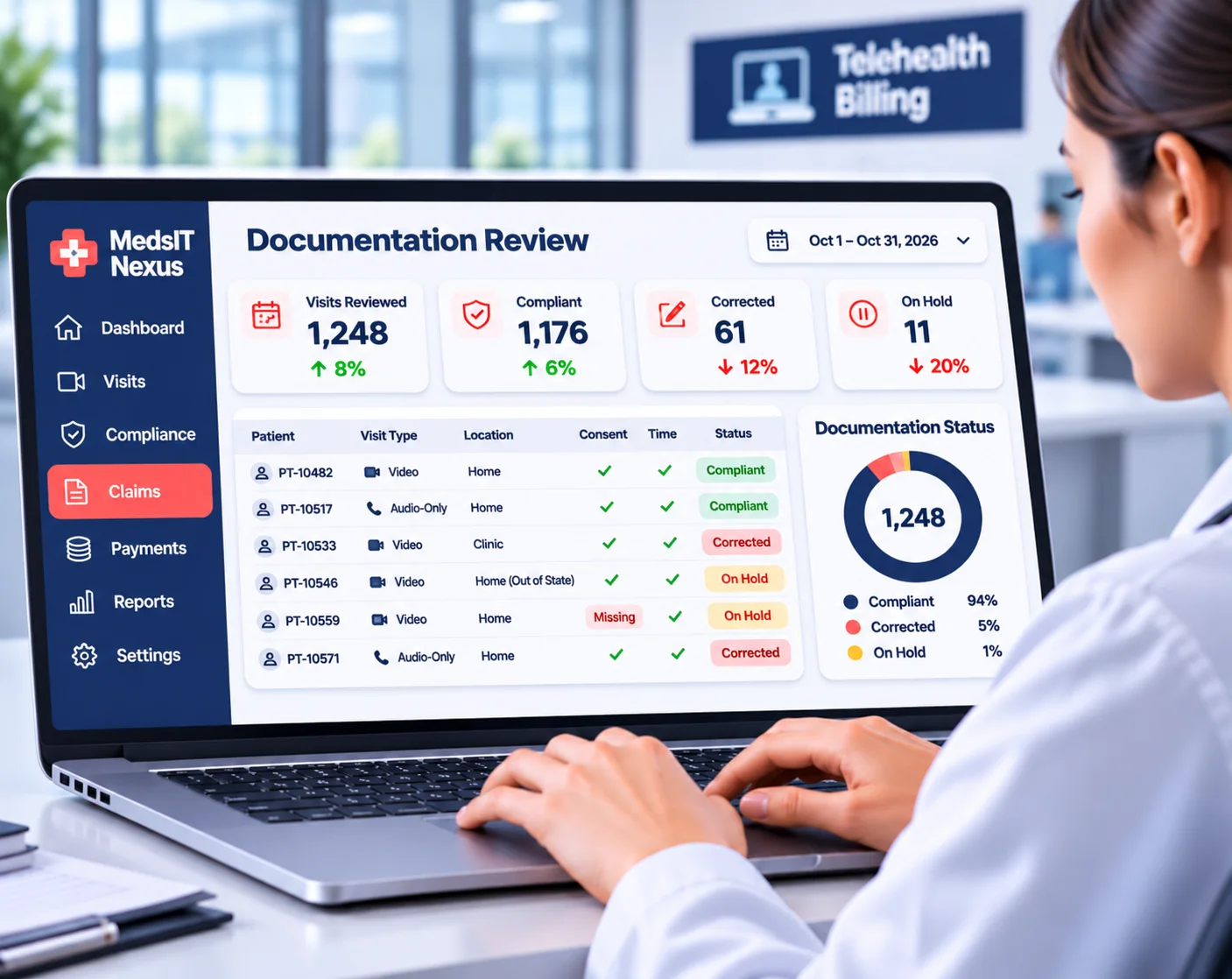
Telehealth billing involves sensitive patient data, strict documentation standards and regulations that change often. Our HIPAA-compliant telehealth billing workflows and documentation standards safeguard patient information at every step, while ISO 27001-certified security and ongoing monitoring of federal and state rules help your claims stay aligned with current requirements.
 Visit modality and patient location checks
Patient consent and time documentation review
Secure, role-based access to patient data
Encrypted handling of claims and records
Ongoing CMS and state rule monitoring

Many telehealth services, including psychotherapy sessions, time-based E/M visits and certain audio-only visits, rely on accurate time documentation to support code selection. As a result, when the recorded time is missing or unclear, claims may be undercoded or denied. To prevent this, our AI-supported tools scan each encounter note, identify missing time entries and flag any code the recorded duration doesn't support before submission. From there, our certified coding specialists validate each code against time-based coding requirements, while RPA tracks claim status and flags outstanding payments. Thus, this process delivers greater coding accuracy, a reduced administrative workload and timely reimbursement for the care your providers deliver.
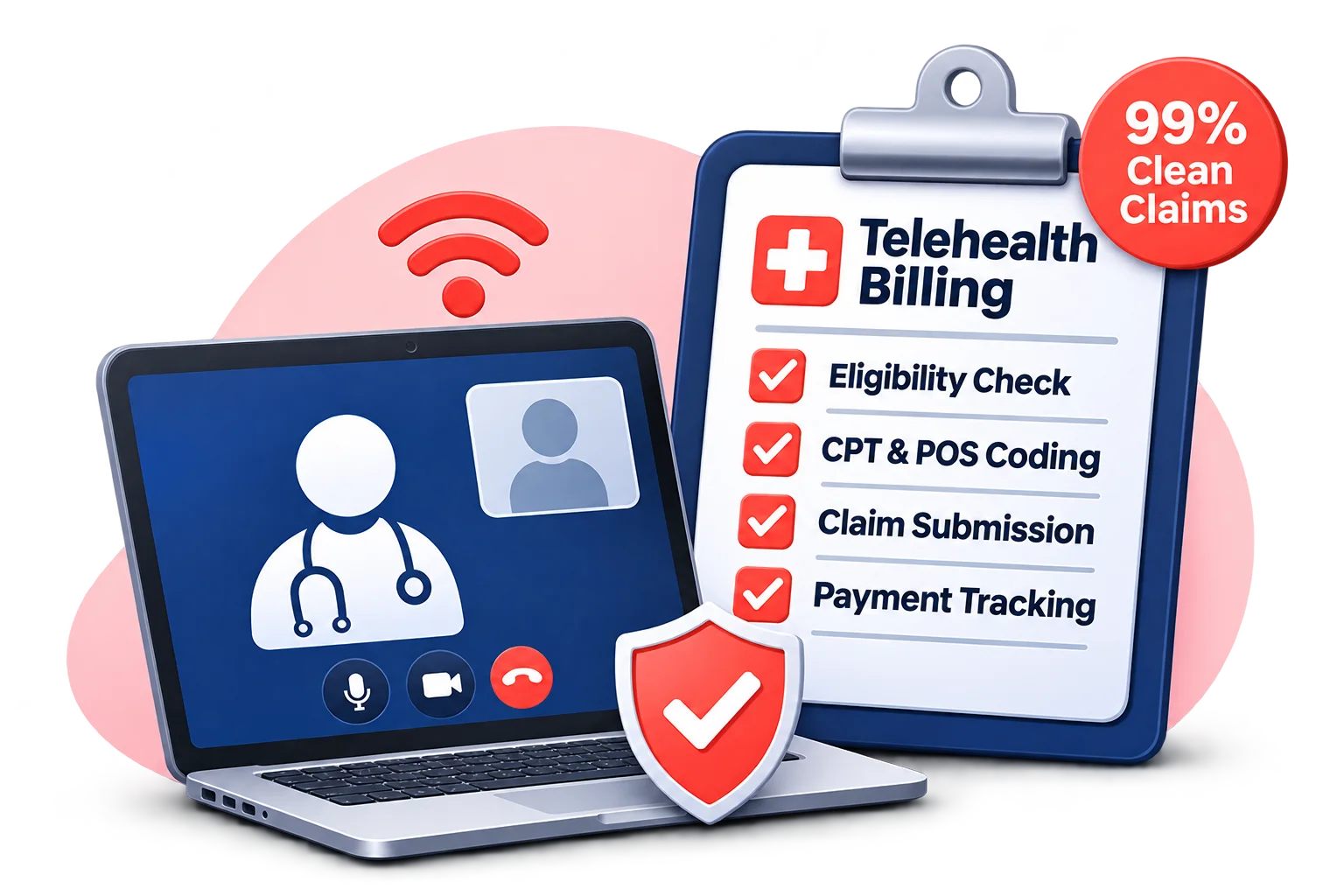
Telehealth claims follow rules that general billing teams often overlook. Our billing specialists apply each payer’s telehealth rules and run AI-powered claim checks to catch POS, modifier and documentation gaps before submission. We also stay current with changing federal and state telehealth policies. That’s how we help our clients maintain a 99% first-pass clean claim rate.
As a dedicated telehealth billing company, we manage the full revenue cycle for your virtual visits. Our team verifies telehealth benefits before each appointment, provides denial management for telehealth claims, and follows up on underpayments until they’re resolved. This way, we help practices maintain an average of 22 days in A/R, ensuring a more efficient revenue cycle.
Our AI learns from past payer responses to flag high-risk claims before they’re sent out.
We handle credentialing and payer enrollment for your providers in every state they serve.
Our reports give clear visibility into claim outcomes, payment delays and open balances.
Steady follow-up on denials, underpayments and aging claims keeps your cash flow moving.




Trusted by healthcare organizations for the highest standards of data privacy and regulatory compliance.
We connect with your EHR, practice management system, and clearinghouse, with no software changes required.







Every system.
Every claim.










 Cleaner Data Flow
 Faster Onboarding
 Accurate Codes & Modifiers
 Better Claim Visibility
Our telehealth billing experts help practices of every size apply each state's rules, reduce denials, and get paid accurately for virtual care services.

Each state sets its own parity laws, Medicaid policies, and licensure rules, and the patient's location decides which rules apply to a telehealth claim. Therefore, we apply those rules to every claim, so your virtual visits stay compliant wherever your patients are.
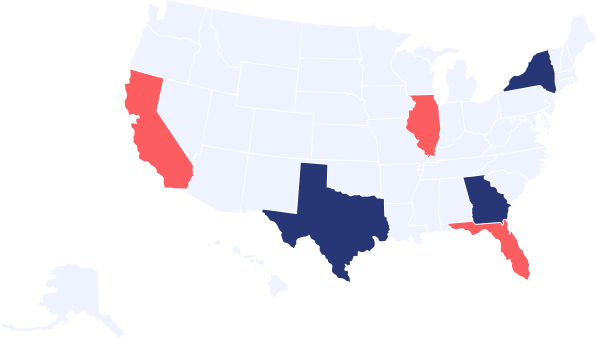
Every payer has its own telehealth rules. Medicare, Medicaid, commercial plans, and behavioral health carve-outs cover different services and require different POS codes and modifiers. Our team bills each virtual visit by its payer’s current policy.














Tracking telehealth policy updates, coverage changes, and state parity laws, so virtual visit claims process without avoidable delays.
Plan-specific telehealth coverage, POS codes, and modifier rules.
State telehealth coverage, audio-only rules, and payment policies.
Telehealth service lists, POS rules, and current CMS policy updates.
Behavioral health carve-outs, Medicare Advantage, and TRICARE claims.
State parity laws, licensure rules, and documentation standards.
Knowing each payer's telehealth rules helps reduce denials and speed up payments.
Telehealth claims across state lines must meet each state's filing deadlines, covered services and payer policies. Our team verifies your providers' credentialing and enrollment in every state you serve, then submits each claim to the right standard.
100+ Payers Supported
We manage every payer's telehealth requirements, so your providers can focus on patient care.
Read reviews from virtual-first practices, behavioral health providers, and multi-state telehealth groups that rely on us, from audio-only telehealth billing services to remote patient monitoring billing.
 Verified Review
“Many of our therapy sessions happen by phone, and those claims were often denied because many payers treat audio-only visits differently. MedsIT Nexus sorted out every plan's requirements, and our phone sessions now get paid without resubmissions.”
 5.0
 Trustpilot

4.8/5
Trusted by Telehealth Providers Nationwide


4.8/5
Telehealth should make your practice more accessible, not your billing more complicated. Our certified coders manage every revenue cycle stage, so your team spends less time on payer rules and rework. That's how we deliver a 99% clean claim rate and faster payments for your practice.
Get answers to your questions and find out what to expect when your practice outsources telehealth billing to us.
Answers built around real telehealth billing questions.
The place of service code for telehealth depends on where the patient is during the visit. Use POS 10 when the patient is at home, and POS 02 when they're somewhere else, such as a clinic or facility. For Medicare, this choice affects payment, since POS 10 is paid at a higher rate. Many commercial and Medicaid plans follow their own rules, so check each payer's policy.
The difference between modifiers 95, 93, GT, and FQ comes down to how the service was delivered and which payer requires them. Modifier 95 identifies a synchronous audio-video visit, while 93 identifies a synchronous audio-only visit. FQ also marks audio-only services and is used mainly on certain Medicare claims. GT is an older modifier that Medicare replaced with POS codes, though some payers may still request it for live audio-video services.
Telehealth claims get denied more often because they carry extra details that must match each payer’s rules. These include place of service errors, modifier mismatches, and errors with patient location, visit type, or provider licensure, since payers don’t all apply the same requirements. Audio-only visits, services a plan doesn’t cover by telehealth, and missing consent or time documentation are other common causes.
Remote patient monitoring (RPM) billing works on a monthly cycle. One code covers device setup and patient education, another covers the device supply based on how many days of data are collected in 30 days, and separate codes cover the time spent reviewing data and talking with the patient. Patient consent is required, and each code is billed only when its requirements are met.
Yes, we can bill for telehealth when the patient is in another state, as long as the provider is licensed in that state, either directly or through a recognized licensure compact, and is enrolled with the patient’s payer. Telehealth rules generally follow where the provider and patient are located so that state’s coverage, parity, and Medicaid rules apply to the claim.
Payers require telehealth documentation that shows how and where the visit took place. That usually includes the visit type, audio-video or audio-only, the patient’s and provider’s locations, patient consent where required, and time for time-based services. For audio-only visits, many payers also expect a note explaining why video wasn’t used, along with the same clinical details needed for an in-person visit.
State telehealth parity laws affect commercial reimbursement by setting rules for how state-regulated health plans cover and pay for telehealth. Coverage parity requires plans to cover services by telehealth if they cover them in person, while payment parity requires the same payment rate. Some states have both, some have only one, and self-funded employer plans are generally exempt because federal law governs them.
MedsIT Nexus helps reduce telehealth claim denials by catching problems before claims go out, including benefit gaps, POS and modifier mismatches, licensure issues, and missing documentation. We increase revenue by billing every qualifying service, recovering underpayments, and following up on open balances, helping practices maintain an average of 22 days in A/R.
What makes MedsIT Nexus different from other medical billing companies is our focus on specialty-specific billing. For telehealth, that means tracking changing federal and state rules, applying payer-specific coding, and supporting multi-state practices with credentialing. With AI-supported claim reviews, ISO 27001-certified security, and AAPC-certified coders, practices get accuracy, compliance, and dependable follow-up in one place.














 Verified Review