F41.1 Complete Guide : GAD Coding & Billing

ICD-10 Code F41.1 Complete Guide to Generalized Anxiety Disorder Coding
Mental health coding is vital to proper diagnosis, insurance payment, and clinical documentation. The ICD-10 Code F41.1, which is used to represent the Generalized Anxiety Disorder (GAD), is one of the most frequently used f41.1 diagnosis code of the ICD-10 system that are related to anxiety. Healthcare providers, medical billers, and coders should know when and how to use this code appropriately.
This comprehensive guide breaks down what f41 1 means, clinical criteria, documentation requirements, billing considerations, and common coding mistakes to avoid.
What Is ICD-10 F41.1 Diagnosis Code?
diagnostic code f41.1 is for Generalized Anxiety Disorder is a condition that is described as a continuous and excessive worry about different areas of life, such as work, health, finances, or family concerns. The anxiety is hard to manage and normally takes at least six months. This code is applied when the provider records a confirmed diagnosis of GAD by clinical assessment (F41.1).
When to Use F41.1 ICD 10 in Clinical Practice
Apply icd 10 code f41 1 in situations where a client exhibits apparent symptoms of Generalized Anxiety Disorder (GAD), such as:
-
Ongoing worry that’s hard to control and happens most days for at least six months.
-
Not only one problem, but worrying about a lot of things, such as work, health, and relationships.
-
Physical symptoms such as restlessness, tiredness, tension, irritability, poor sleep, or concentration.
-
Major life impact, as anxiety gets in the way of daily life and well-being.
What is the difference between GAD and other anxiety disorders?
-
Panic disorder (F41.0): Intense panic attacks with sudden onset, not without worrying.
-
Adjustment disorders: These are brought on by a particular stressful situation and normally take no more than half a year.
-
Situational anxiety: It is specific and is related to certain triggers, whereas GAD is more general.
In order to diagnose F41.1, it is necessary to refer to such tools as the GAD-7 questionnaire and note down the worries that this client has, their duration, and their impact on everyday life. slot gacor
Best Practices for Accurate icd 10 F41.1 Coding
Proper coding assists in treatment, payment, and adherence to regulations. The following are the errors to be avoided:
-
Do not simply enumerate symptoms, as always associate them with the entire disorder (F41.1).
-
In case of a client with more than one condition, specify the primary reason for the visit first. In case of GAD in mind, place F41.1 first.
-
Demonstrate medical necessity by effectively linking symptoms with the diagnosis, treatment objectives, and monitoring progress (e.g., using GAD-7 scores).
Keep informed about the coding change, get regular training, and consult colleagues or billing specialists when in doubt.
Therapeutic Approaches for F41.1
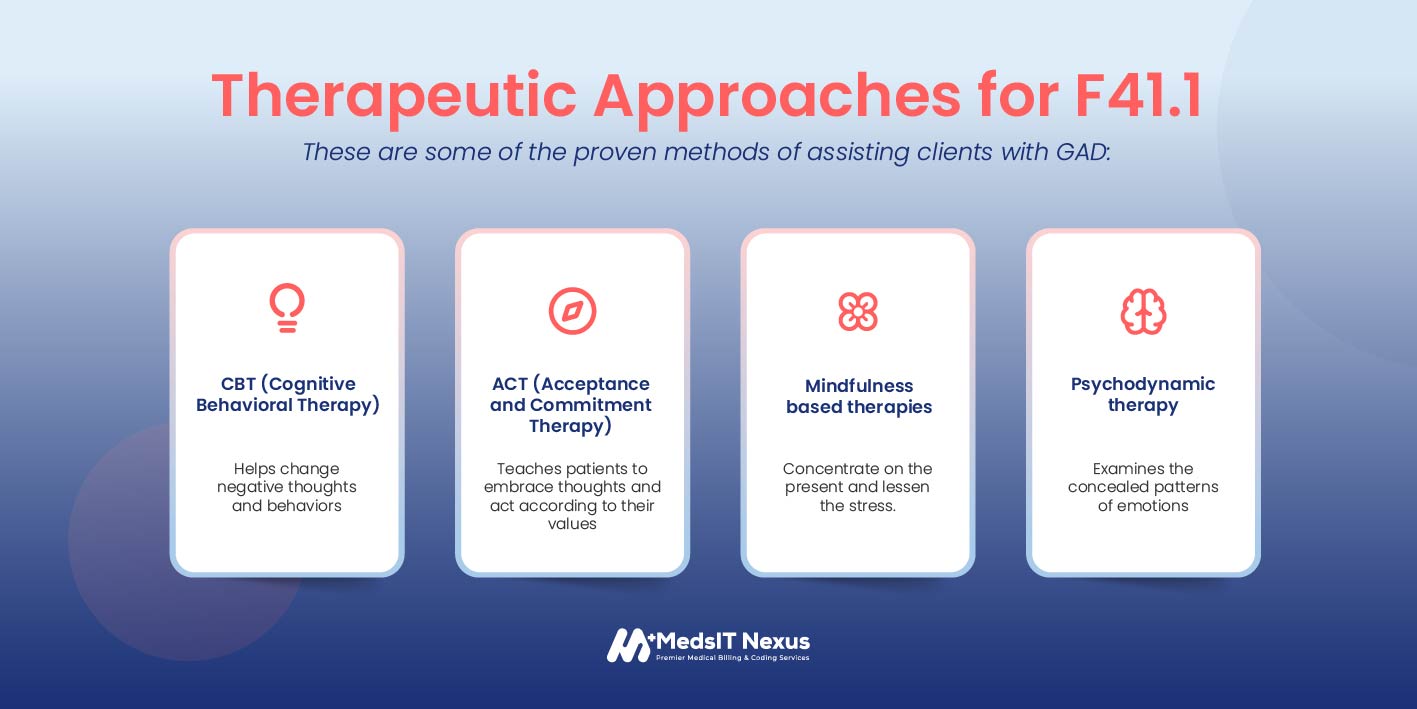
These are some of the proven methods of assisting clients with GAD:
|
CBT (Cognitive Behavioral Therapy) |
Helps change negative thoughts and behaviors |
|
ACT (Acceptance and Commitment Therapy) |
Teaches patients to act according to their values |
|
Mindfulness-based therapies |
Concentrate on the present and lessen the stress |
|
Psychodynamic therapy |
Examines the concealed patterns of emotions |
Helpful skills include:
-
Muscle relaxation, deep breathing (relaxation methods)
-
Refraining (controverting anxious thoughts)
-
Exposure therapy (facing fears step by step)
Work with each client to create a plan that fits their needs. Combine therapy, medication (if needed), and healthy habits like exercise, good sleep, and stress management.
Insurance, Reimbursement, and Compliance
The F41.1 is a diagnosable condition. To earn money and remain in compliance:
-
Show medical necessity: Document symptoms, impairment, and how treatment helps.
-
Connect treatment plans to F41.1: Justify why either of the interventions is necessary.
-
Write concise progress notes: Be specific, objective.
Also:
-
Keep up to date on ICD-10 guidelines.
-
Use correct CPT codes (e.g., 90832, 90834, 90837) with F41.1.
-
Maintain proper, HIPAA-compliant records.
-
Seek the assistance of billing specialists.
Ethical and Cultural Considerations
Note that you should not assume that normal stress is a disorder. Cultural differences matter: In other cultures, anxiety manifests more in terms of physical symptoms as opposed to feelings.
-
Get to know about cultural differences in anxiety.
-
Apply tests that are effective with various groups.
-
When necessary, consult cultural experts.
Clinical Features of Generalized Anxiety Disorder
In order to determine the f41 1 diagnosis, the patient needs to comply with clinical diagnostic criteria. Common symptoms include:
-
Worry and anxiety that occur on more days than not, for at least 6 months.
-
Anxiety or impatience
-
Fatigue
-
Difficulty concentrating
-
Irritability
-
Muscle tension
-
Sleep disturbances
The anxiety has to be a source of serious distress or disability in social, occupational, or other domains of functioning.
Medical necessity is proven by proper documentation of these symptoms and enhances reimbursement claims.
Documentation Requirements for f41.1 icd 10
The right documentation plays an important role in proper coding and insurance acceptance. Such providers should clearly document:
-
Symptom duration (at least six months)
-
Intensity and frequency of anxiety.
-
Effects on functioning.
-
Differential diagnosis (exclude other anxiety disorders or physical causes)
-
Therapy (medication or both)
Know This Before Using icd 10 f41.1
Use diagnosis f41.1 when:
-
The provider specifically makes a diagnosis of Generalized Anxiety Disorder.
-
The symptoms are chronic and not specific to certain triggers.
-
The panic disorder, social phobia, or adjustment disorder does not better account for the anxiety.
It should not be used for:
-
Panic Disorder (use F41.0)
-
Social Anxiety Disorder (F40.10)
-
Specific Phobias (F40.2-)
-
Adjustment Disorder featuring Anxiety (F43.22)
Billing and Reimbursement Considerations
Mental health services with F41.1 can be:
-
Psychiatric evaluations
-
Psychotherapy sessions
-
Medication management visits
-
Telehealth behavioral therapy
To have effective reimbursement:
-
Combine F41.1 with corresponding CPT codes (e.g., 90791 psychiatric diagnostic evaluation, 90834 or 90837 psychotherapy).
-
Verify payer-specific documentation requirements.
-
Establish medical necessity based on the severity of symptoms and functional impairment.
Most insurance companies demand the demonstration of apparent disadvantage affecting the day-to-day functioning by symptoms before they consent to the continuation of therapy sessions.
Common Coding Errors with F41.1
Medical billers and coders often encounter errors when assigning anxiety-related codes. Common mistakes include:
-
Using F41.9 Instead of F41.1
-
Confusing GAD with Panic Disorder
-
Lack of Supporting Documentation
-
Missing Comorbid Conditions
Importance of Accurate Anxiety Coding
Accurate coding using F41.1 benefits:
-
Ensures timely and full reimbursement
-
Supports access to ongoing mental health treatment
-
Reduces claim denials and audit risks
-
Ensures appropriate medical necessity verification
F41.1 and Telehealth Services
-
Apply proper telehealth modifiers (e.g., 95 or GT, based on payer).
-
Assure coverage of behavioral health services.
-
Record that services have been delivered on a secure platform.
Treatment Approaches for Generalized Anxiety Disorder
Even though coding is documentation-oriented, knowledge of treatment options can be beneficial in medical necessity. Common treatments include:
-
Cognitive Behavioral Therapy (CBT).
-
Selective Serotonin Reuptake Inhibitors (SSRI)
-
Lifestyle modifications
-
Stress management techniques
The treatment plans must be clearly recorded to support the continued therapy or medication management visits.
Conclusion
Among the most commonly used mental health diagnosis codes is ICD-10 Code F41.1, which is a Generalized Anxiety Disorder. To use this code properly, chronic anxiety should be documented over a period of six months, functional impairment, and a qualified provider should have to confirm the diagnosis.
In the case of medical billing professionals, proper selection of F41.1 will result in a more efficient reimbursement process, fewer denials, and better payer adherence. To providers, documentation helps in the care of patients and financial sustainability.
In comprehending the clinical criteria, documentation requirements, and reimbursement issues related to F41.1, health practices can enhance the treatment results as well as the revenue cycle.
In case your practice has issues with the accuracy of mental health coding, then investing in trained medical coders or billing specialists can greatly decrease errors and maximize reimbursement effectiveness.
FAQs
1. What is ICD-10 code F41.1 used for?
It is used to diagnose Generalized Anxiety Disorder (GAD), which involves persistent, excessive worry lasting at least six months.
2. How is F41.1 different from F41.0?
F41.0 is for Panic Disorder (sudden panic attacks), while F41.1 is for GAD (ongoing, general worry).
3. What documentation is needed to support F41.1?
You need symptom duration (6+ months), severity, functional impairment, differential diagnosis, and a treatment plan.
4. Can I bill telehealth visits using F41.1?
Yes. Just add the appropriate telehealth modifier (like 95 or GT) and document that services were provided via a secure platform.
5. What’s the most common coding mistake with F41.1?
Using F41.9 (unspecified anxiety disorder) when the documentation clearly supports a GAD diagnosis.
Table of Contents
Services
- Medical Audit Services
- Medical Billing Services
- Medical Credentialing Services
- Medical Coding Services
- Accounts Receivable Management
- Medical Insurance Verification
- Denial Menagement Services
Who we serve
- Private Practices
- Small Practices
- Hospitals & Healthcare
- Physicians
- Medical Equipment
- Outpatient Facilities
Get in Touch
Let's start talking about getting you credentialed